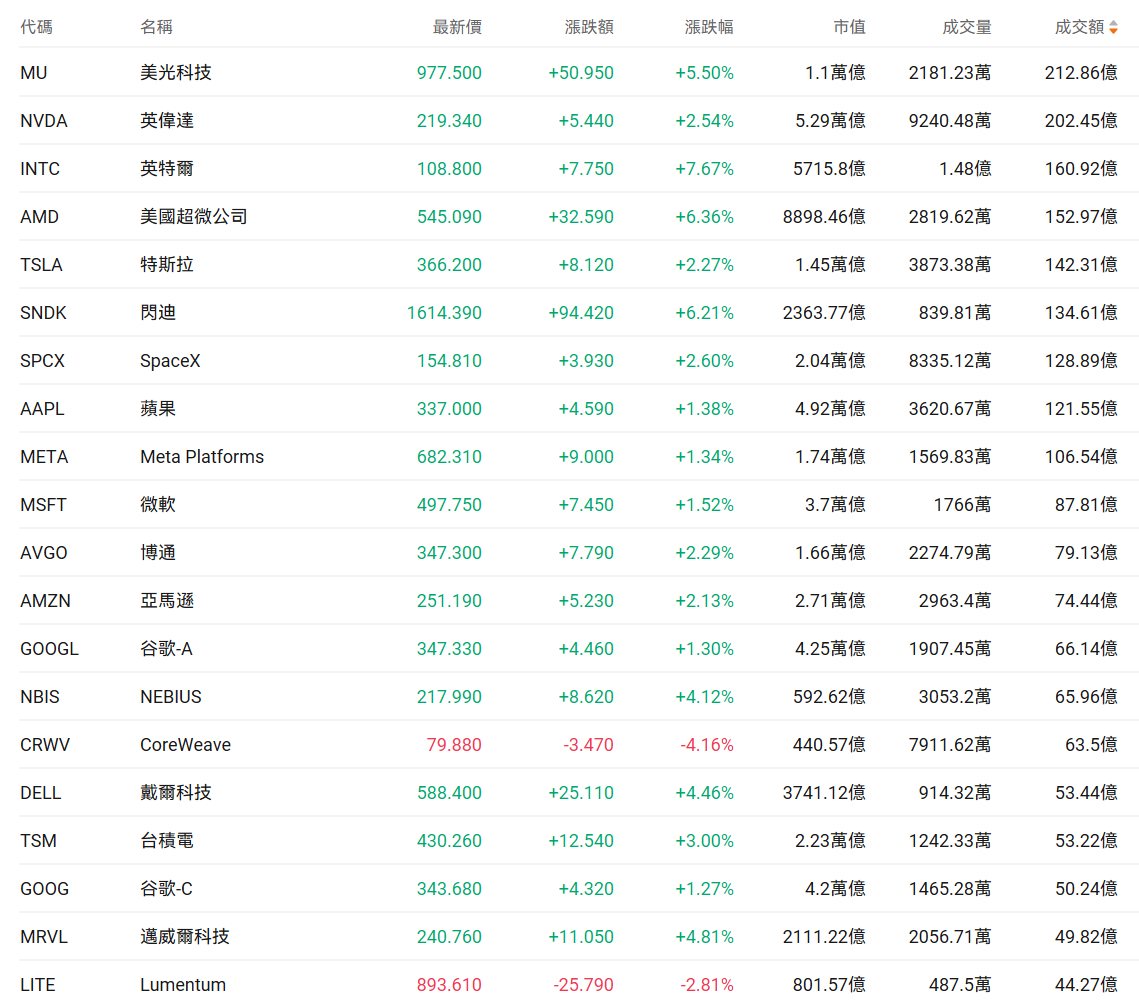
On Thursday, it was the No. 1 stock by trading volume on the U.S. market.$Micron Technology (MU.US)$It closed up 5.50%, with trading volume reaching $21.286 billion.
Micron Technology CEO Sanjay Mehrotra stated that the company's semiconductor packaging and testing facility in Sanand, Gujarat, India, has commenced commercial production to meet the growing demand for memory chips driven by artificial intelligence.
It is reported that the Sanand plant is Micron Technology's first semiconductor packaging and testing facility in India. The plant was jointly invested in by Micron Technology and its Indian government partners at a cost of approximately US$2.75 billion. Its Phase I design includes cleanroom space totaling 500,000 square feet (about 46,452 square meters), making it one of the largest single-story packaging and testing cleanrooms in the world. Micron Technology has already delivered the first batch of memory modules manufactured locally in India to$Dell Technologies (DELL.US)$, used for its laptops manufactured for the Indian market.
 2nd place$NVIDIA (NVDA.US)$It closed up 2.54%, with trading volume reaching $20.245 billion.
Because he is optimistic about the prospects of AI technology being applied across more industries, NVIDIA CEO Jensen Huang made an upbeat statement. He said, "NVIDIA's chip sales next year will be twice this year's." At the same time, he emphasized that unsafe products must be stopped, adding, "AI safety is of paramount importance."
3rd place$Intel (INTC.US)$It closed up 7.67%, with trading volume reaching $16.092 billion, a nearly two-month high.
According to an analyst at Merill Research, driven by foundry agreements and stronger product revenues, Intel's stock price could nearly double to $200. The firm maintains a buy rating on the chipmaker, with a price target of $165 per share. However, as reported by CNBC, Merill analyst Ben Reitzes believes Intel's shares could rise to $200 within the next two years. Reitzes notes that this potential surge may stem from Intel's foundry agreements with Apple and other key companies. He emphasizes that Intel's 14A process—the company's chip‑manufacturing node used to produce high‑performance semiconductors—is a critical factor.
4th place$Advanced Micro Devices (AMD.US)$It closed up 6.36%, with trading volume reaching $15.297 billion.
5th place$Tesla (TSLA.US)$It closed up 2.27%, with trading volume reaching $14.231 billion.
Tesla recently placed a new order for approximately 5,000 units with its suppliers, marking the first mass-production order in the thousands, following earlier trial-production orders of several hundred units. In addition, Tesla is accelerating factory‑inspection efforts for the supply chain of its Optimus humanoid robot in China, visiting suppliers in Shanghai, Hangzhou, Ningbo, Xiamen, and other locations. The combined signals of factory inspections and new orders indicate that Optimus has officially transitioned from an engineering prototype to a replicable manufacturing phase. Industry insiders believe that Tesla's visits to Chinese suppliers further confirm an accelerated pace in its mass‑production rollout.
6th place$SanDisk (SNDK.US)$It closed up 6.21%, with trading volume reaching $13.461 billion.
7th place$SpaceX (SPCX.US)$It closed up 2.60%, with trading volume reaching $12.889 billion.
The latest reports indicate that SpaceX internally discussed acquiring customer information and operational data from struggling or defunct startups, aiming to secure lower-cost data sources to enhance the capabilities of its AI models.
8th place$Apple (AAPL.US)$It closed up 1.38%, with trading volume at $12.155 billion.
The pre-sale delivery lead times for the iPhone 18 Pro lineup widened significantly around the midpoint of the first week after launch, roughly in line with the same period last year, as earlier concerns about weak demand have begun to subside.
According to JPMorgan's product availability tracking report released on September 17, the global average lead times for the iPhone 18 Pro and 18 Pro Max have extended by 12 days and 7 days, respectively, from the pre-sale launch on September 12 to the mid-week check-in point on September 16. The lead time for the Pro Max has now matched last year's iPhone 17 cycle, while the gap for the Pro models has also narrowed significantly.
9th place$Meta Platforms (META.US)$It closed up 1.34%, with trading volume at $10.654 billion.
10th place$Microsoft (MSFT.US)$It closed up 1.52%, with trading volume at $8.781 billion.
In court testimony, senior executives from OpenAI and Microsoft rarely acknowledged that their AI products have a substitutive effect on news and publishing content and pose a substantial threat to the news industry.
Microsoft CEO Satya Nadella stated in his testimony that conversations with chatbots have "replaced" users' visits to publishers' websites; OpenAI senior executive Nick Turley put it even more directly, writing, "Our products are largely substitutive—period."
11th place$Broadcom (AVGO.US)$It closed up 2.29%, with trading volume at $7.913 billion.
12th place$Amazon (AMZN.US)$It closed up 2.13%, with trading volume at $7.444 billion.
Amid calls from several AI giants to slow down AI development, U.S. tech giant Amazon on Thursday, local time, made its first public statement on the AI safety debate: models may only be released after undergoing rigorous testing to ensure their safety. Amazon did not join the call to slow the industry's pace.
13th place$Alphabet-A (GOOGL.US)$It closed up 1.30%, with trading volume at $6.614 billion.
Crux AI, a new cloud service provider backed by Google, has secured a $22 billion bank loan to fund its chip procurement. Crux AI,$CoreWeave (CRWV.US)$The core bullish thesis of these emerging cloud players is to translate long-term customer commitments, available compute capacity, and full-stack delivery capabilities into revenue growth—rather than simply accumulating more GPUs.
14th place$NEBIUS (NBIS.US)$It closed up 4.12%, with trading volume at $6.596 billion.
Starting October 1, Nebius is raising prices across its GPU cloud services by approximately 20%, with price hikes applied to a wide range of chips from the H100 to the B300. This marks the second round of price increases within just a few months, bringing the cumulative rise for the B300 to as much as 56%. With demand visibility extending beyond 24 months, customers are rushing to secure Blackwell‑based compute power, even willing to bid at premium prices. The growing imbalance between AI compute supply and demand is reshaping the industry's bargaining dynamics, quietly shifting negotiating leverage toward the supply side.
15th place$CoreWeave (CRWV.US)$It closed down 4.16%, with trading volume at $6.35 billion.
CoreWeave announced on Thursday that it plans to issue $3 billion in senior convertible bonds, while also launching an at-the-market (ATM) offering of up to 35 million shares. The convertible bonds include a $500 million over-allotment option; if fully exercised, the total proceeds would reach $3.5 billion. Following the news, CoreWeave's stock price fell 5.3% during trading.
16th place$Dell Technologies (DELL.US)$It closed up 4.46%, with trading volume reaching $5.344 billion, hitting a new record.
17th place$Taiwan Semiconductor (TSM.US)$It closed up 3.00%, with trading volume at $5.322 billion.
19th place$Marvell Technology (MRVL.US)$It closed up 4.81%, with trading volume reaching $4.982 billion.
$GlobalFoundries (GFS.US)$and$Marvell Technology (MRVL.US)$We will expand cooperation to jointly advance next-generation optical interconnect technologies.
20th place$Lumentum (LITE.US)$It closed down 2.81%, with trading volume at $4.427 billion.
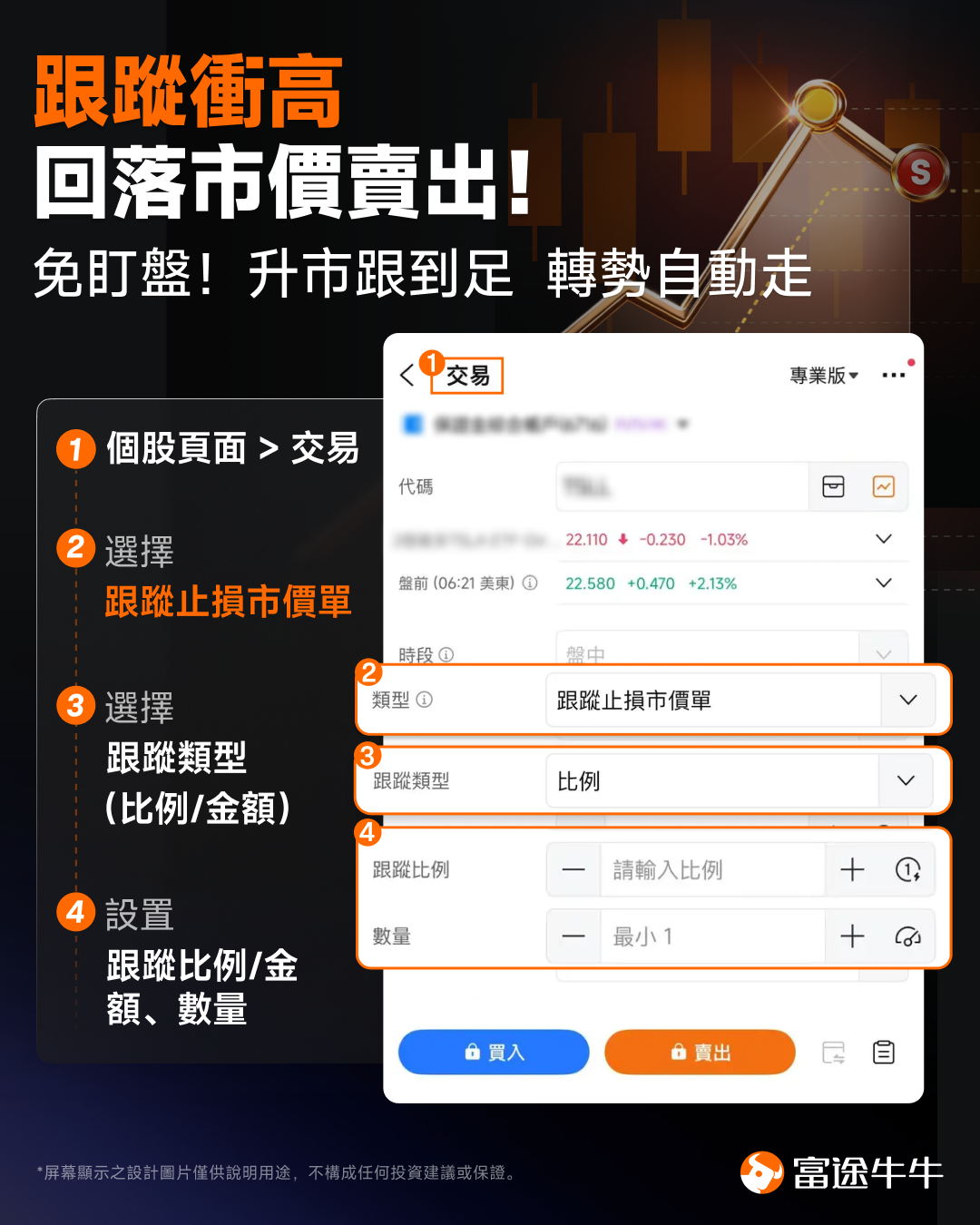
No need to watch the market—ride the rally all the way, and let the trend run on its own! Futu's trailing stop-loss market order lets you dynamically monitor stock prices based on a preset amount or percentage, helping you capture gains while managing potential pullbacks. When the price hits your stop-loss level, the system instantly places a market order to execute the trade.
Note that sharp price swings may lead to slippage; and if the trailing stop is set too tightly, you could be forced out of your position prematurely due to minor short-term volatility. Experience our trailing stop order feature now—automatically sell at the peak!
Editor/Liam