
Anthropic has rolled out a major upgrade to its coding assistant, Claude Code, introducing a multi-threaded automated workflow architecture that enables the AI to continuously and concurrently execute programming tasks even when the user is offline. This marks a significant step forward in AI‑driven project management. The feature is currently available in beta to select Claude Pro and Max subscribers.
On September 17, Claude Code, Anthropic's AI-powered coding assistant, officially launched a major upgrade to its Projects feature, elevating AI-assisted development from a single‑turn dialogue mode to a multi‑threaded, automated workflow. This marks a significant step forward in AI‑driven project management.
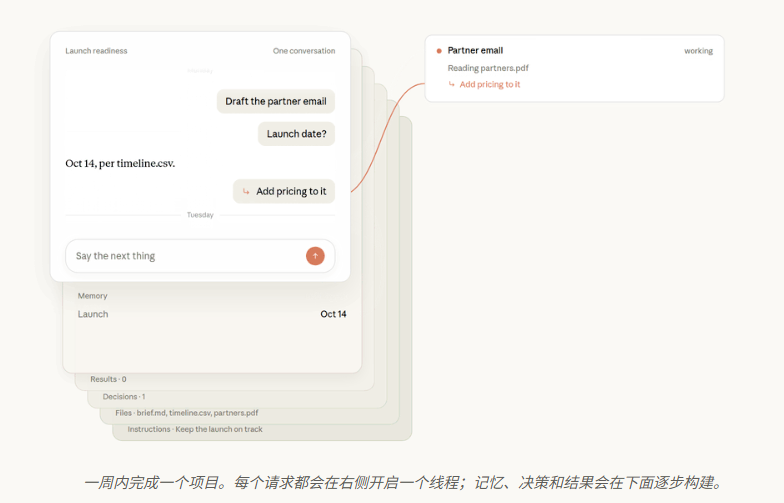
The core innovation of this update lies in its execution approach: users no longer need to open each conversation individually or manually track every subtask. Instead, they simply describe "what needs to be done," and Claude will break down the task, assign threads, and advance it in parallel. According to the official announcement, these threads will continue running even after the user shuts down their laptop.
 Anthropic stated that this feature is currently available in beta to a select group of Claude Pro and Max subscribers. Over the next few weeks, access will be gradually expanded and eventually rolled out to users on the Team and Enterprise plans.
For developers, this upgrade fundamentally transforms how multi‑task projects are collaborated on. Workflows that previously required manually switching between sessions and stitching together output results can now be handled by Claude's unified scheduling, with implications spanning a broad range of users—from individual developers to enterprise engineering teams.
Thread Architecture: Claude assumes the role of "Chief of Staff"
The core design of the new version of Projects is a two-tier architecture featuring a "coordinator + worker thread" model.
On the project's main chat interface, users issue high-level commands, and Claude acts as the chief of staff, routing tasks to newly created or existing work threads. Each thread is an independent Claude Code cloud session, carrying out specific tasks on its own code branch and repository copy.
Taking a real-world scenario as an example: A user can set a goal to reduce the P75 latency in the app's checkout flow, and Claude will then assign multiple parallel threads to perform performance analysis on each API, test optimization strategies, and submit pull requests.
Alternatively, it can simultaneously connect to three code repositories—API, web, and mobile—where Claude creates a separate thread for each repository to handle the migration of deprecated APIs, run tests, and submit pull requests, while also notifying users which pull requests should be merged first.
If different threads modify the same section of code, the system will handle it using standard merge conflicts, consistent with the regular PR workflow. Additionally, a single thread can further invoke sub‑agents, loops, and workflows to break down large tasks, thereby accelerating completion.
Shared Memory: Contextual Information Continuously Accumulated Across Sessions
The new version of Projects is designed for long‑term or agency‑based workflows, supporting the accumulation of context across time and sessions.
All threads share the same memory pool, and Claude continuously accumulates project details over time—such as noting that a release date has been moved to Friday, the reason why a particular feature was deprecated, or which colleague needs to be informed before modifying the billing service—thereby reducing the burden on users of repeatedly crafting prompts.
On a personalized level, Claude also remembers users' work styles and communication preferences. Users can ask it to adjust the frequency of progress reports, the cadence of new thread creation, and the level of detail in updates.
In parallel with its memory‑management capabilities, Projects has also introduced a "Library" feature that automatically organizes user‑uploaded files and various outputs generated by Claude, making it easier to retrieve historical materials and build on existing results in subsequent work.
Usage Restrictions and Future Plans
Because a single project can run multiple threads concurrently, and each thread operates as a full-fledged Claude Code cloud session, the consumption rate of project credits is significantly faster than in single-session mode.
Anthropic advises users to monitor project-level usage and allows them to select models and compute tiers separately for the coordinator chat and worker threads, enabling flexible cost management.
On the feature roadmap, Anthropic stated that Threads currently runs only in the cloud, with support for local execution, invocation of local tools and code, and access to internal networks slated for imminent release.
As of the current beta access eligibility, it is limited to Pro and Max users who are using cloud sessions in Claude Code and do not yet have existing Projects on the web or desktop.
Users who already have Projects can continue to use the existing features as usual; Anthropic will roll out the upgrade in a unified manner when it subsequently expands to include chat and coworking features.
Editor/stephen