On Thursday, the S&P 500 rose 1.14%, the Nasdaq gained 1.69%, and the Dow Jones Industrial Average climbed 0.61%, ending a three-day losing streak across all three major indices. Memory and logic chip stocks advanced in tandem. Arm surged 8.57%, while Advanced Micro Devices jumped 6.36%.$SanDisk (SNDK.US)$Up 6.21%, Micron up 5.50%,$Marvell Technology (MRVL.US)$Up 4.81%. Performance across the optical communications sector was mixed. Tower Semiconductor rose 8.43%,$Corning(GLW.US)$Up 2.46%,$Lumentum(LITE.US)$It fell by 2.81%.
Market panic following the Federal Reserve's rate hike quickly subsided. Oil prices fell for a second consecutive day, helping to temper inflation expectations, while U.S. stocks and Treasury yields both rebounded on Thursday.$S&P 500 Index (.SPX.US)$It posted its biggest single-day gain in six weeks.
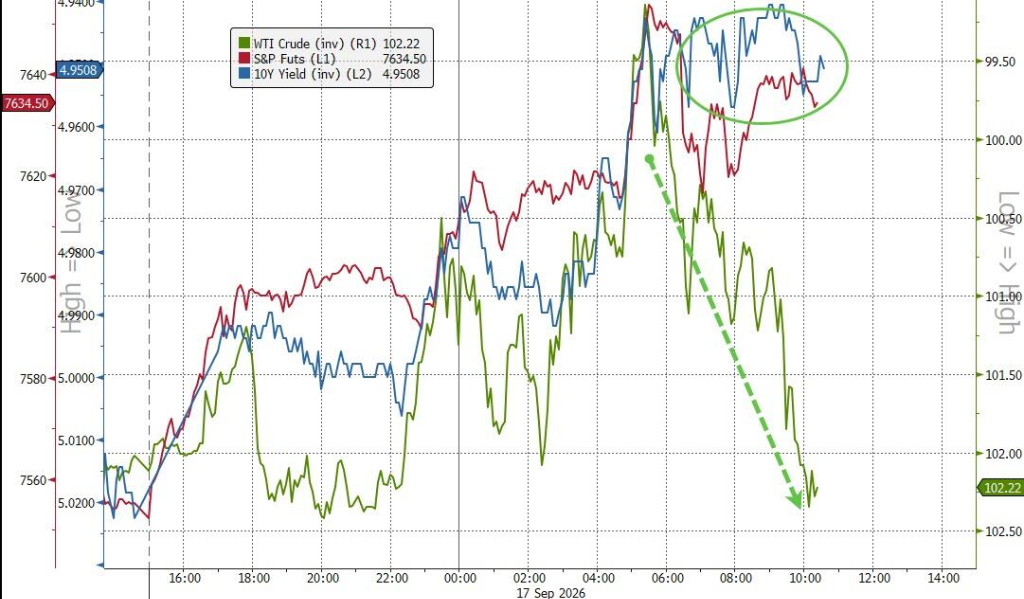
The S&P 500 rose 1.1%,$Nasdaq 100 Index (.NDX.US)$Up 1.7%,$Philadelphia Semiconductor Index (.SOX.US)$Led the gains with a 3.1% increase.
 The yield on the 10-year U.S. Treasury note ended an eight-day rally, falling 9 basis points from its highest level since 2007 to 4.93%. Brent crude closed below $105, while gold rose 1.9%.
Forex.com analyst Fawad Razaqzada stated:
Crude oil prices fell for the second consecutive day, bolstering market sentiment to some extent and easing upward pressure on bond yields.
U.S. stocks ended a three-day losing streak, with tech shares broadly higher.
On Thursday, the S&P 500 rose 1.14% to 7,637.76 points, the Nasdaq gained 1.69% to 26,418.30 points, and the Dow Jones Industrial Average advanced 0.61% to 51,778.04 points, with all three major indices ending a three-day losing streak.
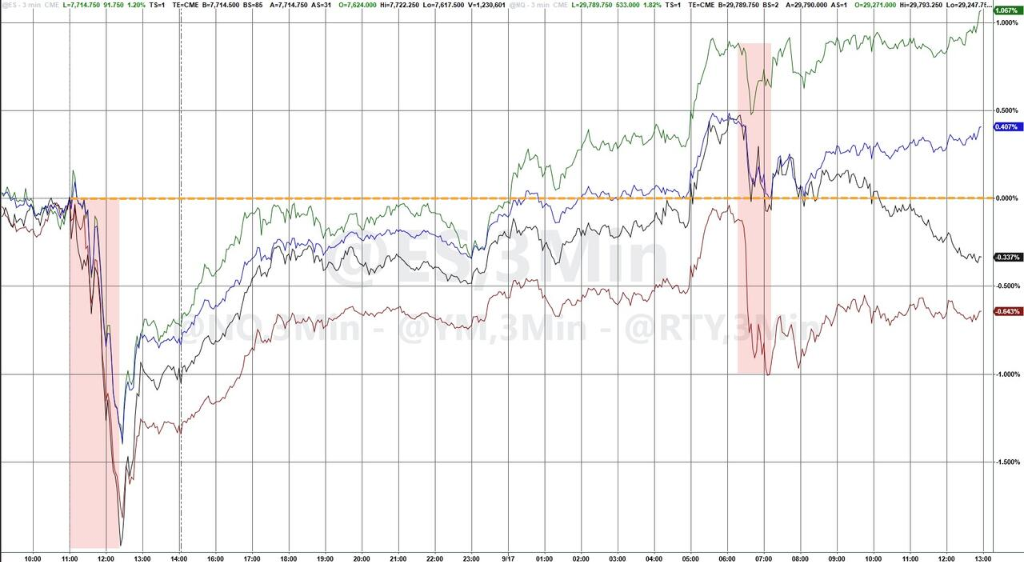
The market broadly characterized Thursday's rebound as a correction of the previous day's excessive decline.
Bob Edwards, Chief Investment Officer at Edwards Asset Management, believes that the stock market's post-Fed rate hike decline was an "overreaction," presenting investors with buying opportunities. He said:
With this rate hike now behind us and uncertainty largely dispelled, equity markets can continue to move higher. I don't believe there's any need to pile on additional rate hikes to make a point; however, the Federal Reserve will act based on its own assessment.
U.S. equities' technology sector led the market with a 2.20% gain, while the financials and consumer staples sectors were the only two to decline, falling 0.10% and 0.01%, respectively.
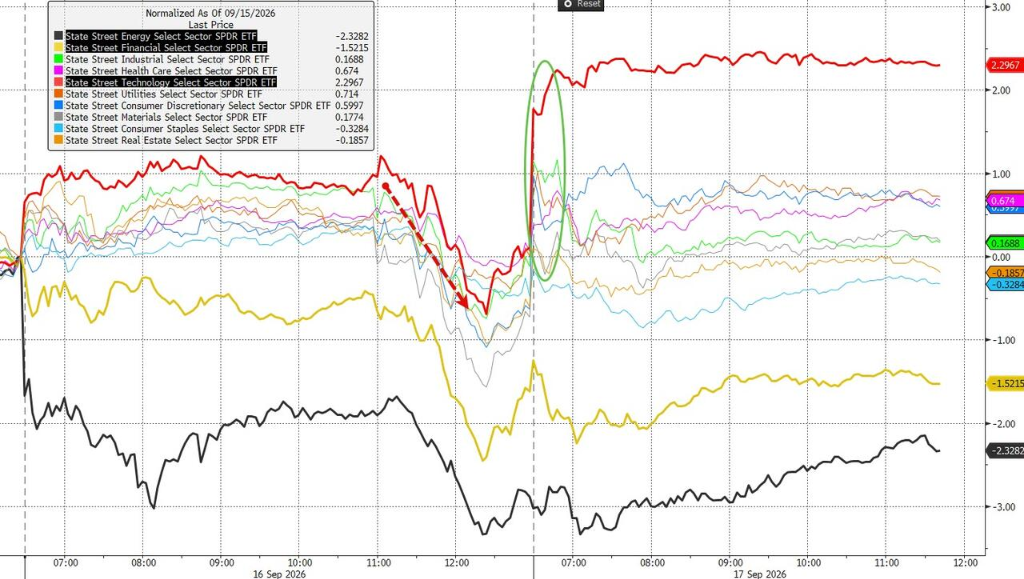
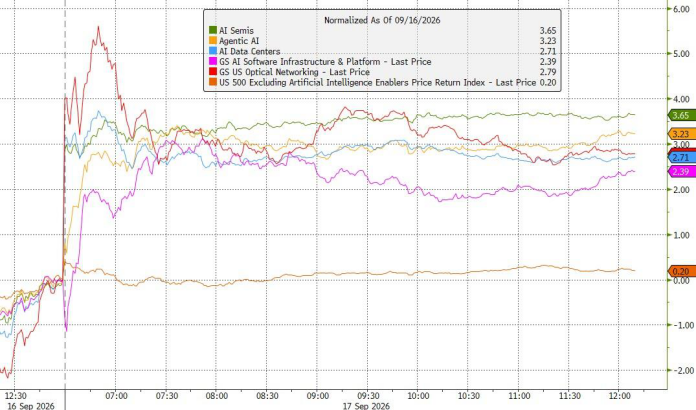
High‑market‑cap tech stocks remain the market's most widely held long positions, with AI‑related names broadly advancing.
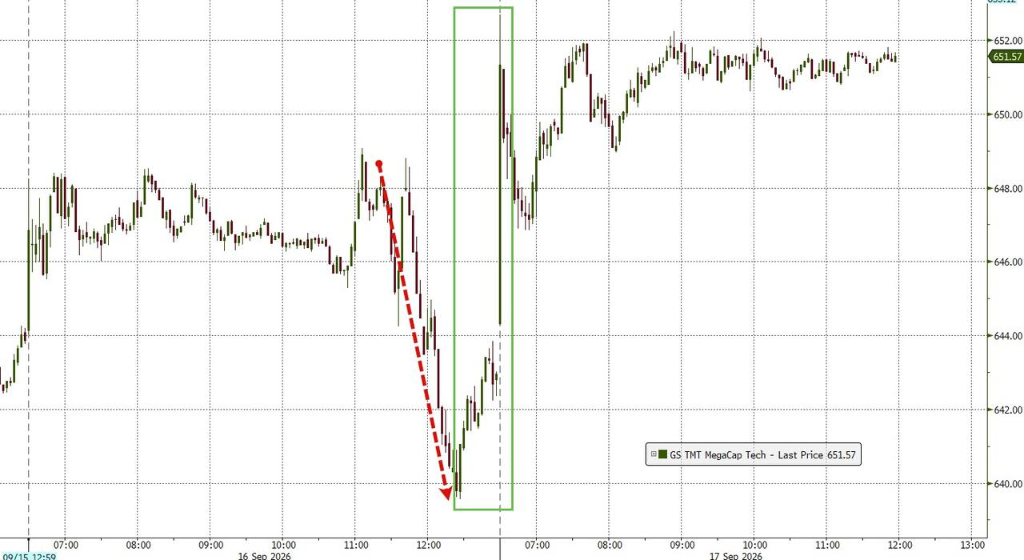
Large-cap tech stocks all closed higher.$Amazon (AMZN.US)$Up 2.13%,$Tesla (TSLA.US)$Up 2.27%,$NVIDIA (NVDA.US)$Up 2.54%,$Microsoft (MSFT.US)$Up 1.52%, Meta up 1.34%, Apple up 1.38%, and Google up 1.30%.
The Philadelphia Semiconductor Index rose 3.14% to 11,599.05 points, making it the strongest-performing major index of the day. Intel gained 7.67% to $108.80, the most representative stock in this rally.
According to reports,$SK Hynix (SKHY.US)$It is currently in negotiations with Intel to produce storage chips for the first time on U.S. soil, with one proposal being to lease capacity at Intel's Ohio facility, which has already faced multiple delays. This deal directly addresses the core challenge of Intel's foundry business—namely, a lack of capacity to serve external customers. Originally slated to begin production in 2025, the Ohio project is now expected to be delayed until around 2030. On September 16, Barclays upgraded Intel's rating from Underperform to Overweight.
Storage and logic chips are rallying in tandem. Arm rose 8.57%, AMD gained 6.36%, SanDisk advanced 6.21%, Micron climbed 5.50%, and Marvell Technology increased by 4.81%.$Western Digital (WDC.US)$Up 1.65%.
The optical communications sector showed mixed performance. Tower Semiconductor rose 8.43%, as the company and NewPhotonics have begun mass production and shipment of laser-integrated optical engines; Corning gained 2.46%, while Lumentum declined 2.81%.
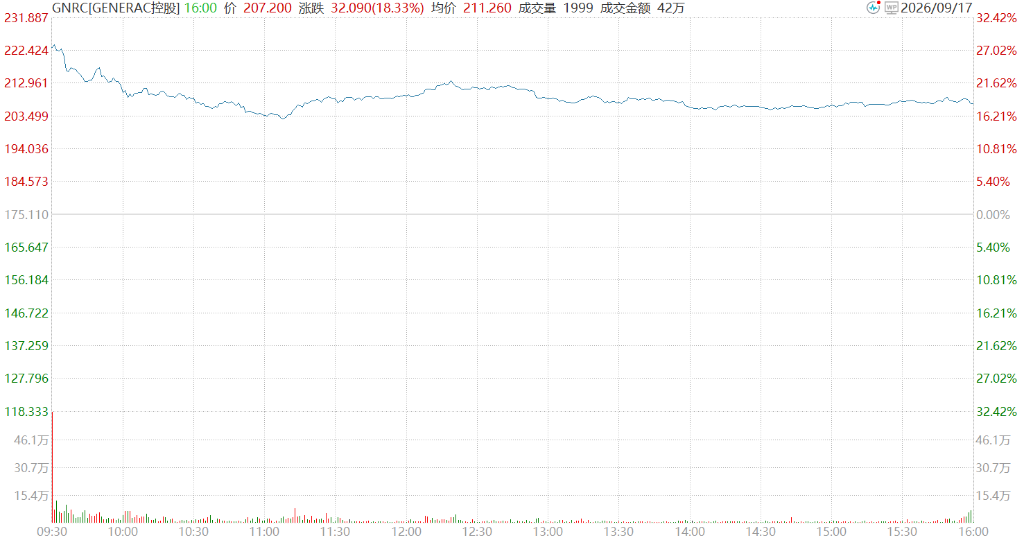
Amazon's $8 billion generator order ignites the power chain,$Generac(GNRC.US)$A record increase of 18.34%
Generac rose 18.34% to $207.23, at one point climbing as high as $233.18 during the session, marking the stock's largest single-day gain on record. On September 16, the company filed with the U.S. Securities and Exchange Commission, announcing that it had signed a long-term agreement with Amazon to supply industrial backup generators for the latter's global data centers.
Amazon has also received a warrant to purchase up to 1.6937 million shares at an exercise price of $200.93 per share, representing approximately 3% of the outstanding shares, with a maximum value of $340 million. The warrant vests in tranches based on cumulative purchase amounts, becoming fully vested when total purchases reach $8 billion; initial deliveries are expected to total $2.4 billion in 2027 and 2028.
Wells Fargo & Co. analyst Praneeth Satish wrote in a report that the warrant arrangement means Amazon's relationship with Generac goes beyond the initial $2.4 billion delivery plan; Amazon will only receive the full warrants if cumulative purchases ultimately reach $8 billion.
He also noted that, prior to this transaction, Generac's stock price had barely priced in any upside potential from its data center business, thereby significantly amplifying the deal's marginal impact.
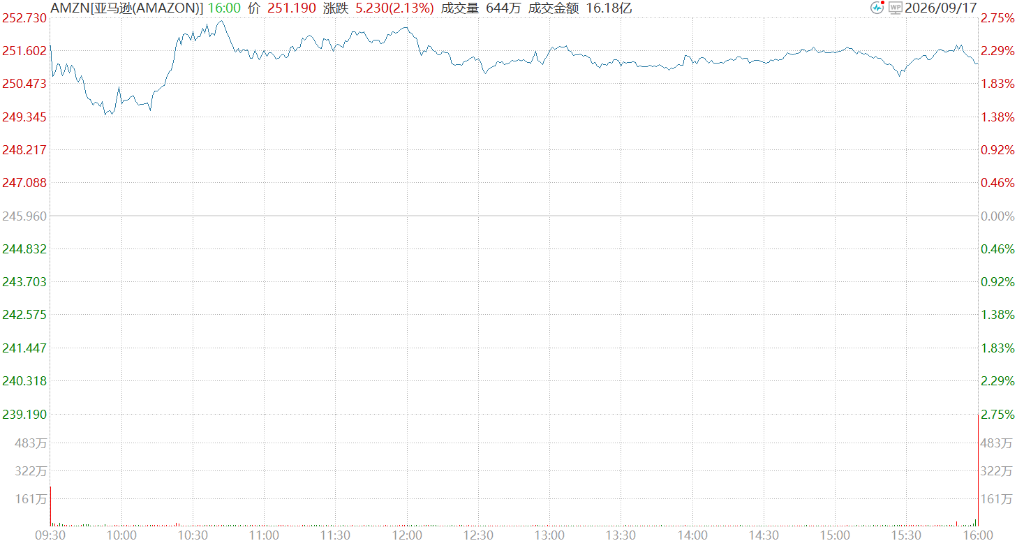
Other segments of the AI computing power chain are also strengthening in tandem.$Super Micro Computer (SMCI.US)$Up 9.50%, Goldman Sachs forecasts that the global AI server market will reach US$1.3 trillion by 2030;$Oracle (ORCL.US)$Up 5.18%.
NVIDIA rose 4.12%, and the company has notified customers that, effective October 1, it will implement across-the-board price increases for its on-demand GPU cloud services, with H100 instance prices rising by approximately 17% and NVIDIA's latest B300 model increasing by about 21%. On the financing front, divergence has emerged,$CoreWeave(CRWV.US)$Following the launch of a financing round that included $3 billion in convertible bonds, the stock turned lower and closed down 4.16%.
On the same day, the U.S. Securities and Exchange Commission introduced a five-year innovation exemption, allowing tokenized shares to be traded on designated trading venues.$Robinhood(HOOD.US)$It rose 5.16%, becoming the most direct beneficiary of this regulatory change in the stock market.
However, the S&P 500 index—excluding artificial intelligence—has barely gained ground, down nearly 1% from Tuesday's close.
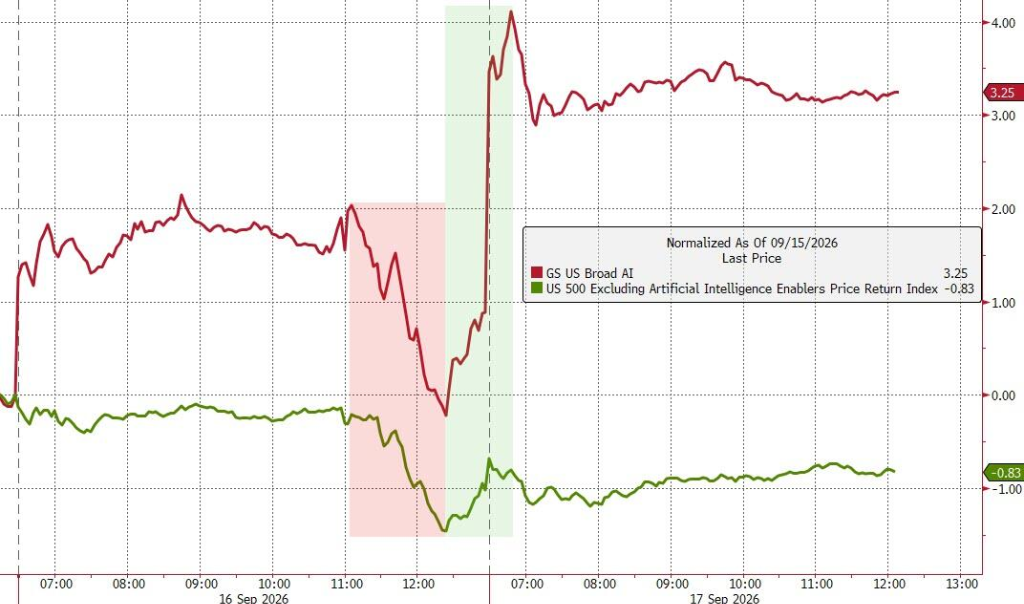
According to observations by Goldman Sachs traders, overall trading activity that day was only rated at "4 out of 10," a stark contrast to the relatively high turnover on the floor, leading many market participants to remain cautious about the market's ability to sustain momentum going forward.
Data from the options analytics platform SpotGamma show that the S&P 500 is in negative gamma territory at or below 7,625 points, implying that if the index falls below this level, price volatility could be amplified.
In addition, CTA models indicate that U.S. equities could face roughly $30 billion in sell-offs over the next week.
Historically, the ultimate magnitude of a Federal Reserve rate-hike cycle typically far exceeds market expectations at the outset of the tightening phase.
According to data from Deutsche Bank, since the 1950s, the 15 rate-hike cycles have lasted an average of 22 months, with a cumulative increase of 478 basis points. By contrast, the market currently prices this cycle's total increase at only about 95 basis points; if that proves correct, it would be the shallowest rate-hike cycle in modern history.
Late September has historically been a seasonally weak period for U.S. equities and a phase when the VIX tends to rise—raising questions about the sustainability of this rally.
The bond market is pricing in Walsh's credibility on inflation, with the 10-year U.S. Treasury yield falling back to 4.95%.
U.S. Treasury yields fell on Thursday, partly due to weaker housing data, while a sharp rebound in UK government bonds also added to the downward pressure.
On Thursday, U.S. Treasury yields across all maturities declined. The 10-year yield fell 5.8 basis points to 4.95%, marking its largest single-day drop in more than three weeks and ending an eight-session rally that had pushed it to a 19-year high the day before.
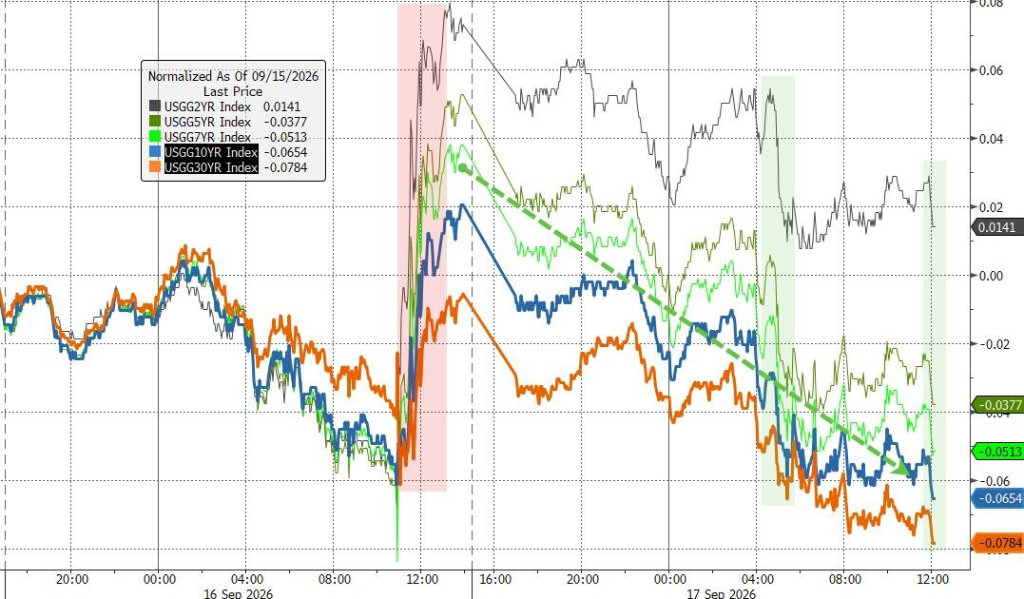
The 2-year yield fell 3.8 basis points to 4.688%, while the 30-year yield dropped 5.0 basis points to 5.296%. Reuters, citing traders, reported that hedge funds that had previously bet on rising yields are now taking profits.
Citi analyst Michael Chang said the Federal Reserve appears credible in its efforts to counter tail risks to inflation, which is positive for bond investors; long-term inflation expectations declined on the day of and the following day after the rate hike.
Tom di Galoma, Managing Director at Mischler Financial, said no one is willing to short the long end anymore, and the Treasury's repurchase program is also helping boost demand for long-term bonds. Meanwhile, Ron Albahary, Chief Investment Officer at LNW, believes the market first saw interest rates rise, has since given back some of those gains, but still hasn't fully figured out what's going on.
On the same day, the Bank of England kept its benchmark interest rate unchanged at 3.75% by a vote of 6 to 3, with three members advocating a 25-basis-point hike. More significantly, the central bank announced the cancellation of its planned sales of long-term government bonds and the suspension of all quantitative tightening auctions until April next year.
The £488 billion asset portfolio will be reduced by 2034 through a combination of maturing securities and targeted sales.$UK 30-Year Government Bond Yield (GB30Y.BD)$It fell by 11 basis points in a single day, marking the largest daily decline since May 20, with the 10-year yield dropping to 5.295%.
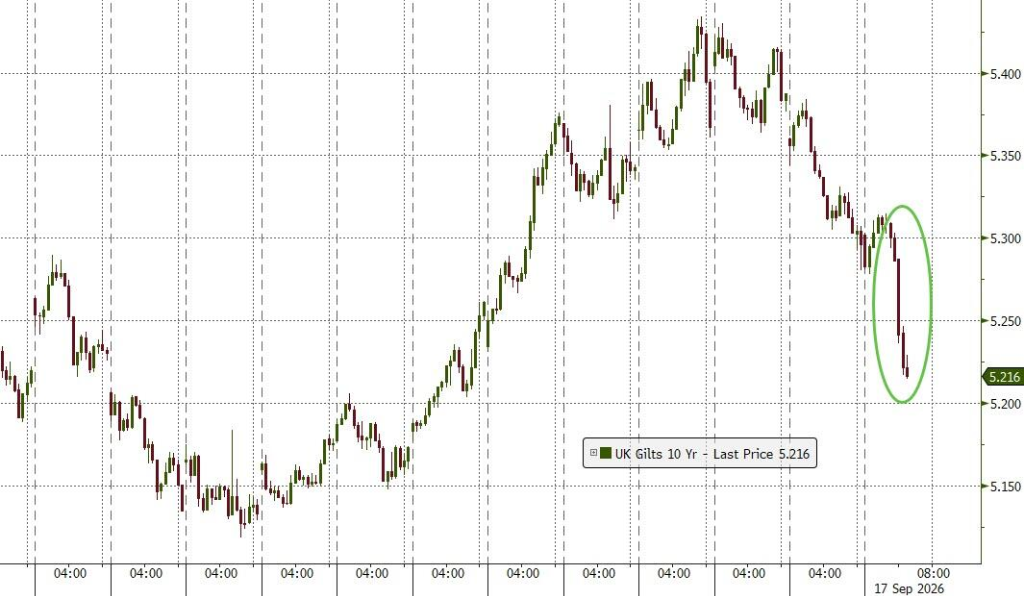
In a letter to the Chancellor of the Exchequer, Governor Bailey stated that this arrangement safeguards the independence of monetary policy. The UBS Group noted that several policymakers who voted to keep interest rates unchanged indicated that, should the conflict and energy shocks persist, the case for raising rates is mounting.
Oil prices are a key variable, but supply risks remain unresolved.
On Thursday, crude oil prices fell, serving as a key catalyst for a回暖 in market sentiment.
The October WTI crude oil contract settled at $101.91 per barrel, down $0.52, a decline of 0.51%, after dipping below $100 during the session.
The November Brent crude oil contract settled at $104.82 per barrel, down $1.01, or 0.95%, after intraday losses that at one point exceeded 3%, hitting the lowest level since September 10. Following the start of U.S. trading hours, oil prices rebounded from their lows.
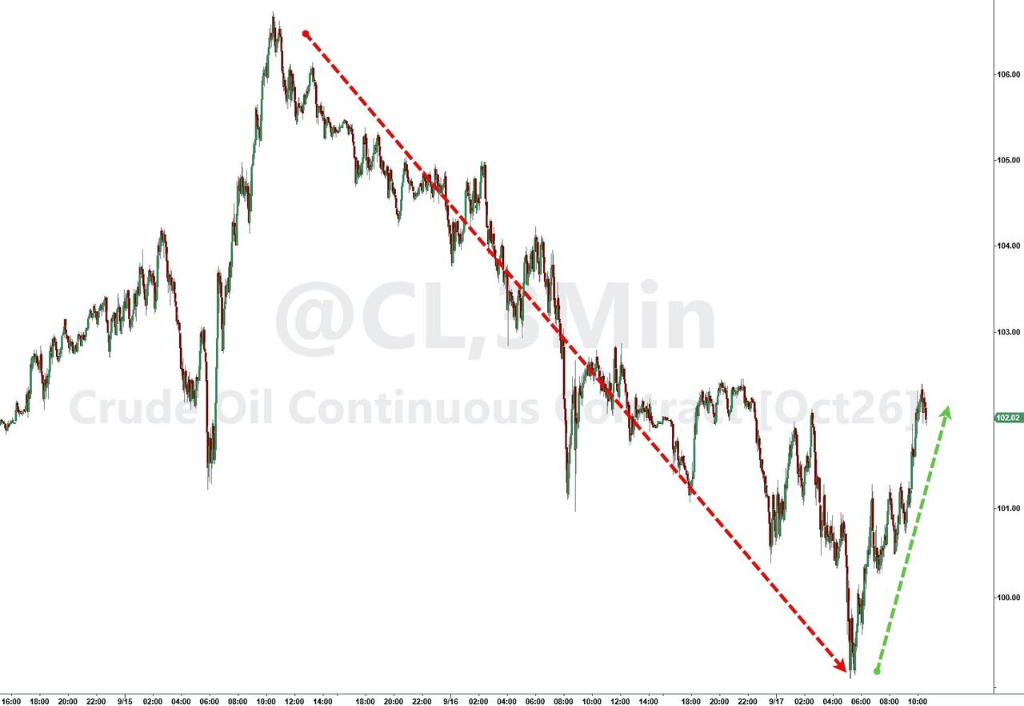
Product prices moved in mixed directions, with gasoline hitting a cycle high while diesel prices plunged and heating oil also declined.
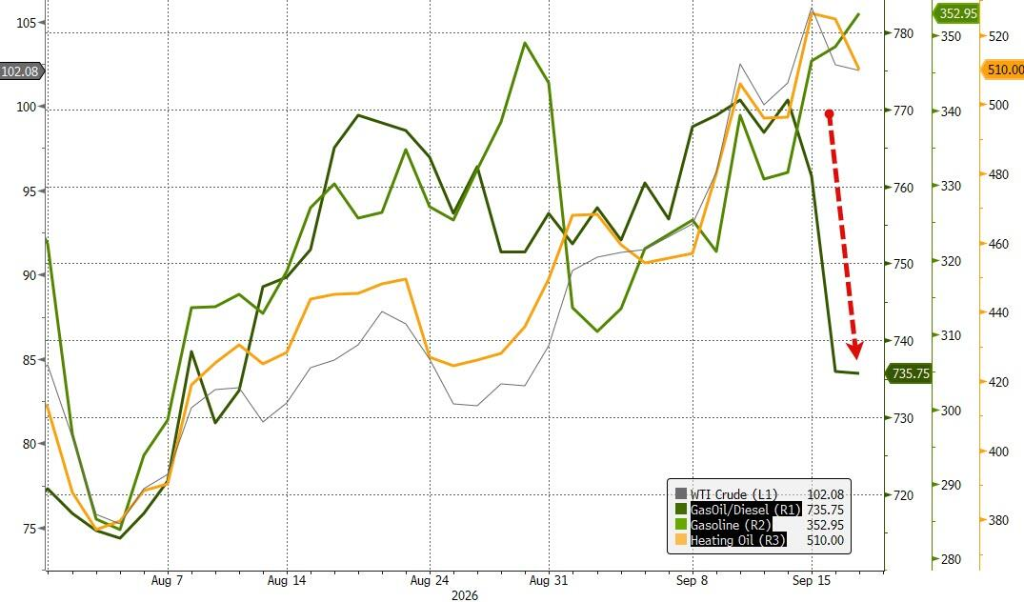
According to reports, Saudi Arabia plans to restore about half of the transport capacity of its key east–west pipeline within days, while also selling additional crude oil to Asian refiners, with deliveries scheduled outside the Strait of Hormuz.
However, Rebecca Babin, a senior energy trader at CIBC Private Wealth Group, cautioned that overall supply remains tight, supporting some of the oil price recovery during U.S. trading hours. Meanwhile, Arne Lohmann Rasmussen, chief analyst at Global Risk Management, stated:
We view this as a buying opportunity on dips for both crude oil and refined products; although prices have retreated, underlying supply risks remain intact.
JPMorgan analyst Natasha Kaneva noted in a report that the disruptions to energy flows caused by U.S.-Iran tensions are "increasingly difficult to predict," adding, "This is the first time since the conflict began that we have no baseline forecast; we simply don't know how to model the eventual outcome."
Precious metals were the second-best-performing asset class of the day. Spot gold rose 2.3% to $4,360.36 per ounce, rebounding from a nearly six-week low in the previous session and hitting an intraday high of $4,381.07. On the New York Mercantile Exchange, December gold futures settled up 0.3% at $4,399.70 per ounce.
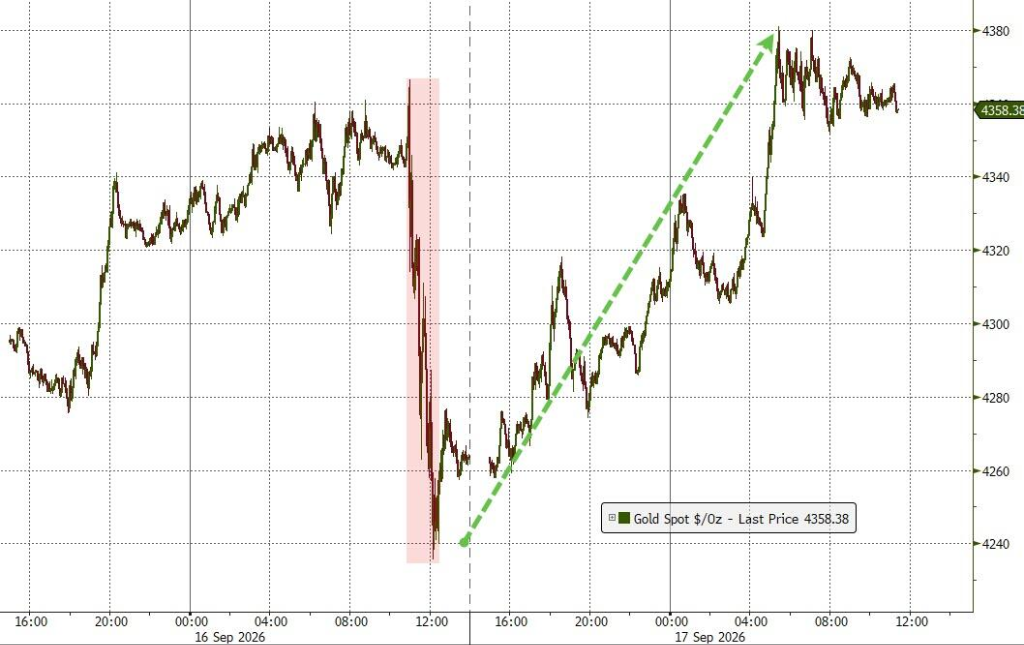
Spot silver rose 3.83% to $65.66 per ounce, with intraday gains as high as 5% to $66.13.
David Meger, head of metals trading at High Ridge Futures, said that gold has recently maintained a close inverse relationship with energy prices. With energy prices falling sharply on the day, those lower energy costs have eased some of the pressure weighing on the gold market.
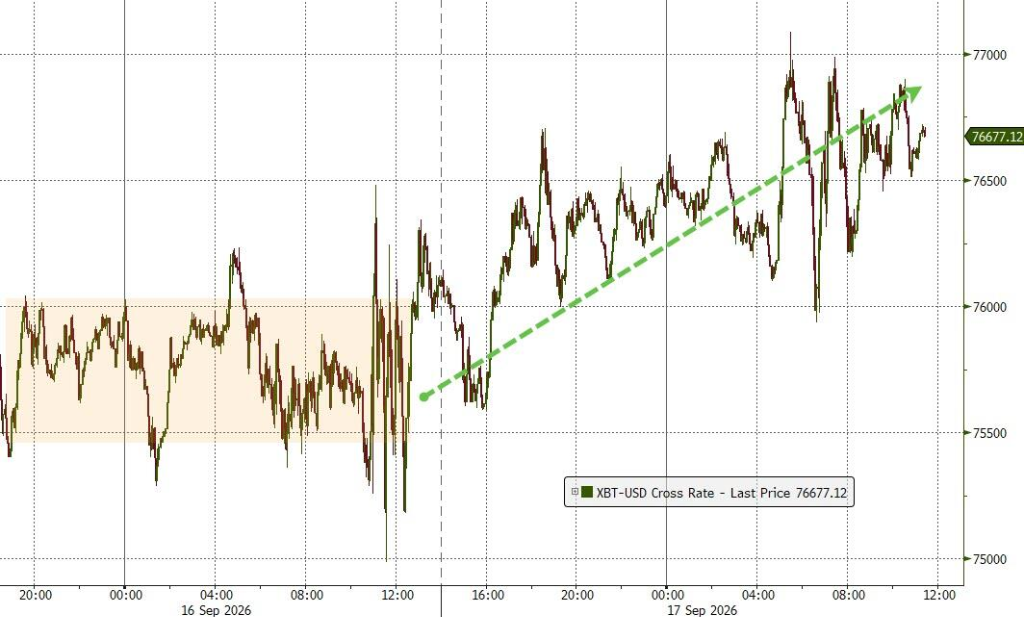
$Bitcoin (BTC.CC)$Back near $76,677, the market has rebounded from the lull that followed the Fed's meeting the previous day. On Friday, investors will be watching two key events: the Bank of Japan's policy decision and the triple witching hour. The BOJ is widely expected to raise interest rates on September 18.
Company News
[NVIDIA CEO Jensen Huang: The company's chip sales will double next year]
NVIDIA CEO Jensen Huang said Thursday local time that, as artificial intelligence continues to permeate industries such as healthcare, manufacturing, and financial services, the company's chip sales next year will double this year's level. Speaking at a summit in Scotland that day, Huang stated: "I expect NVIDIA to sell twice as many chips next year as we did this year. The reason is that AI is delivering tremendous value across diverse industries and economies. You can see it in nearly every country where we operate—people are eager to invest in AI." Huang noted that the current bottleneck is not demand, but rather NVIDIA's capacity to ramp up chip production. In recent years, NVIDIA has been working hard to diversify its supply chain and secure multi-year supply agreements for critical components.
【$SpaceX(SPCX.US)$Allegedly targeting data from bankrupt startups, seeking to acquire AI training materials at low prices.
The latest reports indicate that SpaceX internally discussed acquiring customer information and operational data from struggling or bankrupt startups, aiming to secure lower-cost data sources to enhance the capabilities of its AI models. This approach mirrors Google's earlier proposal to purchase commercial data from the U.S. low-cost carrier Spirit Airlines. After Spirit Airlines ceased operations, Google reportedly offered $10 million to acquire the airline's relevant data. At the time, this offer sparked concerns about data privacy, with some former flight attendants also voicing skepticism.
[Amazon Issues First Public Response to AI Safety Debate: Safety and Development Are Not an Either-or Choice]
On Thursday, U.S. tech giant Amazon issued its first public statement on the matter: "Models should only be released after rigorous testing to ensure safety." Amazon did not join calls for the industry to slow down. A spokesperson for Amazon said, "We don't believe this is a choice between development and safety. Models should be released when they are ready and can be used safely, which requires stringent testing and robust security safeguards. We believe the entire industry will work with governments to identify appropriate protective measures."
[Lucid Bets on a Comeback in Autonomous Driving: Partnering with Bolt to Target 25,000 Robotaxis in Europe]
U.S. electric vehicle manufacturer Lucid Group, Inc. announced that it will partner with ride-hailing platform Bolt to launch at least 25,000 robotaxis in Europe. According to the press release, the two companies will jointly develop and deploy autonomous mobility services. The struggling U.S. EV maker acknowledged that this deal represents "an important step toward stabilizing its financial position." Bolt will build vehicles based on Lucid's upcoming midsize vehicle platform and plans to deploy at least 25,000 fully autonomous cars across multiple European cities, marking a key milestone in Bolt's goal of having 100,000 self-driving vehicles on its platform by 2035.
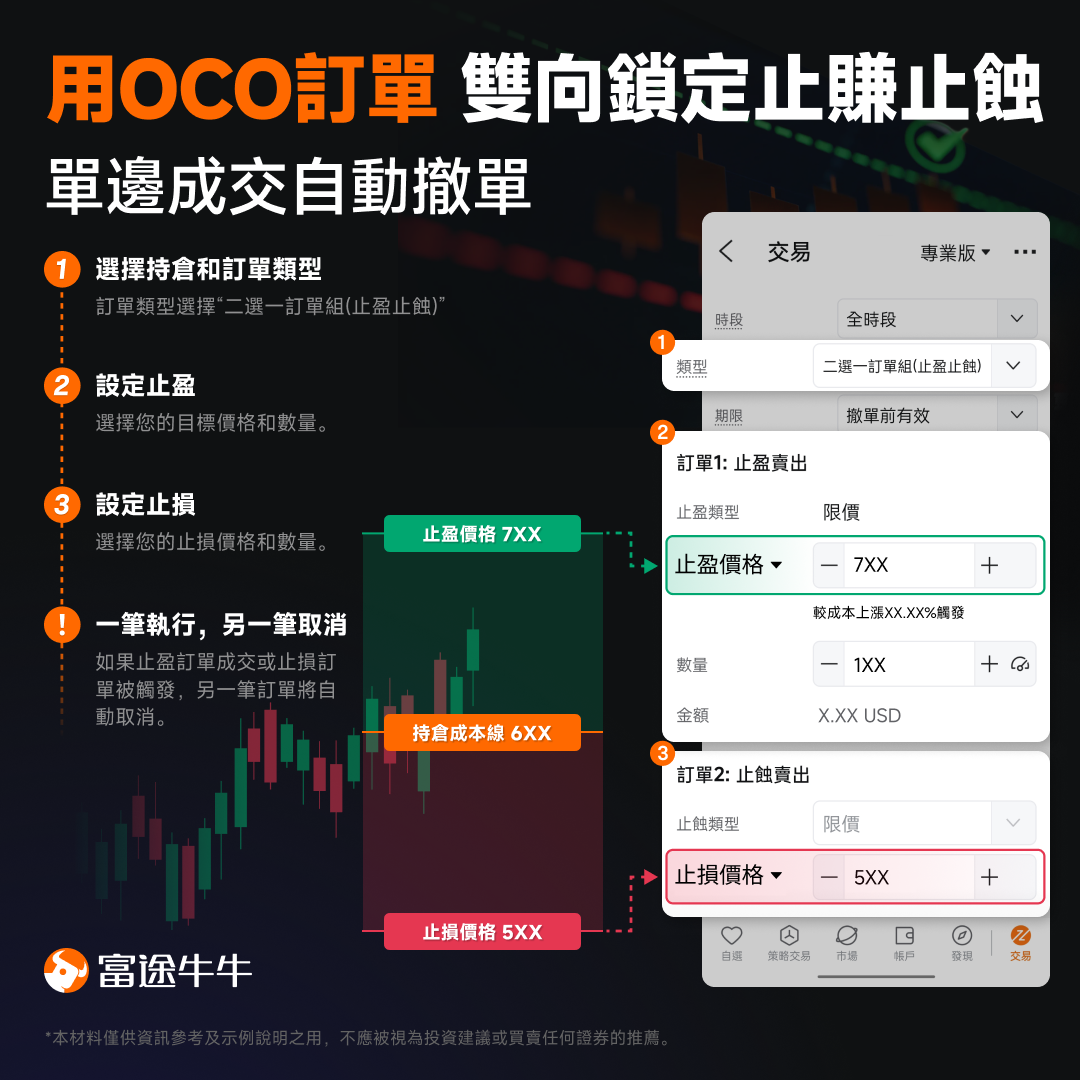
Market conditions can be highly volatile. Rather than rushing to sell once the trend becomes clear, it's better to prepare for both scenarios in advance. OCO (One Cancels the Other) orders let you place two linked orders simultaneously: when one is executed, the other is automatically canceled, giving you the flexibility to adapt to a wide range of market movements.
Editor/Liam