
① Bond investors view inflation as a major threat, as rising prices erode the fixed interest income they receive from bonds. Moreover, they have historically found it difficult to fully trust Mr. Walsh's assurances. ② Clearly, on Wednesday, Mr. Walsh allayed these concerns by signaling a hawkish stance on interest-rate hikes.
If the bond market were to hand out report cards, Federal Reserve Chair Jerome Powell might well earn a top score following Wednesday's rate decision—when the Fed raised interest rates for the first time since 2023.
Reaching this point was far from smooth sailing. In the early days of Jerome Powell's tenure, bond investors were deeply skeptical of him. That skepticism, by driving up mortgage rates and other borrowing costs, ended up exacting a heavy toll on countless households and businesses.
 Bond investors view inflation as a major threat, as rising prices erode the fixed interest income they earn from bonds. Moreover, they have historically found it difficult to fully trust Powell—questioning whether this Fed chair, nominated by Trump, truly has the resolve to bring inflation back to the 2% target through interest-rate hikes; the latest data show that U.S. inflation remains as high as 3.4%.
However, it was clear that on Wednesday, by signaling a hawkish rate hike, Mr. Wash dispelled these concerns. James Egelhof, Chief U.S. Economist at BNP Paribas, praised Mr. Wash, noting that at the press conference he "spoke with confidence and even emphatically underscored that the FOMC will achieve its 2% inflation target."
"We believe that the outcome of the September FOMC meeting represents the most constructive initial step reasonably foreseeable in addressing the credibility challenge," Egelhof wrote.
Why is this important?
Bond investors' confidence in the Federal Reserve influences long-term yields, which in turn affects borrowing costs. Although the Fed's latest rate-hike cycle may keep interest rates elevated for homebuyers, businesses, and investors over the long term, it nonetheless serves as a much-needed boost—especially for the currently volatile long-term bond market.
Notably, the Federal Reserve's rate hike this time was approved unanimously, and the latest dot plot released by officials also suggests that there is still room for further rate increases in the future.
Although Wash has long been wary of central banks providing forward guidance on the path of interest rates, he refrained from offering his own forecast. However, he made it clear that the Fed will not ease policy unless it is confident that inflation is returning to 2% "clearly and at a sufficient pace."
"The undeniable fact is that U.S. inflation remains too high and has persisted for far too long," Wash stated bluntly in his opening remarks.
The bond market promptly responded with a vote of confidence. If investors had turned their backs, the yield on the 10-year U.S. Treasury would have surged; instead, yields remained largely unchanged on Wednesday and, by Thursday, had slipped below the key 5% level that had been under persistent scrutiny throughout the week. Bond yields move inversely to prices.
Market data show that U.S. Treasury yields across all maturities fell on Thursday, with the 2-year yield down 6.54 basis points at 4.666%, the 5-year yield down 9.23 basis points at 4.783%, the 10-year yield down 9.22 basis points at 4.928%, and the 30-year yield down 7.41 basis points at 5.287%.
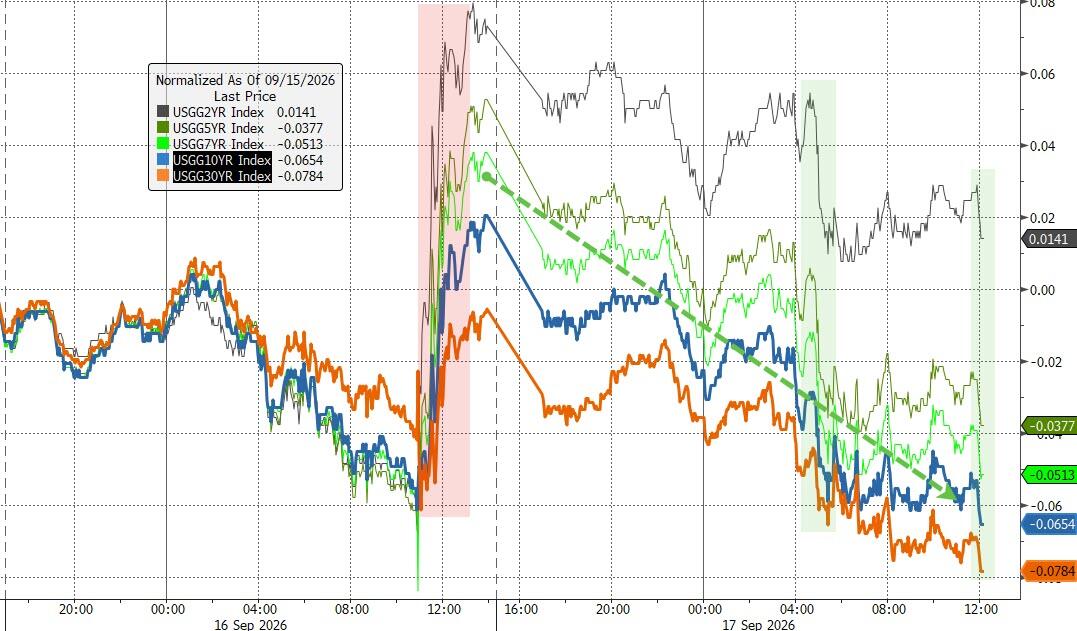
As a key gauge of inflation expectations over the next decade, the 10-year breakeven inflation rate fell from 2.38% before the monetary policy meeting to 2.33%, signaling a marked easing of market concerns about "out-of-control inflation." In 2022, this indicator had surged above 3%, as post-pandemic supply-chain disruptions and the Russia-Ukraine conflict together triggered an inflationary surge not seen in decades.
Further interest rate hikes are imminent.
Ahead of Wednesday's Federal Reserve decision, markets had speculated that the Fed would signal that any rate hike would be a one-off move, thereby tempering expectations of a series of consecutive increases.
However, Aditya Bhave, head of U.S. economics at the Bank of America, pointed out that Wednesday's meeting conveyed an "unreservedly hawkish stance."
Bhave pointed out that the statement removed the previous wording attributing high inflation to energy shocks, signaling that "excuses are no longer acceptable"; meanwhile, Wash also emphasized that economic momentum remains strong, indicating that current interest rates have not weighed on economic growth, thereby creating room for the Federal Reserve to continue raising rates without triggering economic pain.
"Our conclusion is that today's rate hike is not a one-off move," Bhave wrote. "The market shares the same view."
In fact, Wall Street traders are already debating whether the Federal Reserve will raise interest rates at both of its remaining meetings this year or just once more. Some even expect the tightening cycle to extend into 2027—despite the median projection in the official dot plot still pointing to no rate hikes next year.
"History shows that once the Federal Reserve begins raising interest rates, it tends to do so repeatedly," said Chris Zaccarelli, Chief Investment Officer at Northlight Asset Management, in a written statement, adding that he commended Wash for his "exquisitely precise" management of expectations.
There are still challenges ahead.
Of course, although Mr. Walsh's image as an "inflation‑fighting tough guy" has temporarily calmed bond‑market sentiment, long-term bonds still face numerous challenges before they can fully shake off the sell‑off panic.
Bill Adams, Chief U.S. Economist at Fifth Third Commercial Bank, wrote that when diesel prices are hitting record highs every day, putting hawkish rhetoric into practice is far from easy.
Diesel is the lifeblood of the logistics sector, and its soaring costs readily ripple through every facet of the real economy. Even before the resurgence of tensions in Iran sent crude oil prices higher, U.S. diesel prices were already at elevated levels—and now they have climbed even further.
"The higher oil and gas prices rise, and the longer they remain elevated, the more aggressively the Federal Reserve will have to raise interest rates," Adams said, characterizing energy prices as "the biggest 'known unknown' in the Fed's policy decisions over the coming months."
Moreover, even if the bond market acknowledges Mr. Walsh's hawkish stance, Fed policy is far from the sole driver of long-term yields.
The bond market has remained uneasy about rising global debt levels—from U.S. Treasuries to French and Japanese government bonds—and has been steadily demanding higher risk premiums. Market participants are also concerned about inflationary risks stemming from a potential war with Iran. Meanwhile, as data-center construction continues to expand, the bond market is absorbing the tens of billions of dollars that tech companies have suddenly raised through bond issuances.
Moreover, markets are weighing deeper macroeconomic questions: for instance, can AI genuinely boost total factor productivity over the coming decades, thereby providing a rationale for higher long-term neutral interest rates?
Neel Mukherjee, Chief Investment Officer at TIAA Wealth Management, notes that these structural drivers remain unchanged, suggesting that 10-year U.S. Treasury yields could stay elevated for the long term, leaving homebuyers and expansion-minded companies still saddled with heavy financing costs.
But at least one of the bond market's key concerns—Fed inaction—was effectively alleviated this week.
Mukherjee said that Powell has delivered on this promise through a "minimalist" communication style: the entire policy statement contains just 130 words, far below the five-year average of roughly 300 words during his predecessor's tenure. Yet this approach hits the mark precisely. "He has sent an unmistakable signal to both markets and the public: the Federal Reserve is prepared to risk further rate hikes in order to safeguard its inflation target," Mukherjee noted.
Editor/lambor