
What's being revealed isn't a "mass exodus of retail investors from AI," but rather a significant slowdown in the overall pace of market participation under macroeconomic pressure, coupled with more concentrated stock-picking. Regarding the Federal Reserve's unanimous decision to raise interest rates by 25 basis points, bringing the policy rate to 3.75%–4.00%, JPMorgan's view is: if this merely reverses last year's mild tightening cycle—often described as an "insurance cut"—while corporate earnings remain robust and the situation in the Middle East does not spiral further out of control, the stock market will still be able to absorb rising interest rates.
Zhitong Finance APP has learned that, according to JPMorgan's latest "Retail Radar" report, with the Federal Reserve's rate hike finally in place, retail investors have not pulled out of AI across the board. Instead, amid macroeconomic pressures, their overall pace of market entry has slowed significantly, and their stock-picking has become more concentrated on leading AI‑computing companies. Regarding the Federal Open Market Committee's unanimous decision on Wednesday Eastern Time to raise interest rates by 25 basis points, pushing the policy rate to 3.75%–4.00%, JPMorgan's baseline view is that, if this merely reverses part of last year's "insurance‑type rate cuts" in a mild tightening cycle, while corporate earnings remain robust and the situation in the Middle East does not spiral further out of control, the stock market should still be able to absorb the rising trend in interest rates and long‑term U.S. Treasury yields.
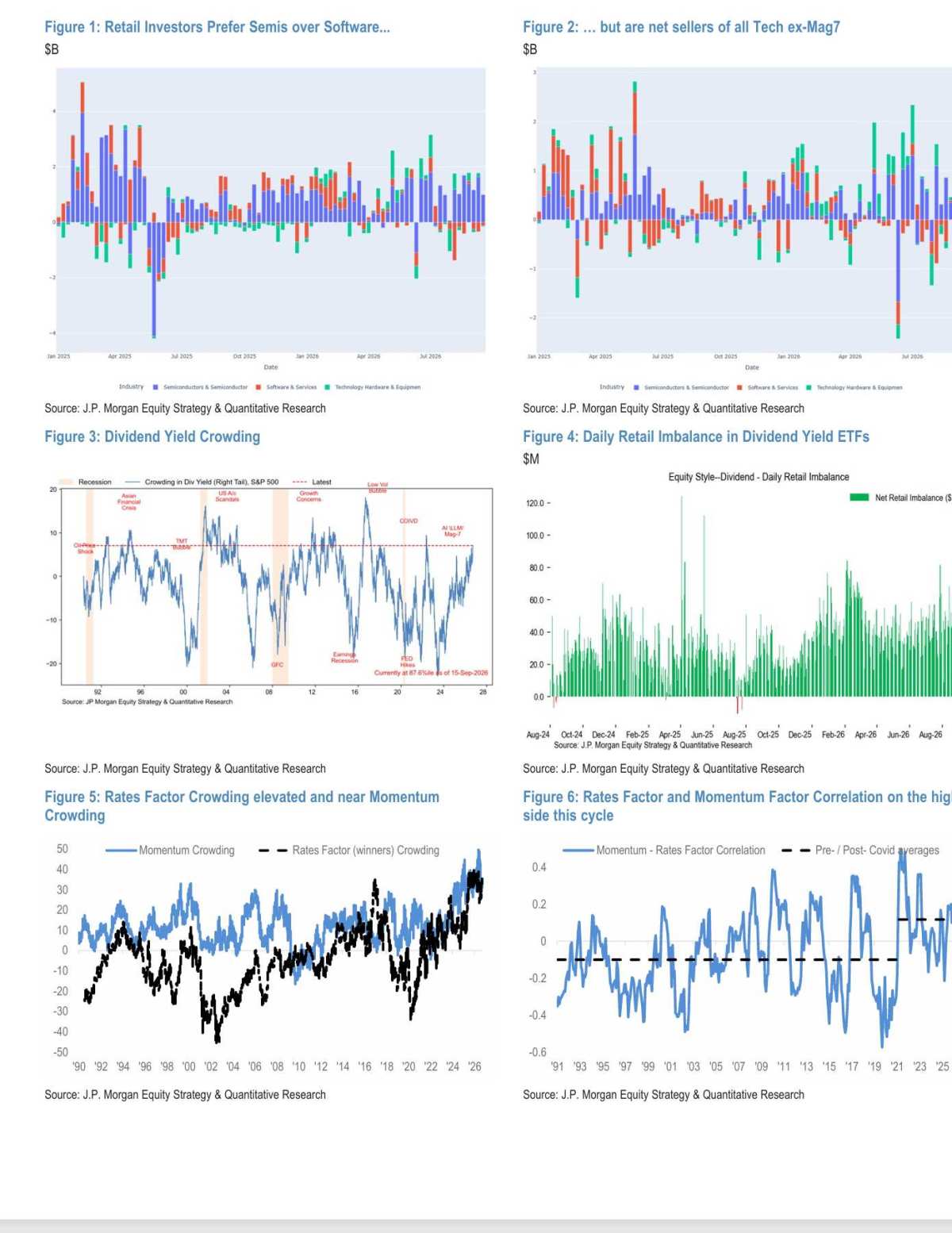
As the drag on valuations from oil prices and long-term yields eases, core assets in the AI computing‑power theme—previously supported by buying—now have the foundation to participate in the recovery of risk appetite. Market attention can also shift back from the impact of rate hikes to the realization of orders, revenue, and earnings. This is why, according to JPMorgan's latest compiled data, from September 10 to 16, retail investors' capital inflows helped the seven major tech stocks collectively attract $1.601 billion in net purchases, with NVIDIA alone accounting for $1.196 billion. Leading players in the AI computing‑power value chain, such as Western Digital, ASML Holding, and Oracle, also saw strong inflows. This "overall contraction with core sectors absorbing the bulk" pattern better explains why, even after the Fed's rate hike was implemented, the AI computing‑power theme still has a solid rebound basis than the more generalized narrative of "retail investors pulling out of tech."
 JPMorgan's analysis report, based on historical data, even suggests that, under the current favorable conditions of a high-growth economy, the stock market can withstand a gradual rise in the 10-year U.S. Treasury yield toward 6%. However, this is an assessment of resilience predicated on robust, AI-driven earnings expansion, not a forecast of a 6% yield.
Coincidentally, two other Wall Street giants, Goldman Sachs and Jefferies, have also recently sent out similarly positive signals. In a research report released last weekend, Goldman Sachs laid out a bullish "earnings trump everything" rationale, asserting that the U.S. stock market's long-term bull run, which has been underway since ChatGPT swept the globe in 2022, will continue robustly—projecting S&P 500 earnings per share to reach $340 by 2026, implying a substantial year-over-year increase of 24% on a high base; and further climbing to $385 in 2027, up 13% from the previous year.
Meanwhile, the forward price-to-earnings ratio has fallen from 22 times at the start of the year to 19 times, indicating that interest-rate headwinds have already been reflected in valuation compression. Historical data show that, three months after the onset of seven rate-hike cycles, the S&P 500 averaged a 2% decline, but twelve months later it had risen by an average of 9%. These figures do not yet support the notion that "a Fed rate hike inevitably ends a bull market," nor can they fully substantiate the idea that future investment returns will necessarily mirror past performance. In its research report, Goldman Sachs emphasizes that the real key lies in whether the trend of earnings realization can offset further declines in valuation multiples.
Jefferies recently stated that, driven by the dual forces of an AI investment boom and stronger-than-expected earnings growth among AI‑related companies, the S&P 500 is expected to surge to 8,000 points by the end of 2026 and further climb to 9,000 in 2027. Jefferies' core rationale is clear and compelling: in a cycle where AI‑powered earnings growth exceeds historical averages by more than double, betting against this trend is risky. The firm's baseline forecast for the S&P 500 at 8,000 points by 2026 assumes earnings per share (EPS) of $373—up 35% year over year, well above the market consensus of 29%—and a price‑to‑earnings multiple of 21.5x.
With the Fed's rate hike now in effect, retail investors appear to be scaling back their buying: capital is concentrating on core AI‑computing assets.
JPMorgan's latest compilation of retail investor flows shows that from September 10 to 16, net retail inflows totaled just $2.5 billion, roughly 63.2% lower than the 12-month average of $6.8 billion per week; ETFs saw net inflows of $3.1 billion, while individual stocks experienced net outflows of $600 million. The report places overall inflow intensity at the 2nd percentile historically, with ETF inflows falling to a one-year low and stock‑level flows at the 12th percentile. Consequently, the most important market signal is "diminishing incremental buying and more selective allocation": high oil prices, rising long-term interest rates, and discussions around AI safety are weighing on short-term risk appetite, yet core assets like NVIDIA continue to attract net purchases.
On Thursday, September 17, the Philadelphia Semiconductor Index surged 3.1% after a brief pullback, coinciding with a sharp drop in oil prices and a decline in the 10-year U.S. Treasury yield to 4.93%. This move reflects a confluence of easing pressure on the interest-rate–long-term Treasury yield curve and a robust rebound in investor confidence tied to AI‑related computing power, driven by expectations that the Federal Reserve's rate hikes have bolstered central banks' credibility in combating inflation.
Although, in terms of timing, JPMorgan's "Retail Radar" was released on the eve of a major rebound in global tech stocks, it provides investors with crucial insights into the flow of capital behind this rally—namely, that overall market participation has slowed, yet selective buying of core AI assets has persisted. In particular, the seven U.S. mega-cap stocks—known as the Magnificent Seven—which include NVIDIA and Google, collectively attracted $1.601 billion in net purchases, with NVIDIA accounting for $1.196 billion alone. Meanwhile, leading players in the AI computing‑power supply chain, such as SanDisk, ASML Holding, and Oracle, also saw net inflows of $202 million, $119 million, and $102 million, respectively.
This "overall contraction with core sectors taking over" dynamic better explains why the AI theme still has room for a rebound than the more general narrative of "retail investors pulling out of tech": while investors are scaling back their exposure to non‑Big‑Seven tech stocks, they continue to favor select companies in areas such as accelerated computing, storage, semiconductor equipment, and cloud infrastructure. The report also clearly notes that the AI data‑center infrastructure value chain, along with themes like electrification, major AI beneficiaries, and AI software commercialization, remain attractive to retail investors.
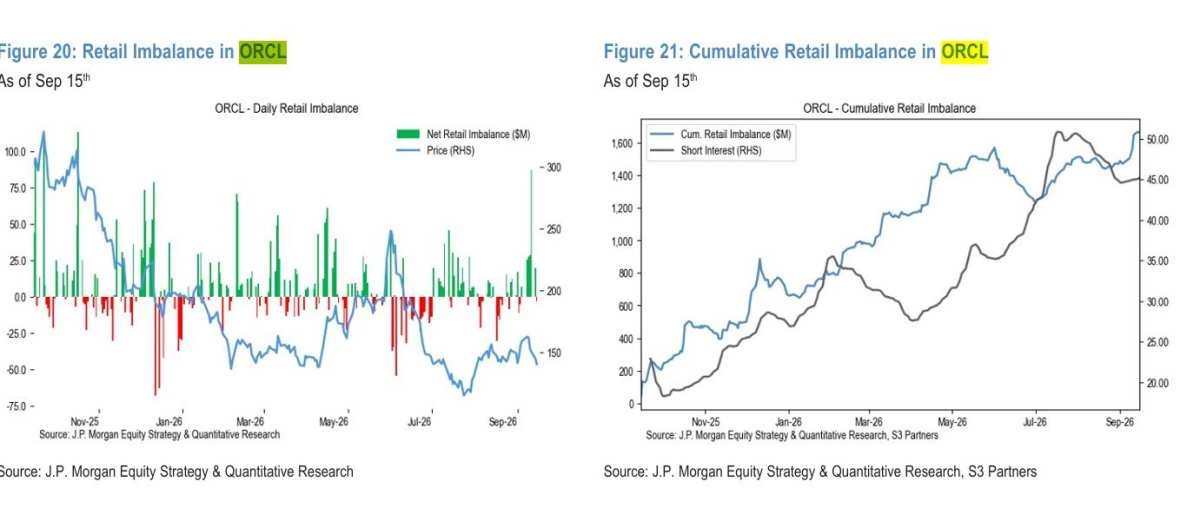
Oracle particularly exemplifies the logic of "buying on dips, supported by profits and orders": its revenue grew 30% year over year, cloud‑related infrastructure revenue posted triple-digit growth, and its remaining performance obligations increased by $26 billion quarter over quarter. Subsequently, on September 11, retail investors net‑purchased $87 million worth of its shares in a single day, underscoring that verifiable business growth continues to attract capital inflows.
Based on JPMorgan's latest assessment that "when earnings remain robust and geopolitical risks are contained, a mild rate-hike cycle and persistently high long-term U.S. Treasury yields can still be absorbed by the stock market," one possible investment strategy is as follows: as the downward pressure on valuations from oil prices and long-end yields eases, AI‑computing core assets—previously supported by buying—will have the foundation to participate in the recovery of risk appetite, providing a funding‑favorable backdrop for Thursday's rebound. Meanwhile, market attention can shift back from the impact of rate hikes to the realization of orders, revenues, and earnings.
The pace of trading and sector flows jointly indicate that retail investors are simultaneously engaging in defensive positioning and selective tech investing, rather than simply shifting from the broader tech sector to defensive sectors. Over the past four trading days, retail investors remained net buyers of individual stocks during the midday session but turned into net sellers in the afternoon, with the main shifts stemming from a shift from buying to selling in non‑Big Seven tech stocks and an acceleration in selling of industrial stocks. In sector‑level data excluding the Big Seven, consumer staples was the only sector to post net buying, totaling $11 million; industrials, communications, and technology saw net outflows of $555 million, $493 million, and $405 million, respectively, while utilities and real estate were among the sectors with relatively modest net sales.
On the ETF front, sector‑specific ETFs posted their third-largest weekly net outflows on record, driven primarily by technology‑focused funds; meanwhile, broad‑market large‑cap ETFs continued to attract $1.3 billion in net inflows, precious‑metal ETFs drew $188 million, and demand for medium- to long‑term bond ETFs also showed a modest improvement. Notably, while crowdedness in the market‑wide high‑dividend strategy has approached a three-year peak, retail investor flows into dividend‑focused ETFs have instead declined.
Meanwhile, JPMorgan's compiled data show that the one-month rolling average of retail options trading as a share of total trading remains at the 96.8th percentile of its historical range, indicating that trading participation remains very high, though there is a divergence between retail investors' willingness to buy spot and their trading direction.
From capital flows to profit realization: AI computing infrastructure investment is shifting from broad‑based chasing to selective allocation toward leading super‑cap companies.
The specific list of purchases shows that funds not only continue to support the seven major tech stocks but also maintain a clear preference for storage, semiconductor equipment, and cloud infrastructure. JPMorgan's compiled retail investor flow data reveals the following (weekly retail investor flow summary from September 10 to 16):
All seven major stocks received net purchases:$NVIDIA (NVDA.US)$US$1.196 billion,$Tesla (TSLA.US)$US$201 million,$Amazon (AMZN.US)$87 million dollars,$Apple (AAPL.US)$63 million dollars,$Alphabet-A (GOOGL.US)$25 million dollars,$Microsoft (MSFT.US)$19 million dollars,$Meta Platforms (META.US)$$10 million, totaling $1.601 billion, of which NVIDIA accounts for approximately 74.7%.
Outside the Big Seven,$SanDisk (SNDK.US)$Received net purchases of US$202 million,$ASML Holding (ASML.US)$US$119 million,$Oracle (ORCL.US)$$102 million, ranking among the top five net buyers of the week alongside NVIDIA and Tesla; the top five net sellers were$SpaceX (SPCX.US)$US$249 million,$Marvell Technology (MRVL.US)$95 million dollars,$Intel (INTC.US)$76 million dollars,$NuScale Power (SMR.US)$60 million dollars and$Advanced Micro Devices (AMD.US)$52 million dollars.
The report also explicitly notes that retail investors continue to buy into themes such as the AI data‑center electrification value chain, the seven major tech giants—key and primary beneficiaries of AI and data‑center infrastructure—and growth stocks, as well as AI software and the commercialization of AI applications. This broadly underscores that retail investors have not abandoned AI; instead, they are concentrating their buying on the seven giants, along with select core companies in storage, hardware, and cloud platforms that command the strongest overall investor preference. Meanwhile, the broader non‑seven‑giants tech sector has seen net outflows, though this does not imply that every individual stock within it has been sold off.
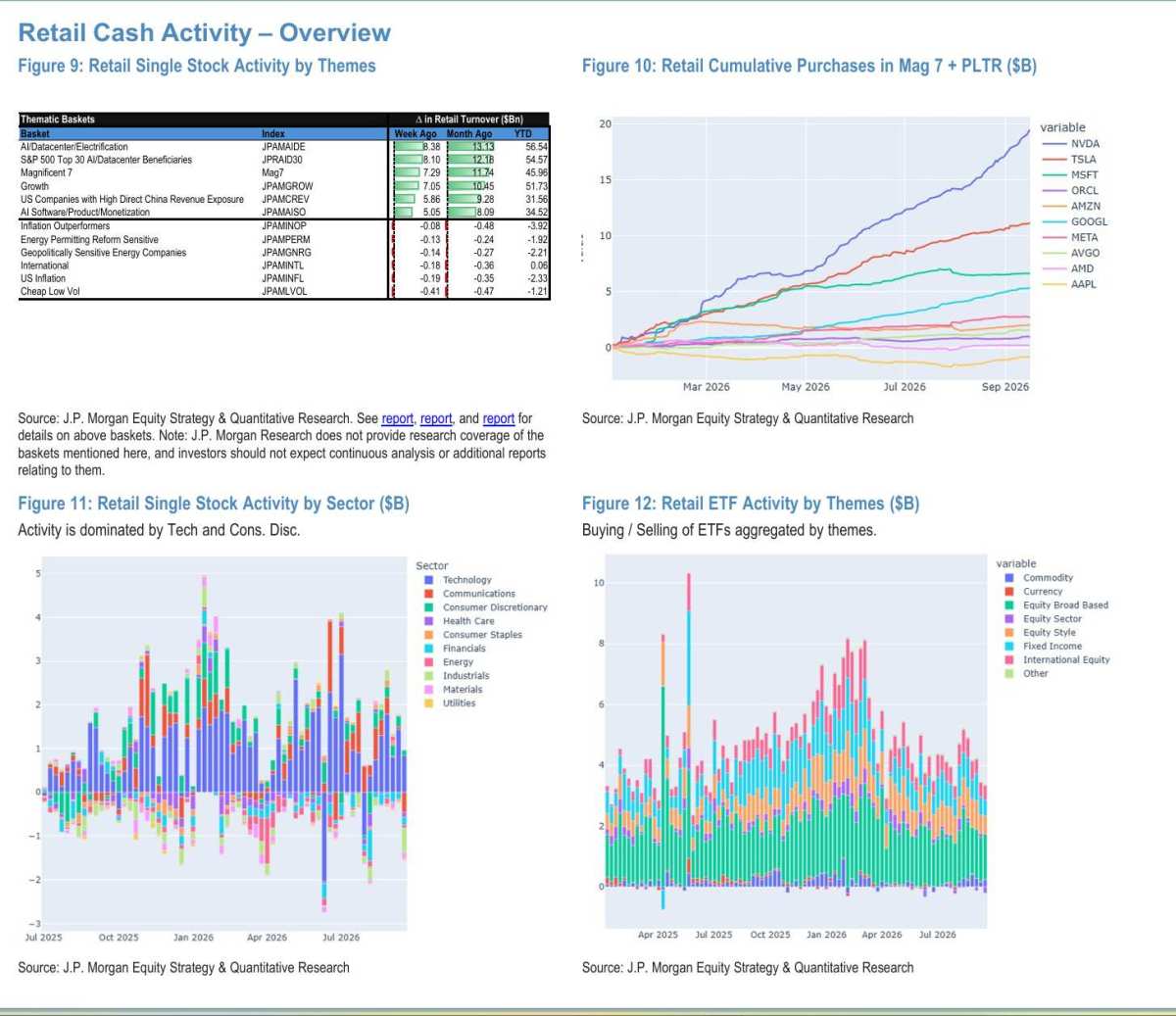
JPMorgan's analyst team upgraded Meta to "Overweight," citing its cutting-edge models, the Muse agent, and model API services, which they believe will further expand AI commercialization beyond advertising into new products and revenue streams. In the cybersecurity space, they are particularly bullish on Okta, Palo Alto Networks, CrowdStrike, Varonis, and Zscaler, arguing that the broader adoption of AI is widening the attack surface, making security firms infrastructure partners to foundational model companies and rendering security spending even more critical. Notably, retail investors remain net sellers of this cybersecurity software portfolio as a whole, suggesting that institutional fundamental views do not fully align with short-term retail trading activity.
Oracle, a leader in AI cloud computing infrastructure, is a key example of positive capital flows: JPMorgan's report cited its year-over-year revenue growth of 30%, triple-digit growth in cloud infrastructure revenue, and a $26 billion quarter-over-quarter increase in remaining performance obligations (RPO), arguing that these results help address concerns about sustained order growth, order-to-revenue conversion, and subsequent financing. On September 11, retail investors net-purchased $87 million worth of Oracle shares, reflecting bargain-hunting following the earnings release. Additionally, on September 15, Skyworks and Qorvo received net purchases of $7.5 million and $400,000, respectively, amid news that the two companies' merger is expected to close within the year—though this should not be directly attributed to AI‑computing‑power buying.
Data on AI industry financing, applications, and delivery provide a fundamental backdrop that keeps core assets in the spotlight, yet they serve as supplementary evidence beyond direct observations of capital flows. According to media reports, OpenAI is reportedly in talks for a new funding round valued at over $1.2 trillion; meanwhile, Anthropic, per Reuters, is preparing for a potential IPO with an estimated valuation of around $2 trillion and plans to raise up to $100 billion, which could become the largest initial public offering in history—both figures reflect ongoing fundraising discussions or preparatory estimates.
On the specific AI application side, Astra enhances programming, browsing, computer operations, and complex workflow capabilities, expanding the scope of tasks that AI can perform; OpenAI has also confirmed that, starting September 10, it will suspend new sign-ups and upgrades for its $200-per-month Pro 20X plan, though existing subscribers will not be affected. On the procurement side, Anthropic has disclosed a deal with Amazon for up to 5 gigawatts, 5-gigawatt agreements with Google and Broadcom, $30 billion in Azure capacity, and a $50 billion U.S. AI infrastructure investment tied to Fluidstack.
On the delivery side of AI computing infrastructure resources, NVIDIA's data center revenue reached $89 billion in the second quarter of fiscal year 2027, up 117% year over year; South Korea's August exports rose 68.7% year over year to $98.26 billion, with semiconductor exports totaling $46.65 billion. As of early September, the country's cumulative annual exports had already hit $709.4 billion, surpassing its full-year record from 2025. From an investment perspective, these figures translate "expanding AI demand" into concrete applications, capacity procurement, and hardware revenues, providing support for the long-term growth of NVIDIA, storage companies, and cloud‑infrastructure firms. This is also why retail investor flows have, in the short term, focused on contrarian buying, continuing to favor select core AI‑computing investment targets.
From a technical perspective, the most noteworthy incremental shift is that AI computing power demand is expanding from centralized pre-training to post-training, continuous inference, and agent execution—this also helps explain why capital is being reallocated within both hardware and software ecosystems.
JPMorgan, citing SemiAnalysis, notes that pre-training now accounts for less than 15% of the computational power allocation structure it examines, while demand for end‑user tokens is expanding, and post‑training techniques have also become a key avenue for enhancing model capabilities. The decline in its share reflects structural changes rather than an absolute reduction in computational demand; in line with "Jevons Paradox," overall AI demand is expected to continue growing as computing costs fall. From a systems‑architecture perspective, total token throughput is influenced by user scale, task frequency, invocation cycles, and context length: prefill processes inputs, decode continuously generates outputs, and the key‑value cache places demands on GPU memory capacity and memory bandwidth. Multi‑tool agents further require CPUs to execute programs, storage‑chip systems to provide data and caching infrastructure, high‑performance Ethernet networking equipment to connect computing resources, and optical interconnect/optical communication systems in AI data centers to enable high‑speed data transmission—while cloud platforms handle scheduling and deliver services in a deployed manner.
This has essentially established a complete demand chain spanning "accelerated computing—memory and storage—infrastructure delivery—software commercialization," with JPMorgan's fund flow reports showing buying interest in NVIDIA, SanDisk, ASML Holding, and Oracle, each corresponding to different segments of this chain. Retail investors' capital flows continue to favor AI computing power and technology themes, but they no longer indiscriminately chase every AI‑related stock; instead, as overall buying cools, they are still allocating to core players in the computing‑power space and to certain critical bottleneck companies within the AI‑computing‑power supply chain.