
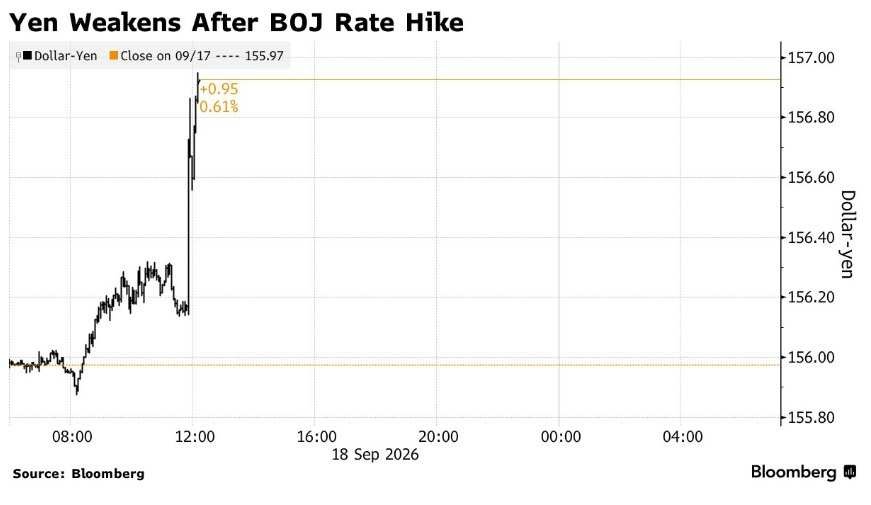
Following the Bank of Japan's expected interest-rate hike, the yen extended its decline against the U.S. dollar, though two dissenting policymakers voiced skepticism about the prospect of further monetary tightening. At one point, the yen fell 0.7% to 157.09 per dollar.
On September 18, the Bank of Japan followed the Federal Reserve in raising interest rates, announcing a 25-basis-point increase to 1.25%, as widely anticipated by the market. Earlier, on September 16, the Fed implemented its first rate hike in roughly three years, lifting the federal funds rate target range by 25 basis points to 3.75%–4.00%. On September 10, the European Central Bank also raised rates by 25 basis points, pushing the deposit facility rate to 2.50%. Meanwhile, on September 17, the Bank of England kept its policy rate unchanged at 3.75%, though three of its nine members favored a hike. These moves collectively underscore a growing consensus among central banks regarding inflation concerns, even as the pace and timing of monetary tightening remain divergent.
Following the Bank of Japan's rate hike, the yen unexpectedly weakened. The key factor is that market expectations for the magnitude of tightening had already exceeded the signals conveyed by this decision; in other words, the rate increase—already priced in—may not provide fresh upward momentum. A 25-basis-point hike had largely been factored into prices, and with two dissenting votes and the absence of new hawkish guidance, market confidence in the BOJ's ability to deliver a series of rapid policy moves has waned. Meanwhile, the Federal Reserve also raised rates by 25 basis points this week. Based on the respective policy rates, the U.S.–Japan yield spread remains at 2.50–2.75 percentage points, unchanged from before this week's rate hikes.
 If U.S. interest-rate expectations continue to rise while Japan fails to match the pace of tightening, USD/JPY could still find support. Consequently, a move toward 160 remains a conditional upside scenario flagged by strategists; precedents of joint U.S.-Japan intervention, coupled with officials' concerns about the speed of depreciation and disorderly volatility, will further weigh on investors' appetite for shorting the yen. Going forward, the market's key focus will be on shifts in both countries' future rate paths and expectations for currency‑intervention activity.
High energy prices constitute a key common backdrop to this round of policy adjustments. According to the Bank of England, Brent crude oil prices reached $106 per barrel on September 14, and the central bank cautioned that energy shocks could continue to propagate into broader price pressures. Inflation concerns and expectations of monetary tightening have also prompted a repricing of long-term bonds: on September 15, the yield on the 10-year U.S. Treasury—the "global asset‑pricing anchor"—rose as high as 5.041%, hitting its highest level since 2007; Japan's 10-year government bond yield climbed to 3.036%, a nearly 30‑year peak; and the UK's 30-year gilt yield surged to 5.96% this week, the highest since 1998. However, following the Bank of England's adjustment to its gilt‑selling program on the 17th, the 30-year UK gilt yield has since eased back to around 5.74%.
Oil prices have made this policy博弈 even more complex. On September 17, JPMorgan stated that the prolonged Iranian conflict makes it difficult to establish a clear baseline scenario for the oil market; the bank estimates Brent crude's fair value in September at around $90 per barrel, significantly below the current market price of approximately $106, which reflects concerns about further supply disruptions.
Compared with central banks in other advanced economies, the Bank of Japan appears to face a more pressing need to assess both the inflationary effects and the impact on real purchasing power stemming from rising energy prices: the longer such shocks persist, the greater the risk of spillovers to the prices of other goods and services, as well as to wages. Yet for Japan, which relies heavily on energy imports, higher import costs may also squeeze corporate profits and household disposable income. This dual‑edged dynamic helps explain why the Bank of Japan is raising interest rates while remaining cautious about the pace of future policy tightening.
The Bank of Japan's rate hike drew two dissenting votes, and the yen continued to weaken.
Following the Bank of Japan's expected rate hike, the yen extended its decline against the U.S. dollar, with two dissenting votes casting doubt on the prospect of further monetary tightening. The yen fell 0.7% to 157.09 per dollar after the central bank's decision. Although all economists surveyed by Bloomberg had anticipated this move, the vote was 7–2, with Policy Board members Toshiro Asada and Ayano Sato voting against it.
Chidu Narayanan, chief strategist for Asia-Pacific at Wells Fargo & Co., said this outcome "was not hawkish enough for the market and should push the USD/JPY higher while pushing short-term JPY yields lower." "There were two dissenting votes at this meeting, albeit from the two most dovish members of the committee, but this does not support the market's expectation that the Bank of Japan will deliver a series of rapid rate hikes."
Prior to the Bank of Japan's rate hike, the Federal Reserve's hawkish move earlier this week had already weakened the yen, partially reversing its strong gains from earlier in the month. Earlier factors that had bolstered the yen included market expectations that the Bank of Japan would accelerate its policy tightening, the unwinding of yen‑funded carry trades, and speculation that Japanese pension funds might shift more capital into domestic assets.
Traders will be watching Bank of Japan Governor Kazuo Ueda's press conference following the policy decision for clues about the pace and magnitude of further policy tightening. The conference typically begins at 3:30 p.m. Tokyo time.
Masahiko Loo, a senior fixed-income strategist at State Street Global Advisors, said: "I expect his tone to remain neutral to slightly hawkish, and he will likely emphasize that, given resilient economic growth, persistent inflation risks, and the fact that policy rates remain accommodative even at 1.25%, interest rates could be adjusted at every subsequent meeting."
Strategists say the USD/JPY could climb toward 160 if investors conclude that the Bank of Japan's pace of monetary tightening will struggle to keep up with the Federal Reserve's. Given that a 25-basis-point rate hike had already been largely priced in, this risk would be particularly pronounced if the BOJ's subsequent communications are interpreted as dovish.
The latest round of declines has once again brought the risk of intervention into sharp focus. This summer, Japan and the United States launched their first coordinated effort to buy yen since 1998. While officials have stressed the pace and disorderliness of exchange-rate movements rather than any specific level, the currency's renewed approach toward 160 could test their tolerance.
Neil Newman, Head of Strategy at Astris Advisory Japan, stated: "If the yen comes under renewed pressure and falls below 160 per U.S. dollar, we should expect Japan and the United States to intervene in the foreign-exchange market once again."
According to data from Japan's Ministry of Finance, in the month ending August 26, Japan spent a record 15.4 trillion yen—roughly $98.3 billion—on currency-market intervention. Since then, U.S. Treasury Secretary Scott Bessent has consistently signaled support for a stronger yen, which may further discourage traders from re-establishing short positions in the yen.
Following a call from U.S. Treasury Secretary Bessent, the Bank of Japan raised interest rates at the fastest pace since 1990.
The Bank of Japan raised its benchmark interest rate, accelerating the pace of rate hikes to the fastest in 36 years, in response to mounting inflation risks and an unusually clear call from Washington for further progress in policy normalization.
A statement from the Bank of Japan indicated that, at the conclusion of its two-day meeting, the bank raised its policy rate by 25 basis points to 1.25% on Friday. All economists surveyed by Bloomberg had anticipated this move. The vote was 7–2, with Policy Board members Toshiro Asada and Ayano Sato casting dissenting votes.
This move had been widely anticipated, and following its announcement, the yen weakened to 156.95 per U.S. dollar. The statement contained no clear indication that the tone had turned more hawkish, failing to bolster bets on a stronger yen.
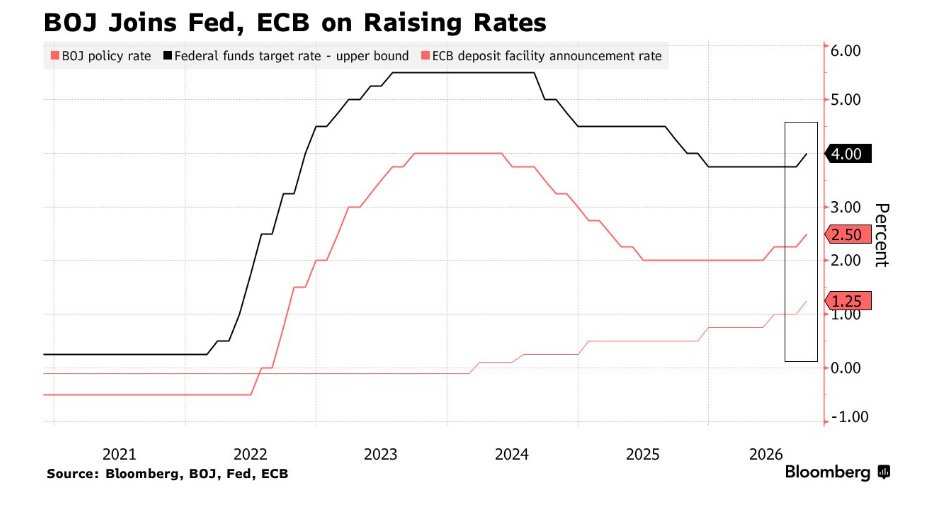
As shown in the figure above, the Bank of Japan has joined the Federal Reserve and the European Central Bank in raising interest rates.
This move comes just three months after the Bank of Japan's last rate hike, the shortest interval between two hikes since 1990. Back then, the Bank of Japan's rapid policy tightening played a key role in triggering the collapse of Japan's asset bubble. This is Kazuo Ueda's sixth rate hike during his tenure as governor, making him the Bank of Japan's governor with the most rate hikes in at least half a century. Prior to this increase, U.S. Treasury Secretary Scott Bessent had repeatedly pressed Japan to raise interest rates.
As authorities around the world grapple with the fallout from the war in Iran, the global monetary policy landscape has shifted, prompting the Bank of Japan to accelerate its pace of interest-rate hikes. On Wednesday, the Federal Reserve raised rates for the first time in three years and signaled that it may hike again later this year, underscoring this shift. Meanwhile, the European Central Bank implemented its second rate increase of the year last week.
Japan's latest interest-rate hike marks the first time that the Bank of Japan, the Federal Reserve, and the European Central Bank have all raised borrowing costs in the same month. These coordinated moves also underscore how the Bank of Japan has largely reversed its long-standing isolation from the global monetary-policy mainstream.
This rate hike came as little surprise, as a series of statements by Bessent had already helped solidify market expectations for such a move.
Although the yen weakened against the U.S. dollar shortly after the decision was announced, it remained stronger than its July levels. At the end of July, the United States and Japan conducted a coordinated intervention, helping the yen move further away from the 40-year low of 163.99 yen per dollar reached on July 23.
The Bank of Japan reiterated that it will continue raising interest rates if its outlook for the economy and prices materializes. With the policy rate now at 1.25%, it has reached the lower end of the bank's estimated neutral‑rate range for the first time. The neutral rate is defined as the level at which monetary policy neither stimulates nor restrains economic activity.
Before the Policy Board meeting convened, Bessent repeatedly voiced support for the Bank of Japan to take action, fueling expectations of a rate hike; by early September, the market had almost fully priced in such a move. According to the U.S. Treasury, during a face-to-face meeting with Kazuo Ueda in North Carolina last month, Bessent "expressed strong support" for Japan to take decisive measures to address the weakening yen.
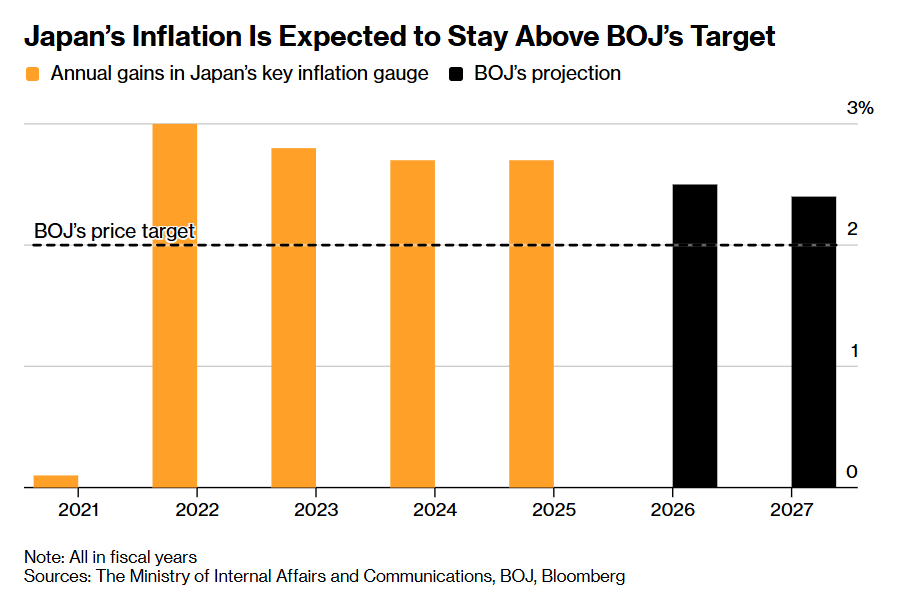
The chart above shows that the market consensus expects Japan's inflation rate to remain above the Bank of Japan's target. Note: All figures are annualized.
As of 2025, a key inflation gauge in Japan has remained above 2% for the fourth consecutive year, and the Bank of Japan expects inflation to stay above its target over the next few years. Data released earlier Friday showed that core inflation eased slightly in August, partly due to statistical distortions caused by government subsidies. Analysts forecast that by early next year, the pace of price increases will accelerate to nearly 3%.
Kazuo Ueda will explain, at a press conference that typically begins at 3:30 p.m., the rationale behind Friday's decision and the outlook for interest rates over the coming months.