
As yields climb to elevated levels, capital is flowing into the bond market at an accelerated pace; in the first eight months of this year, U.S. Treasury funds recorded net inflows of $625 billion, the highest for the same period since records began in 2010. High yields provide a safety cushion, and demographic trends are bolstering long-term allocation demand, reviving bond attractiveness. Institutional manager Riverfront says it has increased its holdings of short-term bonds and is considering further allocations to longer-term bonds, noting that current interest rates are particularly appealing to investors with heavy long-term equity positions.
The ongoing sell-off in the U.S. Treasury market is creating a rare buying opportunity.
The yield on the 10-year U.S. Treasury bond broke 5% this week, hitting a nearly three-year high, and then climbed further to its highest level since 2007 as oil prices surged. Although the Federal Reserve announced its first interest-rate hike in more than three years on Wednesday to curb inflation—briefly pushing yields back down to 4.97%—this sharp rally has already left many investors with losses across major bond indices spanning 2026 and the past five years. Meanwhile, rising long-term rates are pushing mortgage rates to over‑a‑year highs, adding pressure to the economic outlook.
 However, for investors, this bond-market sell-off also offers a glimmer of hope—a rare opportunity since the global financial crisis: locking in annualized returns of around 5% over the next decade or even longer. An increasing number of asset managers are turning this opportunity into action. According to Morningstar data, as of August this year, net inflows into U.S. bond mutual funds and exchange-traded funds totaled $625 billion, the highest level on record for the same period since 2010.
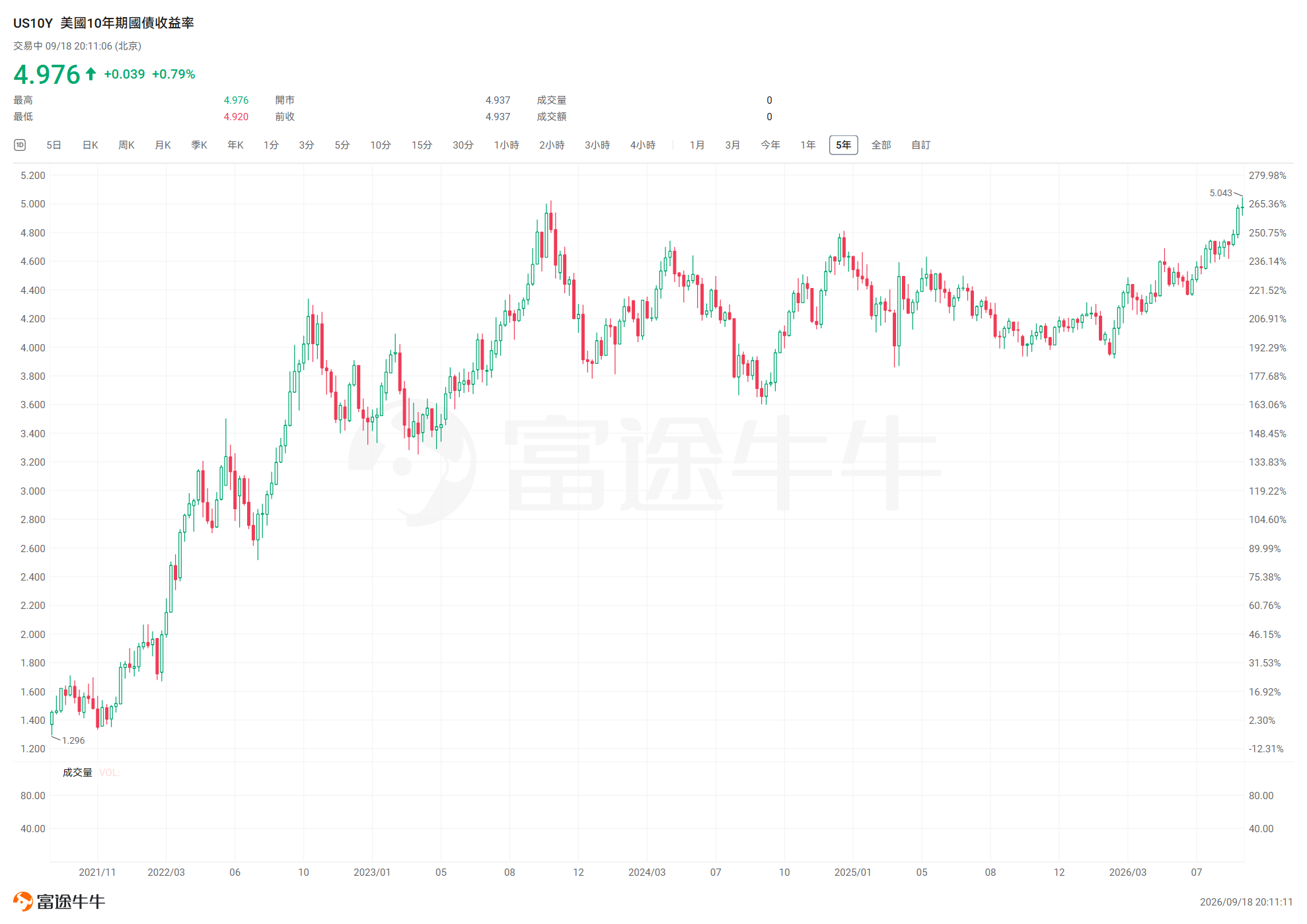
Funds have poured into the bond market, setting a record for the same period in history.
The scale of capital inflows has drawn widespread attention from the market. Both PIMCO and Vanguard Group expect that, as investors rebalance their portfolios from equities to fixed income, this pace of inflows will accelerate further.
"For investors who have been fully invested in equities for the past 15 years or even longer, these interest-rate levels are highly attractive," said Kevin Nicholson, Chief Investment Officer of Global Fixed Income at Riverfront Investment Group, which manages roughly $17 billion in assets. He added that the firm has increased its holdings of short-term bonds and is considering purchasing longer-duration securities.
Last week, both the 10-year and 30-year U.S. Treasury auctions cleared at the highest yields since 2007, yet demand remained robust—particularly for the 30-year bond, which saw a yield of around 5.31% and recorded historically strong demand. This week, when the 10-year yield broke above 5%, buying quickly reemerged and was further validated following the Federal Reserve's policy decision.
Daleep Singh, PGIM's chief global economist, said the scale of capital inflows is "absolutely encouraging," adding that "even with record‑breaking corporate bond issuance competing for the same pool of funds, Treasury bonds remain attractive at current yield levels." He also noted that market concerns about a wave of borrowing by ultra‑large AI data‑center operators driving U.S. Treasury yields higher have been among the factors prompting Treasury Secretary Scott Bessent to push for measures such as expanding repurchase agreements on long‑term bonds.
A 5% yield provides a "safety cushion," and bond math underpins the buy thesis.
This round of yield increases is not confined to the 10-year Treasury; it has spread across the entire investment-grade U.S. fixed-income market. The Bloomberg US Aggregate Index's yield-to-worst has risen from 4.15% in February—before the outbreak of the Iran conflict—to 5.3%.
This level is also becoming more attractive relative to money market funds, which averaged a yield of about 3.4% before the Federal Reserve's rate hikes. Meanwhile, the yield spread between 10-year U.S. Treasury bonds and the S&P 500's expected dividend yield for next year has risen to near the highest level in nearly two decades of Bloomberg‑compiled data.
"Bonds are back, and yields have already materialized—this is a powerful tool," said Matt Wrzesniewsky, Head of Fixed Income Portfolio Management at Vanguard. "A 5% yield is typically the level at which the market begins to truly reach consensus."
Bond math also provides support for current buyers. Michael Cudzil, a senior portfolio manager at PIMCO, notes that, given the yield levels currently generated by the U.S. Aggregate Bond Index, investors entering the market today would only begin to incur losses if yields were to rise further to around 6.2% over the next year—while the index's worst-ever yield since 2001 has never exceeded 6%. "For buyers at current levels, there remains substantial upside in yields as a buffer," he said.
Demographic shifts are driving sustained long-term demand for bond allocations.
The stock market's sustained rally is also boosting demand for bonds. According to Morningstar data, target-date funds have been increasing their bond allocations every quarter since the end of 2023—these funds gradually adopt a more conservative stance as investors approach retirement.
As the large baby-boom generation nears retirement, demand for stable investment returns is expected to persist over the long term, particularly when yields remain at elevated levels.
"We are still in a demographic cycle in which the baby-boom generation is shifting more of their assets into stable-income investments—such as bonds and high-dividend stocks—and moving away from pure growth stocks," said Shelly Antoniewicz, chief economist at the Investment Company Institute.
Of course, over the past five years, the appeal of bonds has been repeatedly touted—only to be dashed time and again by unexpectedly robust growth, inflation, and concerns about fiscal prospects. The shift in stance by Hoisington Investment Management, a long‑term U.S. Treasury bond bull, to a bearish outlook this July, is a clear reflection of these risks. Yet for investors entering the market today, the cushion provided by yields above 5% is prompting an increasing number of asset managers to reassess the value of this asset class.
Editor/joryn