
① Goldman Sachs expects that approximately 35% of the capital expenditures of the five major tech giants in 2027 will rely on debt financing; ② Global AI-related debt issuance has reached $578 billion this year, with financing entities accelerating their expansion into upstream and downstream industries; ③ The weight of AI bonds in credit indices continues to rise, and increased supply has put pressure on spreads for related investment-grade bonds.
Cailian Press, September 18 (Editor: Xia Junxiong) – On September 17, Goldman Sachs released a report raising its estimate for the global investment-grade debt issuance of the five tech giants in 2027 from approximately $400 billion to $420 billion, representing an increase of about 68% compared to the full-year forecast for 2026.
Meanwhile, since the beginning of 2026, global artificial intelligence (AI)-related debt issuance has reached $578 billion, with the tech giants accounting for only about 40% of this total.
 Goldman Sachs believes that this multi-year AI construction cycle is reshaping the global credit market. AI is no longer just a story of earnings growth discussed by equity investors; it has also become a matter of financing supply and balance sheet management that bond investors must confront.
AI Capital Expenditures Continue to Expand
This forecast covers Amazon, Alphabet, Meta, Microsoft, and Oracle. Goldman Sachs raised its debt issuance expectations primarily because capital expenditure forecasts increased following the release of the latest round of financial reports. Its assessment is that the supply-demand imbalance in AI infrastructure construction will persist, with the high-investment cycle lasting at least until the end of 2027.
Data center construction, server procurement, and computing power deployment require significant upfront capital, while revenue and cash returns materialize gradually. The time lag between investment outlays and returns makes debt an important tool for balancing funding needs.
Goldman Sachs expects that 35% of the capital expenditures of the aforementioned companies in 2027 will be supported by debt. Based on the issuance forecast of $420 billion, the capital expenditures of the five major tech giants in 2027 could reach approximately $1.2 trillion. The full-year debt issuance forecast for 2026 is $250 billion; as of September 14, $229 billion had been issued, equivalent to about 92% of the full-year forecast.
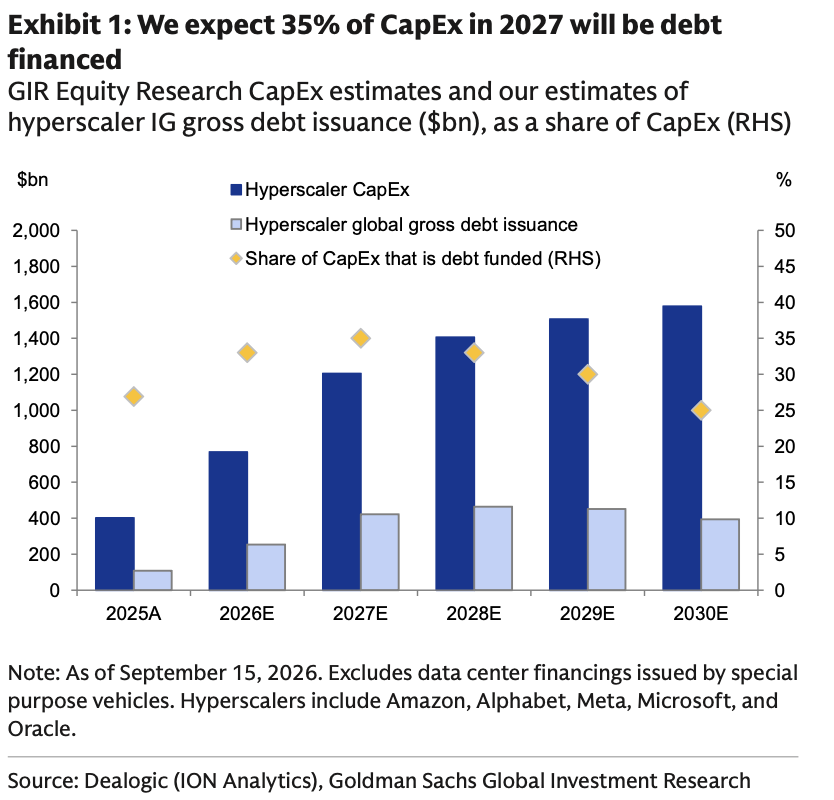
(Goldman Sachs expects that approximately 35% of the capital expenditures of the five major tech giants in 2027 will be supported by debt financing, after which this proportion will gradually decline)
However, growth in capital expenditures does not mean that debt issuance volumes will continue to rise in tandem. Charts in the report project that while capital expenditures will continue to grow until 2030, the share of debt financing will gradually decrease after 2027, reaching approximately 25% by 2030. The scale of financing also depends on the companies' internal cash generation capabilities and their financing structures.
It is important to note that the $420 billion figure does not include financing for data center and chip projects. Goldman Sachs estimates that financing in this segment will reach $300 billion by 2027. While a simple mechanical addition of these two categories would yield a total of $720 billion, this figure should not be interpreted as Goldman Sachs’ forecast for the total financing scale of the entire AI industry chain.
AI financing is no longer limited to tech giants.
According to Goldman Sachs statistics, global AI-related debt issuance reached $578 billion by mid-September 2026. Hyperscale cloud providers accounted for only about 40% of this total, with the remaining financing coming from a wide range of upstream and downstream industries, including data center projects, semiconductors, software, equipment, power, and energy.
In terms of credit market segments, approximately $490 billion originated from the global investment-grade market, while another $88 billion came from the global leveraged finance market.
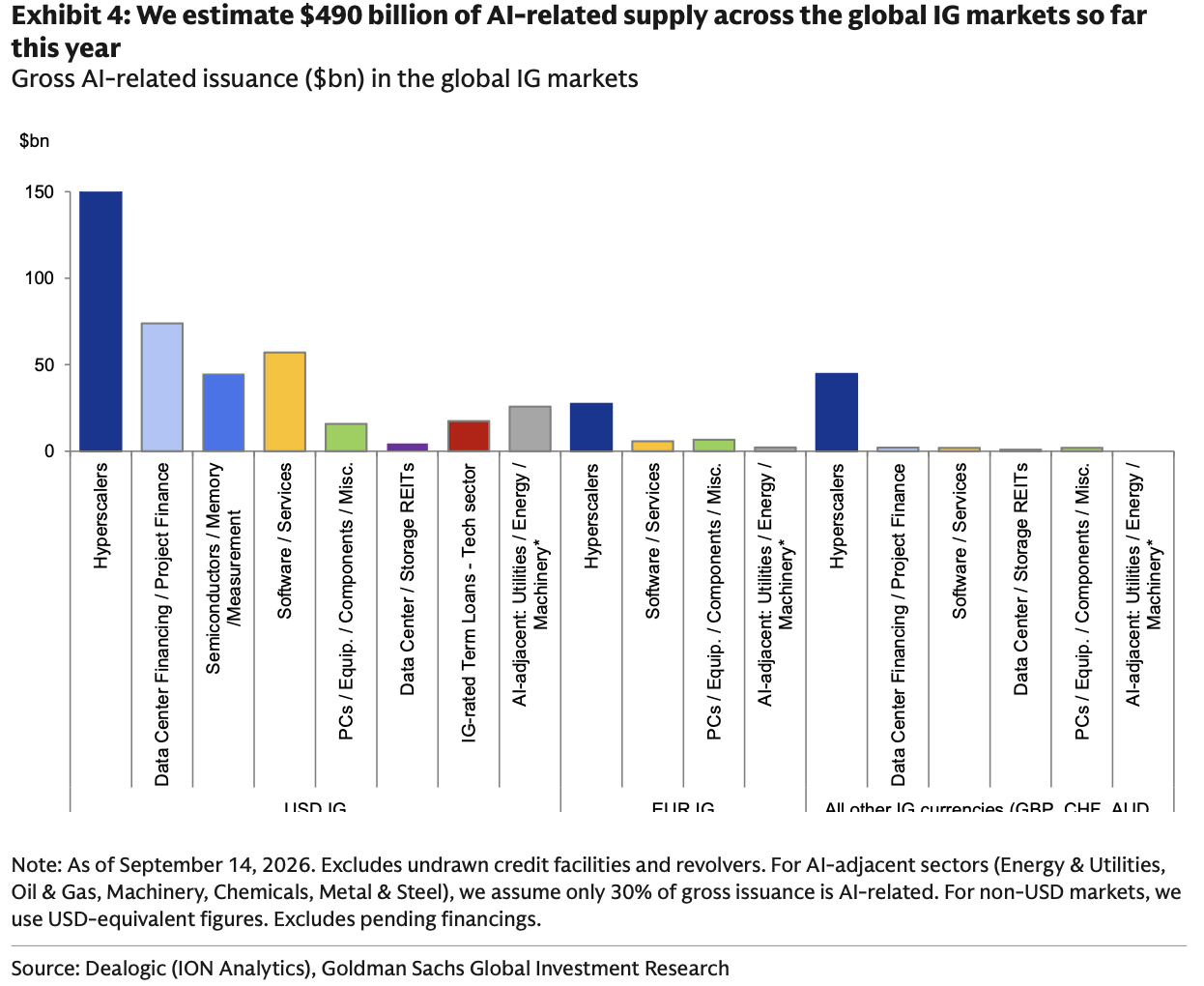
(Since 2026, AI-related debt issuance in the global investment-grade market has reached approximately $490 billion, with financing entities expanding beyond cloud computing giants to include multiple sectors such as data centers, semiconductors, software, and energy.)
Financing entities in the investment-grade market include hyperscale cloud providers, data center and project finance vehicles, semiconductor and memory companies, software and service firms, PC and equipment manufacturers, data center and storage REITs, and investment-grade term loans within the technology sector. Meanwhile, traditional industries related to AI infrastructure construction—such as utilities, energy, machinery, chemicals, and steel—are also becoming part of the financing chain.
To avoid overestimating the scale of AI financing, Goldman Sachs counts only 30% of the total issuance from these “AI-adjacent industries” toward AI-related financing, while excluding undrawn credit facilities, revolving credit lines, and incomplete financings.
This financing structure indicates that AI investment is spreading from chip and cloud computing companies to physical infrastructure.
Data centers require servers and storage equipment, as well as power, transmission networks, cooling systems, real estate, and corresponding long-term financing. As the scale of AI infrastructure expands, the capital needs of an increasing number of traditional industries will become linked to AI construction.
The US dollar market serves as the mainstay, while the euro bond market is expected to shoulder a larger share of financing in the future.
Goldman Sachs estimates that approximately 65% to 75% of the $420 billion in debt issuance by the five major tech giants in 2027 may be completed in the US dollar investment-grade bond market, equivalent to roughly $273 billion to $315 billion. The final proportion will depend on market conditions and investors' acceptance of the rising concentration of issuers.
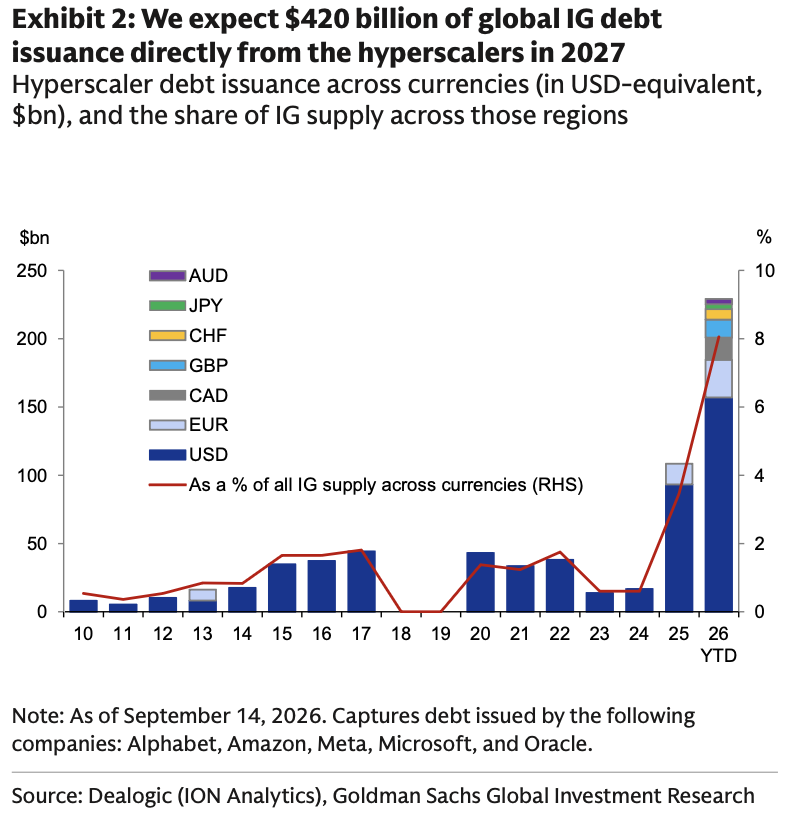
(Goldman Sachs projects that global investment-grade debt issuance by the five major tech giants will reach $420 billion in 2027, with issuance volume having accelerated significantly since 2026.)
Goldman Sachs believes that there is still significant room for expansion in the debt scales of these companies. Compared with current largest issuers in the US dollar investment-grade market, such as JPMorgan, Morgan Stanley, and Bank of America, the outstanding bond volumes of the five major tech giants that meet index inclusion criteria still have considerable scope for expansion.
Meanwhile, Goldman Sachs expects the eurobond market to assume a larger role in AI financing in the future.
Since the beginning of this year, the share of AI-related debt absorbed by the euro market has remained relatively limited. However, apart from the US dollar, the euro investment-grade bond market is one of the few globally with sufficient scale to accommodate large-scale corporate financing. In comparison, the corporate bond markets denominated in British pounds, Japanese yen, Canadian dollars, Australian dollars, and Swiss francs are significantly smaller in overall size.
In addition to traditional bonds, Goldman Sachs also predicts that convertible bonds may play a greater role in financing AI infrastructure in the future. This indicates that financing instruments for AI construction are gradually becoming more diversified.
Divergence in Performance Between AI Bonds and Non-AI Credit Bonds
Goldman Sachs has observed a clear divergence in credit spread performance between AI-related corporate bonds and other investment-grade bonds. Since 2026, spreads on AI-related US dollar investment-grade bonds have widened significantly, while non-AI bonds have remained relatively stable overall.
Performance varies across different AI subsectors. According to Goldman Sachs data, cumulative spread widening has been most pronounced for hyperscale cloud providers, followed by software companies, while hardware firms had previously demonstrated greater resilience.
However, Goldman Sachs does not believe that hardware companies will remain immune indefinitely. As shipments of computing devices grow and related financing demands expand, hardware enterprises may face more pronounced credit supply pressures in the future.
This reflects the differing perspectives of equity and bond investors regarding AI investments. Equity investors focus more on whether AI can drive revenue and profit growth, while bond investors primarily consider how capital expenditures are financed, whether companies need to increase leverage, and whether sustained large-scale bond issuance will widen credit spreads and depress relative valuations.
The share of AI-related debt in credit indices is rising rapidly.
Goldman Sachs estimates that AI-related bonds currently account for approximately 12% of the Bloomberg USD Investment Grade Corporate Bond Index and about 6% of the USD High Yield Bond Index. The proportion is relatively lower in European markets, with AI-related debt representing around 3% of the EUR Investment Grade Index and 1% of the EUR High Yield Bond Index.
For comparison, the banking sector currently accounts for approximately 22% of the USD investment-grade corporate bond market and about 31% of the EUR investment-grade corporate bond market. Therefore, while AI bonds are not yet large enough to completely dominate the entire market, their index weights still have significant room to rise if the current financing cycle persists for several years.
This also explains why pressure on AI-related bonds has not dragged down the entire USD investment-grade market.
Goldman Sachs believes that, on one hand, U.S. economic activity remains robust, corporate credit fundamentals are generally supported, and high absolute yields continue to attract yield-seeking investors. On the other hand, large sectors such as banking, energy, and healthcare have low correlation with the AI investment cycle, providing strong diversification benefits for credit indices.
Nevertheless, Goldman Sachs remains cautious about significantly increasing exposure to AI-related credit.
The firm believes that as AI infrastructure construction enters a multi-year cycle, companies may accelerate bond issuance to take advantage of more favorable financing windows once market sentiment improves and credit spreads narrow, thereby recreating supply pressure. For the financing of data centers and computing power projects, Goldman Sachs also advises investors to remain selective and focus on assessing specific project risks.
Edited by KOKO