Behind this lies a triple shock: post-holiday sell‑offs in South Korea, the early termination of Samsung and SK Hynix's largest-ever share buyback program—worth roughly $40 billion—and ChangXin Technology's announcement of a breakthrough in its 4F² architecture, which could put it two years ahead of the Korean giants in cell‑architecture innovation. The market paradox is that, despite fundamentals hitting all-time highs, stocks are being sold off, as investors have already begun pricing in the risk of a supply‑demand reversal triggered by capacity expansions expected in 2027–2028.
The storage sector is undergoing a concentrated sell-off driven by the cumulative impact of multiple pressures.$Micron Technology (MU.US)$It closed down 3.88% on Monday,$SanDisk (SNDK.US)$The decline deepened to 5.97%, with the two benchmark stocks falling for six of the past seven trading days. Micron has dropped nearly 20% from its June high, bringing it close to a technical bear market.
The trigger for this round of adjustments stems from a triple shock: the Korean market's post-holiday catch-up sell-off,$Samsung Electronics (005930.KR)$and$SK Hynix (000660.KR)$The largest share buyback program in history has been terminated ahead of schedule, and…$CXMT Corporation (688825.SH)$(CXMT) announced in Shanghai that it has made key progress on its 4F² next-generation DRAM architecture and plans to launch server memory products by year-end. Rich Privorotsky, Head of EMEA Trading at Goldman Sachs, summarized the situation as "storage remains the epicenter," directly pointing to the market's core concern: despite exceptionally strong recent fundamentals, worries about peak earnings are weighing on valuations.
 However, the market's paradox is that while the storage industry's fundamentals have never been stronger, investors are already looking ahead to 2027–2028—when China's expanding storage capacity and South Korea's new fabs come online in tandem, potentially reversing the supply‑demand dynamic. As Jon Withaar of Pictet notes, storage stocks "have become value stocks, trading at cheap valuations relative to current earnings," yet "retail investors and short‑term hedge funds are chasing growth rather than value."
The Korean market is catching up on earlier losses, as share buybacks that had been propping up prices have dried up.
South Korea's Composite Stock Price Index (KOSPI) plunged 3.65% on Monday, closing at 6,384.2 points, with the close hovering just above the 200-day moving average support level of 6,376 points. The KOSDAQ, which carries a heavier weighting in technology stocks, fell 4.8%, while the semiconductor index KRXSEMI dropped 5.2%. SK Hynix and Samsung both declined by about 4.5%, with Goldman Sachs' Seoul trading desk describing the day's performance as "a one-sided downward move from the open."
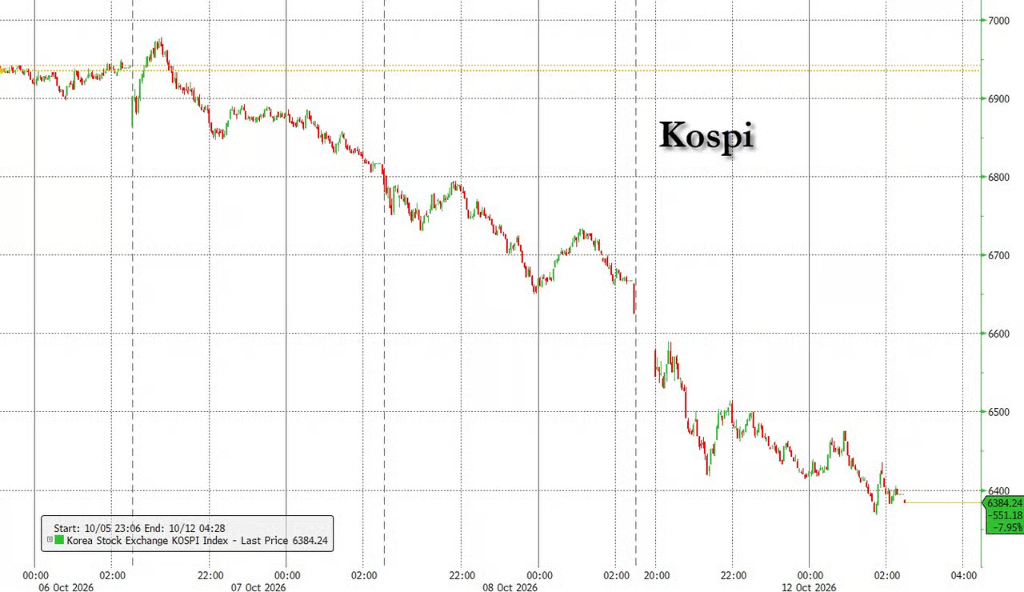
The immediate cause of this pullback is that, after the Korean market was closed for Hangeul Day, it needed to absorb the declines posted by U.S. chip stocks over the previous two trading sessions. Foreign investors recorded net sales for the fifth consecutive day, with the technology sector seeing daily net outflows totaling $1.3 billion—of which SK Hynix faced $782 million in selling pressure and Samsung saw $415 million in sell-offs. Meanwhile, retail investors bucked the trend, net-buying $710 million worth of Samsung shares; however, Goldman Sachs noted that the scale of retail net buying has been on a downward trajectory.
A deeper structural issue is the disappearance of share‑buyback support. According to earlier reports, Samsung and SK Hynix's combined buyback program—worth roughly 55 trillion won (about $40 billion), the largest in South Korean history—was wrapped up several weeks ahead of schedule, with Samsung's repurchases officially ending on October 6. In the three trading days following the conclusion of the buybacks, the KOSPI has already fallen by approximately 8%. The index is now down about 30% from its June 22 all‑time high, while SK Hynix has posted an even steeper decline of 45%.
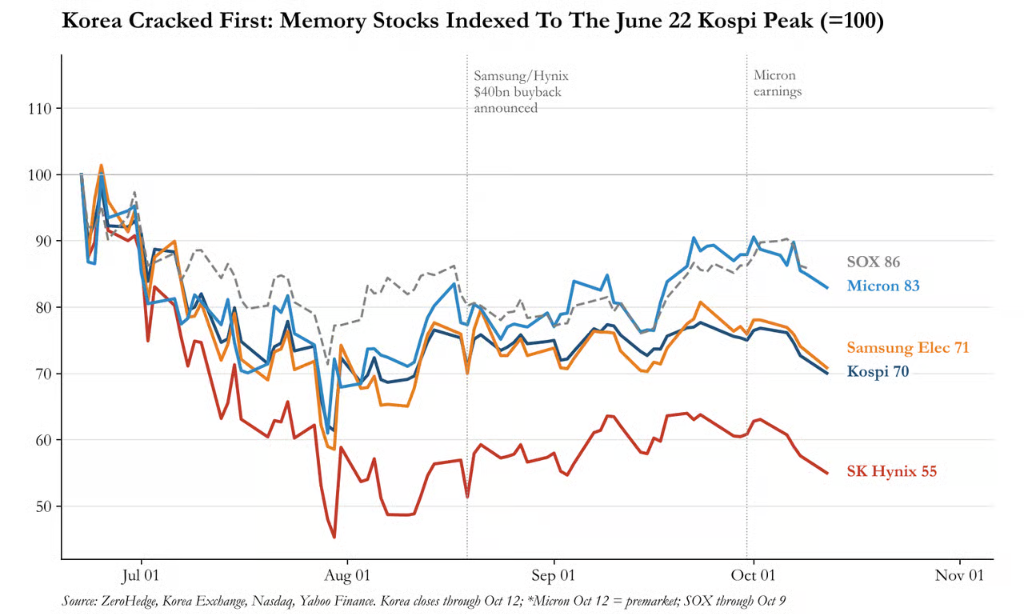
Analysts believe that the South Korean market has historically led the way during memory‑sector upcycles and has been the first to break down during downturns, suggesting it may once again serve as a leading indicator.
Changxin's 4F² breakthrough has heightened long-term concerns on the supply side.
News from Shanghai over the weekend served as a key catalyst for this round of selling. According to the Shanghai Securities News, at the Fourth Integrated Chip and Chiplet Conference held on October 9–10, Cao Kanyu, President of Changxin Technology, announced that the company has made significant progress in developing its 4F² architecture. He also officially stated that the company expects to launch, by year-end, a new generation of DDR5 RDIMM modules incorporating advanced technologies such as the 4F² architecture and hybrid bonding, targeting the server memory market directly.
The core significance of the 4F² architecture lies in its leap in density. Currently, the DRAM industry predominantly employs the 6F² architecture, where each memory cell occupies a planar area equal to six times the minimum feature size. The 4F² architecture reduces the cell footprint by roughly one-third, theoretically enabling about a 50% increase in storage density at the same wafer area and process node. The key innovation of ChangXin's 4F² architecture is its self-developed VSG (Vertical Surrounded Gate) transistor, which enhances gate control through a vertically wrapped channel structure, while simultaneously mitigating leakage and short-channel effects. Moreover, the vertical stacking of transistors further contributes to area scaling.
The transition from 6F² to 4F² represents a fundamental shift in transistor channel orientation, moving from a horizontal to a vertical architecture. This requires the integration of entirely new process flows and cannot rely on the design and manufacturing frameworks of the 6F² era. Furthermore, ChangXin has decoupled DRAM from CMOS processes and achieved high-speed interconnects through wafer-level hybrid bonding, a development regarded as a pivotal turning point marking DRAM technology's evolution from two-dimensional scaling toward three-dimensional integration.
According to reports, since its inception, ChangXin has launched research and patent‑driven development around the 4F² architecture, with more than 300 publicly disclosed patent families—a number reportedly surpassing that of its domestic and international peers. In 2021, the company published a paper on the 4F² architecture and has continued to share updates on its R&D progress in 2023 and 2025. In 2025, ChangXin also presented a paper at IEDM, detailing the successful experimental validation of DRAM–CMOS wafer‑level bonding on a 12‑inch wafer platform.
For Samsung and SK Hynix, this timeline poses direct pressure. SK Hynix did not unveil its 4F² roadmap until 2025, while, according to South Korean media The Elec, Samsung aims to achieve mass production of sub-10nm DRAM based on this architecture by 2028. If ChangXin delivers its 4F² DDR5 RDIMM products as scheduled by year-end, it will lead the two Korean giants by approximately two years at the cell‑architecture level.
Fundamentals have been strong recently, but the market has already priced in the peak.
The storage industry's current fundamentals remain robust, which is precisely where the market faces its challenge: strong earnings have already been fully priced in, and investors are beginning to discount more distant risks.
Goldman Sachs' Taipei trading desk described Taiwan-based Nanya Technology's third-quarter results as "another remarkable quarter": revenue reached NT$133.6 billion, up 62% quarter-over-quarter and a staggering 612% year-over-year; gross margin stood at 85.7%, an increase of 6.2 percentage points from the previous quarter; operating margin was 80%; and the average selling price rose by more than 60% quarter-over-quarter, with over half of this increase attributable to contract resets under long-term agreements expiring in 2025. Management expects contract prices to continue posting double-digit growth in 2027, while maintaining a gross margin above 80%, which they deem "promising."
However, Goldman Sachs's Taipei trading desk stated bluntly in its commentary: "There have been insufficient catalysts recently to drive further revaluation." Samsung's third-quarter operating profit surged nearly ninefold, which should have reignited the memory‑chip market; instead, it triggered a sell-off—this in itself reveals where market expectations currently stand.
Goldman Sachs Prime Book data show that last week, the U.S. information technology sector reversed its trend from being the most heavily net-bought sector for four of the previous five weeks to becoming the most heavily net-sold sector—marking the fastest pace of selling in seven weeks. The subsectors with the highest concentration of sell-offs were technology hardware, storage and peripherals, and semiconductors.
The pressure on storage‑sector stocks stems not from deteriorating fundamentals, but from the market's early pricing in of a cyclical peak.
Meanwhile, the market's core narrative has shifted from "how strong are the near-term fundamentals?" to "what will the supply-and-demand landscape look like in 2028?" Goldman Sachs' Korea research team outlined six key takeaways from Samsung's earnings call on October 29, with the top priority being: Will the company, like Micron, explicitly state that memory supply will tighten by 2028?
In addition, Acer CEO Jason Chen previously stated publicly that "supply shortages have completely disappeared" and predicted that memory prices would peak around mid-2027. Acer,$HP Inc (HPQ.US)$StarHub has already adopted Changxin chips in its PC products. ASML is reportedly raising spare-part prices by about 10% for its Korean customers, and Samsung and SK Hynix have accepted this price hike, which will take effect from January 2027.
This week, the market will also see several key milestones:$Taiwan Semiconductor (TSM.US)$Earnings will be released on Thursday, ASML is set to report its results on Wednesday, and SEMICON West will also take place—these events are expected to provide fresh directional signals for the semiconductor sector.
Editor/lambor