
Source: The Intelligent Investor
In March 2025, Lip-Bu Tan took over.$Intel (INTC.US)$At that time, the company was going through one of its most challenging periods since its founding.
In the previous year, Intel's stock price had fallen by about 60%, and the company posted a full-year loss of nearly $19 billion. The chip giant that once defined the PC era has clearly fallen behind in the AI wave; despite massive investments in foundry services, it has yet to prove it can become another$Taiwan Semiconductor (TSM.US)$。
 After a year and a half, the situation has already undergone noticeable changes.
In the most recent quarter, Intel's revenue grew 25% year over year to $16.1 billion, marking its fastest quarterly growth in more than 15 years; its operating margin also rebounded from -24.7% in the same period last year to 11.1%.
Meanwhile, Intel's stock price has risen from $20.68 on the day Lip-Bu Tan was appointed to $86.96 on October 23, an increase of approximately 320%.
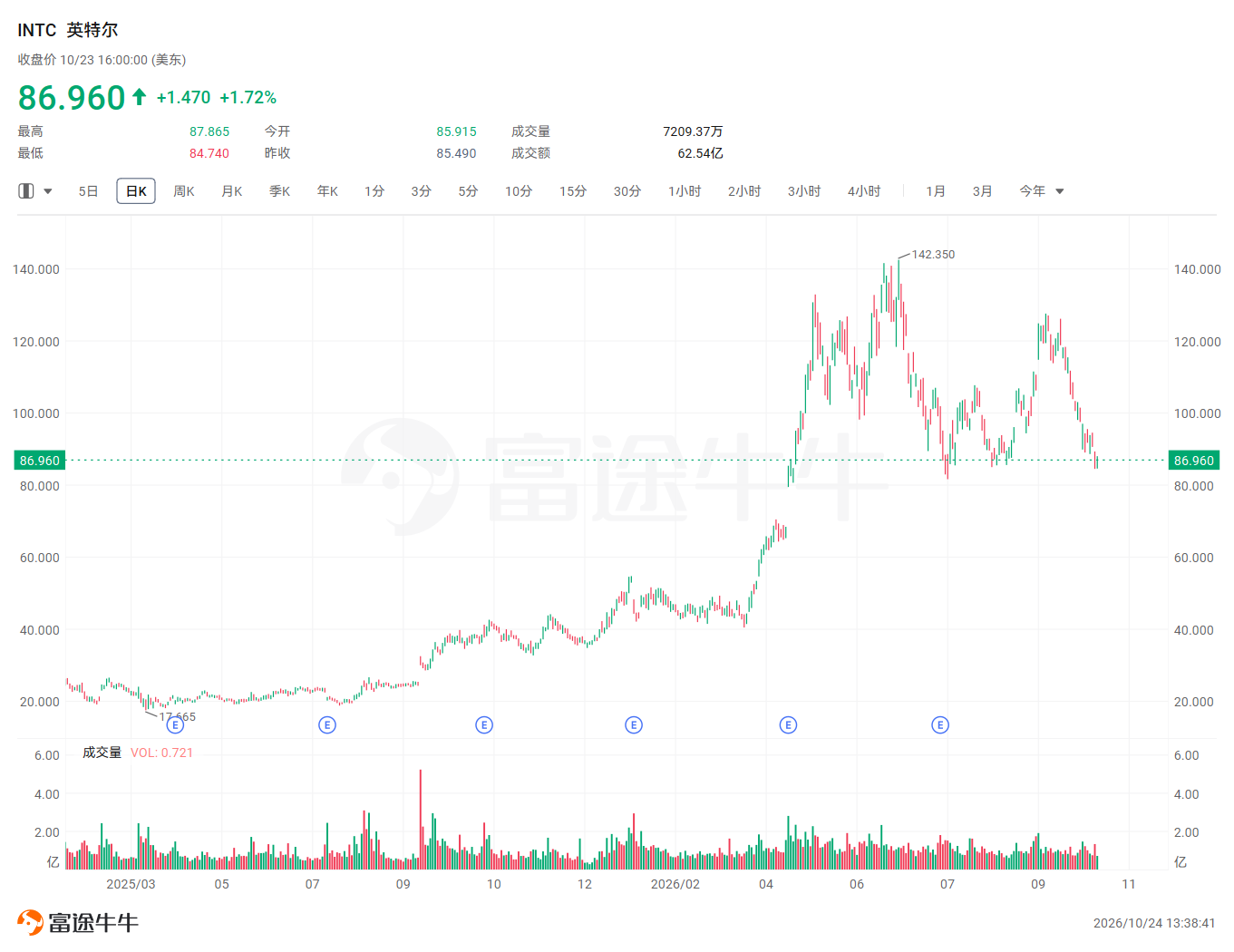
After Lip-Bu Tan took office, the U.S. government acquired approximately 9.9% of Intel's shares for $8.9 billion—judging from the details revealed in this interview, he himself was a key driving force behind the deal; SoftBank subsequently invested $2 billion,$NVIDIA (NVDA.US)$It has also invested $5 billion and launched in-depth product collaboration with Intel.
The market has begun to bet on Intel again. And Lip-Bu Tan is a figure that's hard to overlook in this shift.
The first time I introduced Lip-Bu Tan on Smart Investor, simply calling him "Intel's CEO" would hardly do justice to his true standing in the global semiconductor industry.
He is not a professional manager in the traditional sense.
He grew up in Malaysia, left home at 19, and studied nuclear engineering at MIT. He worked as a nuclear engineer, started his own business, and, after being appointed CFO, went on to pursue an MBA.
Later, he joined Walden Capital as a venture capitalist and went on to co‑found Walden International. Thereafter, for several decades, he remained at the forefront of semiconductor venture investing.
But he is by no means just an investor.
In 2009, Lip-Bu Tan assumed the position of$Cadence Design Systems (CDNS.US)$(Cadence Design Systems) CEO, who led one of the industry's most remarkable transformations, turning the company into a global leader in electronic design automation.
Upon stepping down as CEO 12 years later, Cadence's revenue had more than doubled, its profitability had improved significantly, and its stock price had accumulated a gain of over 3,200%.
In 2022, the Semiconductor Industry Association of the United States awarded the industry's highest honor, the Robert Noyce Award, to Lip-Bu Tan. The list of past recipients includes Morris Chang, Gordon Moore, Jensen Huang, Lisa Su, and a host of other figures who have defined the semiconductor industry.
The association at the time commented on Lip-Bu Tan, saying that his career had "greatly strengthened the global semiconductor ecosystem."
"Ecology" may better explain Lip-Bu Tan's standing in the industry than any other title.
So in this interview, Lip-Bu Tan's statement that he "never really sees others as competitors" is more than just a management philosophy.
Over the past four decades, he has spent much of his career shuttling between capital markets, chip design, EDA (Electronic Design Automation), manufacturing, and major customers.
Morris Chang has been a longtime friend for over 40 years, and Jensen Huang, Lisa Su, and C. C. Wei are also long-term partners.
However, after listening to the entire conversation, one realizes that this "industrial credibility" is not simply a matter of knowing many people.
When Lip-Bu Tan makes investments, the first thing he looks at is actually people.
He spends a great deal of time assessing whether a founder is honest, open to dissenting views, deeply understands the work at hand, and, when real challenges arise, can lead the team through them.
When it comes to the business itself, he places great emphasis on whether it's "important enough": whether the market is large enough, whether it addresses a genuine problem, whether the technology delivers a tenfold rather than just a twofold improvement, and ultimately, whether there are customers who are truly willing to pay.
He said that fewer than 10% of the companies he invested in ultimately failed.
Beyond professional judgment lies extraordinary diligence.
He also rarely views business as a zero-sum war: "Doing business is not a zero-sum game."
So Jensen Huang can be a competitor, or he can become a partner investing 5 billion dollars; Taiwan Semiconductor can compete with Intel in the foundry business, yet it remains an important partner as well.
And he was actually aware of Intel's issues much earlier than most people.
In 2022, Lip-Bu Tan joined Intel's Board of Directors; he resigned in August 2024. More than six months later, he returned—this time not to offer advice on the board, but to assume the role of CEO and take full responsibility for the outcomes.
What happened next was even more dramatic.
In August 2025, Trump publicly called for Lip-Bu Tan to resign; four days later, the two met at the White House; subsequently, the U.S. government became a major shareholder in Intel.
Lip-Bu Tan had discussed this matter before, but this latest conversation revealed many more personal and specific details. And the fact that he was willing to go this far also had to do with the person sitting across from him.
Jodi Shelton, host of "A Bit Personal," is the co-founder and CEO of the Global Semiconductor Alliance (GSA) and has been a firsthand witness to the global fabless industry's development for more than three decades.
More importantly, she has known Lip-Bu Tan for over 20 years.
So we heard a Lip-Bu Tan far richer than just "Intel's CEO," from his youth through his family to the pivotal moments of his career…
Throughout the entire conversation, I particularly appreciated a recurring attitude he repeatedly conveyed: do your homework thoroughly, observe people with care, and make decisions thoughtfully; respect others, and remain honest with yourself.
Then, "Keep your eyes wide open and take on the risks you've carefully considered and are willing to accept."
01. On Work Habits and Principles
Host: We've known each other for many years—at least 20, right?
Lip-Bu Tan At least. Possibly even longer.
Host: Over the years, I've seen you on the Board of Directors, and I've also watched you attend meetings with other CEOs. The two of us have had many one-on-one conversations as well. So I've formed some observations about you and would love to hear your own perspective.
First of all, you truly are a very gentle person. In every sense, you're a gentleman—reserved in speech and deeply introspective.
But at the same time, you're also a very risk-tolerant person. You invest in Venture companies, run businesses, and constantly have to make many extremely difficult decisions.
So I'm really curious—where is that Lip-Bu Tan I never see? Where has that competitive, ambitious Lip-Bu Tan, that tough boss, even that "cold-hearted manager," hidden himself?
Lip-Bu Tan I have a twin brother (laughs), just kidding.
I think this might just be my natural temperament. I grew up in Asia, so I'm usually quite quiet. I only speak when it's truly necessary.
If I have a very strong opinion about something, I'll voice my view.
But I don't feel the need to keep repeating myself, nor do I see any reason to deliberately show off. I'm usually quite quiet—only speaking up when I genuinely believe I can add some value.
As for doing business, sometimes you really do have to make some very tough decisions and weigh the trade-offs between different options.
At this point, you can only rely on your intuition and experience to tackle the issue, but I'll do my best to approach it with respect for others.
Even if you have to lay someone off, it's still the same.
When I was in venture capital, I often had to replace certain members of the founding team. Even so, you can still treat them with respect and care.
Some of the people I replaced back then are still my friends today.
Host: Really?
Lip-Bu Tan: Really. In fact, some people later came back to me, hoping I would invest in their new companies.
At least they respected my judgment, because I would explain to them why I had to do things that way, and they understood the circumstances at the time.
So I believe that, no matter who you're dealing with, you should always respect the other person.
Everyone makes mistakes, and everyone has their own weaknesses; what matters most is doing the right thing.
Host: So, do you ever get angry? Has anyone ever seen you lose your temper?
Lip-Bu Tan I rarely get angry.
But if someone betrays others or acts dishonestly, I must set things right—at the very least, the facts must be made clear. This is extremely important.
I won't do it in a confrontational or overly aggressive manner, but I will make sure to state the facts clearly.
That way, the other person can at least understand. If there's any misunderstanding along the way, just clear it up. Stay respectful and stay honest.
I think this is the best way.
Host: You're probably one of the busiest people in all of Silicon Valley. With only 24 hours in a day, how do you manage to fit so much into your schedule? Do you have any secrets?
Lip-Bu Tan My idea is actually very simple. Everyone has breakfast, lunch, and dinner, and everyone also has 24 hours in a day. God is very fair—He gives everyone the same amount of time.
Of course, I wish a day had 48 hours too. But since it only has 24, you just have to find ways to squeeze more out of your time and make yourself more efficient.
I might be a bit unusual in that I switch gears very quickly when it comes to technical matters. I can jump from one topic to a completely different one in an instant—so much so that even my wife sometimes finds it surprising.
Sometimes, when the phone rings at 2 a.m., I can immediately switch into high gear and tackle the issue right away.
I can switch quickly from one topic to another, and once I dive in, I can explore it in great depth. That's probably the result of years of practice.
In a way, I think this also has to do with my childhood.
I'm the youngest child in my family. My older siblings are incredibly disciplined. They have to excel—win all sorts of awards, study the violin and piano, and practice until they're ready to perform on stage. At the same time, their grades must be straight A's.
But the youngest one, well, sometimes they can get away with it pretty easily. (laughs)
Host: So that's how it is.
Lip-Bu Tan My mother is probably tired too, so when she gets to my place, she basically lets me do whatever I want.
That's precisely why I've developed many hobbies of my own. For example, many people don't know that I used to keep over a hundred betta fish—and I ranked them every single day. Each fish had its own name, and I watched them grow and change day by day.
So perhaps from that time on, my brain got used to processing different things quickly, jumping from one task to another.
Moreover, I'm very attuned to numbers. When others talk to me about figures, I usually pick them up quickly.
I think these things have shaped me without me even realizing it.
From this perspective, I'm truly grateful to my mother—she's the one who gave me such freedom.
02. On the Adolescent Years
Host: Before becoming the "Intel CEO Lip-Bu Tan" everyone knows today, before joining Cadence, and before venturing into venture capital, you were just a little boy growing up in Malaysia.
Do you still remember what your childhood home was like? Was there always music playing in the house? When you came home from school, was your mom there? Tell us about your life when you were little.
Lip-Bu Tan I have one older brother and three older sisters; I'm the youngest in the family.
Each of them is exceptionally accomplished. My older brother was a Rhodes Scholar, went on to become a cardiac surgeon, and earned a doctorate researching artificial hearts. My older sister is a professor at Harvard University.
They're not just good students; some of them are even concert‑level performers. That's the kind of environment I grew up in.
But maybe because I'm the youngest, I actually feel like I should just do what I enjoy—there's no need to compete with them. Of course, there's still some pressure.
My mom is very strict—she's the quintessential "tiger mom."
Later, when I hadn't finished my PhD, she even sent my older brother over just to see what was going on with me: "How come he still hasn't completed his doctorate?" (laughs)
Host: I think everyone is curious—what exactly is your mother's secret for raising such outstanding children?
Lip-Bu Tan She is very self-disciplined and sets very high standards for us.
For example, at mealtime, I had to finish everything on my plate before I could leave the table. Even today, I still carry that sense of discipline I developed as a child.
Looking back, I think this kind of upbringing was actually quite beneficial.
From a young age, we've developed a habit: if we're going to do something, we either don't do it at all or see it through to the end. When you're entrusted with a task, you focus on it, finish it properly, and only then move on to the next.
So focus, self-discipline, and seeing things through to the end have, in a sense, become habits in our family.
Host: With so many family members who can play music, your home must have had a very strong musical atmosphere when you were growing up, right? Did you often hear music playing?
Lip-Bu Tan: That's right. But when I was little, I was actually quite annoying sometimes. (laughs)
Just imagine: you're doing your homework, and there's an older sister playing the piano right beside you—though for some reason, she keeps getting stuck on the same note—and another sister is belting out an opera… There's always music filling the house.
Although I can't play myself, I served on the San Francisco Opera's Board of Directors for many years. Even today, we still love opera and music very much. Music has always been a part of our lives.
Host: If I were to ask your older siblings, "What's something about Liwu that I could never have imagined?" what would they tell me?
Lip-Bu Tan They might say that when I was little, my mother gave me far too much freedom, which is why this younger brother is especially mischievous. (laughs)
When I was very young, they all really liked me. But over time, they probably started to think, "Why is this little brother so mischievous? Mom even lets him get away with everything."
However, as we've grown older, we've come to respect one another more and more.
Host: Now let's talk about your experience leaving Malaysia. You were 19 at the time, and you left home on your own to come to the United States. That must have been quite frightening, right? Or did you feel mostly excited—finally in America, with so much more freedom? How did it feel for you back then?
Lip-Bu Tan To some extent, it's actually not that difficult.
Since my older brother went to Cambridge and all three of my older sisters have also come to the United States, it was only natural that when it was the turn of the youngest child in the family, they followed their siblings over here as well.
At the time, I applied to MIT, Stanford, UC Berkeley, and several other schools. Both Berkeley and Stanford rejected me, and only MIT extended me an offer.
At the time, my older sister and her husband even helped me write my application essays and prepared a great deal of application materials for me.
I was fortunate to eventually have the opportunity to come here. Since my older siblings had either moved to the United States or to the United Kingdom, when it was my turn to leave home and go abroad, it felt entirely natural—not to stay in Singapore.
Actually, I also had the chance to study electrical engineering, but I still believe that energy is the real big issue.
Unfortunately, my foresight was 30 years ahead of its time. (laughs)
Host: That's right—energy has indeed become a major issue.
Lip-Bu Tan So at that time, I felt the direction I should pursue was nuclear engineering, and in the end, I went to MIT to study nuclear engineering at the graduate level.
Host: I first learned that you studied nuclear engineering at a GSA Board meeting in 2011. At the time, Japan had just experienced a major earthquake, and some nuclear facilities had been damaged, so we were discussing the situation at the board meeting. Then you suddenly said, "Let me tell you about it—I studied nuclear engineering."
At that moment, I thought to myself, "He's actually a nuclear engineer too." (laughs) It felt like yet another thing you'd picked up on the fly.
Lip-Bu Tan In fact, MIT did eventually reach out to me. I am now a member of their advisory board.
Host: So, how did someone who studied nuclear engineering end up entering the semiconductor industry?
Lip-Bu Tan, when you think about it, is quite interesting.
When my older siblings were young, our parents sent them all to English‑medium schools. But by the time it was my turn, the youngest child, my mother suddenly thought, "We should still have one child who learns Chinese."
So I went to Chinese school. Later, she often felt sorry for me and would say, "Your English isn't as good as your older siblings'."
But I would tell her, that's not the case. As it turns out, learning Chinese later proved immensely helpful in my business dealings across Asia—whether in Singapore, Taiwan, or China.
Of course, at first, English was definitely one of my weak points. During my first semester at MIT, I even doubted whether I could make it, because the professors' accents were so strong that I could hardly understand a single word. (laughs)
Moreover, I made another mistake back then. Having been trained in physics, whenever I encountered a formula, I would try to derive it from scratch.
Later, a professor finally told me, "Just use the formula as it is." (laughs) Only then did I gradually get used to it.
Back then, I was juggling three sources of funding at MIT—one of which was tied to my dissertation.
There was also a professor, who happened to be a dean. Seeing that I seemed rather down on my luck, he said to me, "Liwu, I think you're quite good at computer science and also excel in math. Why don't you come help me with a project? I'll pay you."
As a result, I gained an additional source of income, and I also received a scholarship from Singapore.
That's how I learned to handle three or four things at once.
Host: Back then, when you were turned down by Berkeley and Stanford, were you disappointed? Did you ever wonder that if you'd gone to one of those schools, your life might have turned out very differently?
Lip-Bu Tan: No. MIT is a very good school, and I had a great time there. It has always been one of the best schools, and I believe that even today, its engineering program remains number one in the United States.
As for Berkeley, they seemed to take a liking to me again later on. (laughs)
My situation is rather unique: I currently serve on the advisory boards of two schools at UC Berkeley—one in the College of Engineering and the other in the College of Computing, Data Science, and Society.
In fact, I currently serve on the advisory boards of engineering schools or newly established schools of computing at five universities.
03. On Venture Capital
Host: There's something I don't think I've ever heard you talk about: how did you ultimately make the leap from MIT to venture capital? You started in venture capital very early in your career, and you've kept doing it ever since. What was the turning point that led to that shift?
Lip-Bu Tan After leaving MIT, I first joined a nuclear engineering analysis firm called EDS Nuclear, whose largest client was Bechtel.
Later, the company faced a crisis, and the root of the problem lay in the design methodology we were using: how could we demonstrate that our design was sound?
So I handled this matter together with the CEO.
I spent six months—working almost every day, every night, and every weekend—conducting extensive statistical analyses and bias assessments, ultimately demonstrating to Bechtel that our design was sound.
In a sense, you could say I saved the company. As a result, the CEO came to value me highly and later assigned me to manage projects directly from his office.
One day, three people from the company suddenly came to see me and invited me to lunch. During the meal, they started urging me to join them in starting a business.
Host: So this was your first entrepreneurial venture.
Lip-Bu Tan: That's right, that was my first entrepreneurial venture. After the company got off the ground, I was responsible for completing the technical design.
Later, the group took a look and said, "We're all in our fifties, and you're only in your twenties. So let's just assume you'll be the CFO."
I asked, "What does a CFO do?"
They said, "Keep the accounts."
I said, "What account? How do we manage it?"
One of them, Charles, said to me, "I think you really know nothing about finance."
I said, "Yeah." (laughs)
So they sent me to the University of San Francisco to pursue a part-time MBA, majoring in finance.
So I worked during the day, pursued an MBA in the evenings, and at the same time served as the company's CFO, responsible for managing the books.
That's my experience as CFO.
Later, after completing my MBA, we sold the company we had founded.
Host: What's the name of that company?
Lip-Bu Tan EcoEnergy.
After the company was sold, I decided to enter the venture capital industry. I reached out to roughly a dozen VCs, but none of them offered me a position. At the time, I was quite disappointed.
In the end, I reached out to Walden International and told them straight up: "You don't need to pay me—I'll cover my own expenses. Just give me a place where I can sit down and get some work done."
That's how I started.
Then I started doing venture capital. At first, I had about three million dollars—funds provided by family friends and my father-in-law—and I used that sum to get going.
Later, with solid investment returns, the asset management scale gradually grew to roughly $5 to $6 billion.
Host: That's amazing! And even today, you're still investing.
When many people think of venture capital, their first thoughts often turn to the financial side—spreadsheets, risk management, and the like. But once you've actually done it, you realize that, at its core, venture capital is all about working with people.
Lip-Bu Tan That's right.
Host: Over the years, you've worked with thousands of founders, giving you a unique "laboratory" that few others can access—a chance to observe people over the long term.
One could even say that, in a sense, you saved the semiconductor investment industry. For as long as 10 or even 15 years, almost no one was willing to invest in semiconductors—while Walden was among the few institutions that kept investing.
So when an entrepreneur walks into your office, what do you look at first—technology or the person?
Lip-Bu Tan At first, I mainly observed people.
You need to truly understand a person's strengths and weaknesses, assess whether they can work well as part of a team, and determine if they are honest. Some people deliberately conceal their vulnerabilities, focusing only on how accomplished they are while never addressing their shortcomings.
So you need to be able to distinguish these things.
I call it "Signal and Noise."
You need to focus on the real signals and get a clear sense of what kind of person this is. Does he listen to others' opinions? Is he honest? Does he truly understand what he's doing?
Every Venture goes through some kind of "life-or-death moment," so it also depends on whether he has enough resilience to pull through.
Moreover, can he build a strong team around himself, rather than trying to handle everything on his own?
These are all things I'll watch.
After doing it for a long time, I feel I've become fairly good at reading people.
I'm also very good at conducting due diligence. Of course, everyone will tell you how exceptional they are, but I have my own method for performing background checks.
Even if he gave me a list of references, I usually wouldn't reach out to the people on it. I have my own way of doing things.
Over the years, I've gained considerable experience and built a solid network, so I know exactly whom to approach and can verify whether that person truly lives up to their reputation.
Later, after working with many top-tier venture capitalists, I gradually came to understand one crucial lesson: the market must be large enough, and the company must have the potential to become a market leader.
So later, I would pay close attention to a few key questions: How big is this market, exactly? Who are the most critical customers?
For example, when investing in semiconductors, I always start by asking whether the technology actually addresses a real-world problem—and how significant that problem is. If it only delivers a two-fold performance boost, I'd pass; I'm looking for at least a tenfold improvement.
Then you also need to consider: who is your real customer? Who is willing to pay for your product or service?
When making semiconductor investments, I usually pay close attention to the hyperscalers—those tech giants—because they can truly help a Venture scale up.
I and$Amazon (AMZN.US)$、$Microsoft (MSFT.US)$Google has always been a very close partner, and many of them later became my good friends. So sometimes I'd just pick up the phone and ask, "Is this really what you need?" Only when it truly meets the customer's needs does the company have a real chance to grow big.
Ultimately, it also depends on the team's ability to execute—whether they can truly build the product and deliver it.
These are basically the things I pay the most attention to when I invest.
Host: So, what about today? Which technology currently fascinates you the most? For example, quantum computing—would you invest in it?
Lip-Bu Tan: Sure. I've invested in three quantum computing Ventures, and they're all doing well now.
One is IonQ, which has already gone public. There's also PsiQuantum, where I serve as a Director.
In addition, there's an Israeli company called Classiq, in which I've been an investor for quite some time.
I've been searching for truly disruptive technologies, and quantum computing is one of them. Another area I've been closely following is high-speed interconnects.
I invested in Credo Semiconductor very early on and have long been highly confident in its CEO, Bill Brennan.
Also, there is...$Astera Labs(ALAB.US)$. At that time, the four founders from$Texas Instruments (TXN.US)$(Texas Instruments, TI) came along, and I invested in them very early on together with Peng Qihua (Victor Peng, CEO of PsiQuantum).
Now I've once again shifted my focus to optical interconnects and have invested in several related companies. For example, Celestial AI—later, we sold it to Marvell. I'm also good friends with Matt at Marvell.
In addition, there is another Israeli company, Teramount Photonics, which we have just sold.
So high-speed interconnects are crucial, quantum computing is equally important, and thermal management is also essential.
New cooling technologies are now emerging, such as microfluidic cooling, a field in which I am also investing.
In addition, I've also invested heavily in software related to several cutting-edge models.
All of these will continue to drive the advancement of AI.
Another area is applying AI to healthcare. I've also invested in quite a few companies in this space.
This is also one of the reasons I joined the University of California, San Francisco (UCSF) Board of Directors; I have already invested in three companies founded by UCSF professors.
Host: So when you run into a medical issue, can you also give your brother a call and ask him? After all, he's a cardiologist.
Lip-Bu Tan sometimes does. If it happens to be in his area of expertise.
Host: Over all these years, has there been any company you didn't invest in at the time that you later came to deeply regret?
Lip-Bu Tan Of course there is.
There are a few companies that, looking back, I really wish I'd invested in.
But that's just how investing is: some opportunities, once missed, are gone for good, so you have to keep looking ahead.
Some people make money, and some lose it—that's perfectly normal.
In a sense, the venture capital business is quite simple: you invest one dollar, and if it succeeds, you could earn ten dollars—or even a hundred; if it fails, at worst, you'll just lose that one dollar.
So far, my investment track record has been quite solid, and I haven't invested in many companies that ended up failing.
Host: Approximately how much?
Lip-Bu Tan less than 10%.
04. On Leadership
Host: Let's return to the topic of "reading people." When you meet someone for the first time and chat for five or ten minutes, can you already tell whether you'd be willing to work with them?
Lip-Bu Tan Usually, before we meet, I've already done most of my homework.
I always start by reviewing his background and resume, and I also reach out to people who know him to get a sense of the situation. No matter who I'm meeting, I make sure to prepare in advance, because I believe that's a sign of respect for the other person's time.
I'm not going to just walk into the meeting room without knowing anything.
Typically, I first clarify who I'll be meeting and ask the other party to provide me with some materials in advance, so I can get a general sense of what they're working on.
A single page will do, or a few PowerPoint slides—either way is fine. I'll review everything in advance and be fully prepared. Once we meet, just go straight to the questions you're most eager to ask.
It might take half an hour, or maybe an hour—there's no need to go through the entire presentation from start to finish.
This has always been my style.
I was the same way when I ran my own company. So, before we even sat down for a meeting, I usually already knew who I'd be meeting and what questions I needed to ask.
Once the discussion is over, you'll be able to roughly determine whether or not this task should be undertaken.
Host: Do you think leaders are born, or are some people simply destined to lead while others are not? Or is leadership, in fact, something that can be developed over time?
Lip-Bu Tan I firmly believe that leadership can be developed.
Let me give you an example from my own experience.
When I was CEO of Cadence Design Systems, a coach administered the Myers–Briggs Type Indicator (MBTI) to me.
The first time I took the test, I was classified as "extremely introverted." But five years later, when I took the same test again, the result had changed to "extremely extroverted."
So people do change. You can train yourself, and you can gradually transform who you are.
When they first asked me to step in as CEO of Cadence Design Systems, I had never held the role before. But I saw that the company truly needed someone to take the lead, so I accepted the position and threw myself into it wholeheartedly.
I still remember that at the time, our HR lead, Tina, gave me three books—one of which was probably a CEO‑for‑Dummies style introductory guide.
I've read all three books, and I later found that they really do work.
Since this is my first time serving as CEO, I actually feel quite unburdened. I'm very open-minded and eager to hear others' perspectives.
Of course, I made a few mistakes at the beginning as well.
At our first all-hands meeting, I told everyone, "This is my first time serving as CEO. If you have any good ideas, please email me—I'll get back to you."
As a result, I'd receive about 200 emails a day, and I really did reply to every single one. After some employees sent me their emails, I'd even go straight over to see them in person. They were all quite taken aback—(laughs).
So sometimes, doing something for the first time can be an advantage. You don't have as many preconceived notions; you simply ask yourself: What's best for the company? Then you genuinely get to know the company and identify the problems that need to be addressed most urgently.
To be honest, when I first took over Cadence Design Systems, I knew almost nothing about EDA.
So I just learn.
Many people in the company are especially excited, as they finally have the chance to be my mentors and teach me about various EDA tools—plus, I pick up new skills quickly.
Before long, I became increasingly familiar with the industry and began to run the company in earnest, gradually turning it around.
Now that I've joined Intel, it's actually the same. You have to put in the effort, and I can say that no one works harder than I do.
Respect from others is earned bit by bit, too.
Of course, sometimes we still have to make very difficult decisions, but everyone knows that Lip-Bu Tan will always do his homework thoroughly.
I often tell them, "Let me go back and get some sleep—I'll let you know tomorrow." But in reality, I hardly slept at all that night; I kept poring over the issue. (Laughs)
Finally, I will make a decision and explain to everyone why I've made it.
At least so far, this method has worked pretty well for me.
Host: Transformations like the one you spearheaded at Cadence Design Systems back then invariably require making many tough, even unpopular, decisions. What was the most difficult decision you made there? Or, put another way, which decision ended up having the greatest long-term impact?
Lip-Bu Tan has a few things.
One of the biggest challenges was that I was living in Piedmont and had to drive to Santa Clara every day, a one-and-a-half-hour commute each way.
I've been driving for a full 15 years. That might just be the hardest part. (Laughter) In fact, later on, many of my clients came to deeply respect the dedication I've put into this.
Another truly challenging aspect is transforming a company's culture. Culture is by no means easy to change, and unfortunately, sometimes you have to replace certain members of the management team.
Such decisions are quite difficult, so before making any choice, I always do my homework as thoroughly as possible.
To be honest, during the first few months after I took over—especially the initial three weeks—I could hardly sleep at all.
Because you think about it—there are so many employees in the company, and so much responsibility rests on your shoulders—I'm especially afraid of making the wrong decision.
Later, someone gave me some very good advice—someone you're quite familiar with, Moshe Gavrielov.
He used to work at Cadence, and later became the CEO of Xilinx. At that time, I approached him, hoping to invite him to join our Board of Directors.
He said there was no way to join.
But he was truly very generous. During that period, he would spend two and a half hours every evening talking with me, walking me through the entire organization layer by layer and sharing his insights.
His most important piece of advice to me was: "If 70% of the decisions you make are right, you're already an outstanding CEO."
After listening, I said, "Wow, those words of yours have lifted more than half the burden off my shoulders."
Because I suddenly realized that you get to make your own choices. And if some of those choices turn out wrong, that's okay too.
Host: In other words, being a C‑grade student is good enough. (laughs)
Lip-Bu Tan: That's right. (laughs) That sentence ended up helping me a lot later on.
In fact, I've met a few people in my life, and they all gave me excellent advice.
When I was about to graduate with my master's degree, I also asked my professor, "Before I graduate, could you offer me a piece of advice?"
He said, "Keep your eyes open and take calculated risks." In other words, stay alert and embrace the risks you've carefully weighed and are willing to accept.
This sentence has had a profound impact on me.
Later, I went into venture capital—it was an adventure of that kind.
Taking on the role of CEO at Kaideng Electronics was also a first.
Now taking on the role of CEO at Intel is yet another challenge, and this time the risks are much greater.
Back then, many friends tried to talk me out of it, saying there was no way I could pull it off. One particularly close friend even went out of their way to persuade my wife to stop me. (laughs)
So sometimes, you just have to keep your eyes wide open, think through the risks clearly, and then decide whether you're willing to take them on.
But sometimes, you simply can't know everything. When you don't know what the future holds, you have no choice but to move forward with conviction and do your utmost to get things right—turning the company around.
This sentence has always been a great help to me.
And over the years, Mosh has also been a very important mentor to me.
I think the hardest part is actually making the decision itself. And one thing I learned at Cadence is: don't be afraid to make a choice. You won't get it right every time.
05. Regarding the succession at Intel
Host: When you first decided to take on the role of CEO at Intel, I was actually one of those who were very skeptical.
You'd only been in office for a few days when we happened to meet in Montana. I asked you straight out why—after all, your track record in Silicon Valley was virtually impeccable. Everyone backed you, and they all liked you.
But just at this moment, you took on such a job. At the time, many people even wondered whether Intel could still be turned around.
So tell me again—how did you respond to me back then? Why was this matter so important to you, so significant that you were willing to take on this challenge?
Lip-Bu Tan I have a very good friend.
When I was at Cadence, he was a very important client of mine and also an exceptionally talented chip architect.
One day, he sent me a very long text message—written beautifully. I still have it to this day.
He said, "Liwu, you've already achieved such great success at Kaideng Electronics, and you've invested in over 150 companies that later went public… Meanwhile, Intel is a landmark company. It's incredibly important to the entire industry—and to the United States as well."
"Before you retire, bring Intel back."
This sentence really touched me.
Of course, the toughest hurdle ahead is my wife.
In fact, five years ago, I was already on the shortlist for Intel's CEO position.
But that time, she said to me, "No. You've just become a grandfather for the first time. Back when your two sons were growing up, you already missed so much. Don't make the same mistake again."
That time, I took her advice, and I too felt that it really wasn't the right moment.
But five years later, the situation was different.
I have many friends who all come from Intel. Watching this company grow step by step to where it is today actually makes me feel very sad.
There's also a very close friend of mine who used to be one of my clients. Usually, I visit him once a month to hear about what's been going on in his life.
But this time, he actually came all the way to my house and talked with me for two hours. That was very unusual.
His real purpose in coming was simple: to talk me out of taking the job. But as we talked, he probably realized that I was, in fact, leaning more and more toward accepting it.
He said, "Based on what I know about you, I just want to make sure: what exactly are you hoping to achieve by taking this job?"
First of all, you already have enough money and don't need to rely on this job to make a living. So I don't think you're doing it for the money.
Moreover, you're not someone who craves power. You've always been humble, focused solely on doing things well.
Third, you've always been low-key and don't need others to pay attention to you. But once you take on this company, you'll inevitably become the center of everyone's attention. I don't think you need any of that…
He went through each item one by one with me, trying to pin down exactly what my starting point was.
Finally, he said, "I think, Liwu, you've already made up your mind. Then go ahead and do it."
So sometimes, a true friend may not immediately support you. They might even try to talk you out of it, but they'll also help you carefully work through these questions: Why do you want to do this? What's really driving you?
I still remember that conversation to this day; it was profoundly meaningful to me.
Host: Finally, your wife agreed as well.
Lip-Bu Tan: Yes. In fact, even when I was still on Intel's Board of Directors, I was already struggling greatly. I knew what problems the company was facing, but sitting on the board, there were many things I simply couldn't do.
At that time, many former executives and current employees of Intel would send me emails and text messages.
I often don't sleep well at night.
Later, my wife said to me, "I think you'd better resign from the Board of Directors. If this keeps up, it won't be good for your health either." So I resigned.
But this time, she said to me, "Liwu, I know how much you care about this company. You have my support. Since you're so determined to do it, then go ahead and do it."
So she's my final hurdle. If she says "no," I still won't take it.
Host: So when Intel officially invited you to become CEO, what kind of call was it? Were you surprised, or had you already known beforehand?
Lip-Bu Tan: Actually, it wasn't over the phone—it was a face-to-face conversation. All in all, we talked for about five months.
They'll ask me: When can you come? What conditions would make you willing to join? If you take this job, what do you plan to do? How will you turn Intel around?…
Later, President Trump asked me, in fact, the same question: "How do you plan to turn Intel around?"
I think these questions are very well asked.
Because, in the process of answering, I myself have come to understand this matter more and more clearly.
Once I've clearly defined why I'm here and what I intend to do, nothing can stand in the way of my driving these changes forward.
My starting point is actually very simple: to bring Intel back. That's my mission.
06. Regarding Trump and the government's equity stake
Host: But before we ask how you plan to save Intel, Trump once publicly posted that you shouldn't continue as Intel's CEO. So what exactly happened?
How did you feel when you first found out about this? And how did you eventually resolve it?
Lip-Bu Tan: As you know, I've made many investments in the past—both in the internet sector and in other industries.
But over time, I came to realize that, for me, the semiconductor sector offers the best investment returns. As a result, in recent years, I've increasingly focused on semiconductors.
Through EDA, by collaborating with Taiwan Semiconductor, and by maintaining long-term relationships with many leaders in the semiconductor industry, I have steadily deepened my expertise in this field.
Later on, basically whenever someone wanted to start a semiconductor business, many would come knocking on my door first—because they knew I could bring them real value.
So over the years, I've been investing globally. I've invested heavily in Israel, and I've also invested in Singapore, India, China, and Taiwan.
China is a huge market, and of course I've invested there as well. Moreover, back then, it was quite common for Silicon Valley firms to invest in China.
Do you still remember Silicon Valley Bank back then? At the time, they brought many VCs to China. By then, China had already become a critically important market for semiconductors, and everyone wanted to be there.
So I voted too.
But later, the situation changed. As China emerged as an increasingly significant competitor to the United States, these investments began to be viewed as potentially involving conflicts of interest.
Moreover, I wasn't the only one under scrutiny. At the time, four or five other large institutions and major venture capital firms had also faced similar questions.
So by the time it reached me, those past investments in China were also deemed potentially to constitute a conflict of interest. And given Intel's very close ties with the U.S. government, the matter naturally became even more sensitive.
That's why the president asked me to resign.
Host: So someone told him, "You've made numerous investments in China's semiconductor industry in the past?"
Lip-Bu Tan: That's right. Anyway, to make a long story short, he asked me to resign.
It was Thursday morning. I received many phone calls that day.
Normally, I have my own routine: before heading to work each day, I always start with a swim and a workout. But that morning, the phone rang at 5 a.m., and my entire schedule was thrown into disarray.
The first thing I did was to calm myself down.
After all, being publicly called upon to resign by the U.S. president is highly unusual.
Almost unheard of.
But I still tried to accept it as calmly as I could. Then I told myself that the most important thing was this: don't think about myself first. I never really needed this job in the first place. If everyone feels I'm not a good fit, then so be it.
So I set aside my personal gains and losses and asked myself: what is best for Intel right now?
I'm not trying to hold onto my position; what I really need to consider is how to move forward in a way that's best for Intel.
So the first thing is to clearly define how we should respond and how we should communicate.
The second—and most important—task is to find a way to meet with the president.
At the time, three or four people were a great help to me; I won't mention their names. They gave me plenty of advice and also helped arrange my meeting with President Trump.
Finally, let's meet at 4 p.m. on Monday.
I went on Monday. I first thanked him for agreeing to meet with me, and then he listened very carefully as I explained the situation. I laid out the facts for him.
I have never lived in China. I grew up in Singapore, then went to MIT from there, and later became a U.S. citizen—something I've been for over forty years now.
After listening, he understood as well. Then he began asking me about Kaideng Electronics.
So I told him the story of Cadence Design Systems and explained how I turned that company around.
He was very interested after listening.
Then he asked me, "Liwu, with Intel in such a bad state right now, how do you plan to turn things around? How long will it take?"
So I explained my plan to him. I told him it would take about two years and outlined the changes I intended to make.
He was very interested after hearing that. Then he asked me a question: "Would you be willing to let the U.S. government become a shareholder of Intel?"
I said, "That's a very good question." In fact, I'd thought about it myself before.
I told him that when Taiwan Semiconductor was first established, government funds were already involved in the investment. At that time, I was also in Taiwan, around the same period as Morris Chang.
Back then, they invited me to venture capital, and they also invited Morris Chang to enter the semiconductor industry; it was only later that Taiwan Semiconductor came into being. So Morris Chang and I have known each other for over 40 years.
Chartered Semiconductor in Singapore is a similar case, with government‑related capital serving as a major shareholder. Japan is no different—there, too, the government remains a key stakeholder.
Because semiconductors are themselves a critical infrastructure, much like roads, transportation systems, and bridges, the U.S. government must support them.
It is of paramount importance that the United States maintains its own semiconductor design and manufacturing capabilities. Moreover, as advanced process nodes progress, the challenges only intensify: moving from 1.8 nm to 1.4 nm and beyond entails ever-smaller feature sizes and increasingly sophisticated technologies.
"These capabilities must be developed in the United States, and Intel is the best platform."
I also told him, "I hope to make Intel a success. At the same time, our relationship with Taiwan Semiconductor remains very strong; we are still one of their most important customers and will continue to collaborate closely. However, the United States must have its own semiconductor manufacturing capabilities."
I think he took it to heart.
Then he said, "All right. It's Monday afternoon, and I'll make the announcement on Friday. You go talk to Howard Lutnick, the U.S. Secretary of Commerce, and Scott Bessent, the U.S. Secretary of the Treasury, and work out the plan. I'll announce it on Friday."
So over the next four days, I really worked my hardest. We had to come up with a solution that both sides could accept—one that would benefit Intel as well as the U.S. government.
Host: Indeed, it's a truly remarkable story. After all, being "fired" by the U.S. president—or at least publicly asked to resign—is an experience few can claim. So this tale is genuinely exceptional.
Lip-Bu Tan Everyone was also very surprised that things could change so dramatically in just a few days.
07. On the Mindset of Win-Win
Host: Just now you mentioned your relationship with Taiwan Semiconductor. Over the years, I've observed one thing that's particularly striking: you place great importance on your partners. It seems that wherever you go, you're making friends and constantly thinking about how to collaborate with others.
And today, in this industry, not only are collaborations among semiconductor companies on the rise, but cross-industry partnerships are becoming increasingly common as well. So I'm curious—what's your take on "partnerships"? Why are they so important to you?
If the person sitting across from you today could become your competitor next year, can you still regard them as a partner?
Lip-Bu Tan: I think this might just be my personality. I don't really see others as competitors.
Of course, I love winning. I play basketball, and I also played volleyball in college—naturally, I want to win every game.
But business isn't a zero-sum game, so you always need to find partners—no one can do everything on their own.
You need partners, and I've always cherished these collaborative relationships.
So when I first joined Intel, many people were surprised that I actually took the initiative to seek out Jensen Huang. Everyone thought he was my competitor, but we later became partners.
When I needed it, he invested 5 billion dollars, and we also began jointly advancing several R&D projects.
Similarly, many people think AMD CEO Lisa Su should be my competitor, but we are very good friends. When I was in venture capital, she even acquired three companies I had invested in.
We have always had a very good relationship and have also served together on the board of directors of the Semiconductor Industry Association in the United States.
There's also Taiwan Semiconductor. Many people think Taiwan Semiconductor should be my biggest competitor, but I don't see it that way.
Once at a VIP banquet, Taiwan Semiconductor Chairman C. C. Wei joked, "My competitor is actually sitting at my main table." I immediately corrected him: "I'm not your competitor; we're partners."
Moreover, we are indeed partners.
When Morris Chang was just starting out, I was by his side. Later, I invested in numerous fabless chip design companies.
Not long ago, when I attended Computex, I even made a point of having lunch with Morris Chang. We had a very pleasant conversation.
I told him, "You truly are a legend in this industry. If you hadn't pioneered the foundry model back then, none of the many companies I later invested in would have gone public one after another, because almost all of them are fabless."
Think about it: if every company had to build its own fab, what would happen? They simply wouldn't be able to turn a profit.
So Morris Chang's contributions to this industry are immense, and I have always held him in high regard. Even today, our relationship with Taiwan Semiconductor remains very close.
As I just mentioned, Intel remains one of Taiwan Semiconductor's top ten customers, and we will continue to collaborate with them.
Taiwan Semiconductor is the gold standard in this industry, so I have great respect for them.
Moreover, C. C. Wei sees it that way too. He told me, "With AI advancing so rapidly these days, even my own production capacity can't keep up, and I simply can't meet all my customers' needs. That's why I also hope Intel's foundry business will succeed—then we can serve our customers together."
I said, "That's wonderful. It seems we're on the same page—let's work together then."
Host: It feels like the semiconductor industry has truly become more moderate and more welcoming these days.
I remember that last year, when we had a fireside chat with Matt Murphy (Chairman and CEO of Marvell), he seemed to have said something similar. That's so different from the atmosphere when we first entered this industry.
Lip-Bu Tan: Yes, I think this is a good thing.
There's one thing about Jensen Huang that I deeply respect. He has said that he doesn't view others as competitors; instead, he strives to create his own market.
I want to do the same: identify my target market, carve out my niche, and deliver exceptional customer service.
Ultimately, we are all serving our customers.
08. On Work and Life
Host: You've been CEO of Intel for less than two years, yet you've already accomplished a great deal. For seven consecutive quarters, your performance has exceeded expectations, and your growth rate is the fastest in 15 years. In such a short time, many changes have already taken place.
But is there anything you're most proud of that you wouldn't include in an investor presentation?
Lip-Bu Tan The friend I mentioned earlier is the one who specifically came to confirm why I decided to take this job, and he also gave me some very good advice.
He said, "Liwu, this is going to be an extremely challenging job—perhaps the most demanding in the entire industry. So you must find something that inspires you and makes you smile."
To be honest, what inspires me most is seeing our customers want us to succeed. Even those whom everyone considers our competitors wish us well and are rooting for our success.
This really inspires me.
There's one more thing. As you know, I've brought some exceptionally talented people and outstanding leaders to Intel, and they all hope to see a revitalized Intel rise once again.
This also gives me a lot of encouragement, because it means I don't have to shoulder everything on my own.
In the first three months, I had to chair as many as 22 meetings in a single day—breaking my own record!
I'd have three dinners a day, and sometimes even two breakfasts. (Laughs) That was pretty much how it went back then—every spare moment was put to good use.
Things are a bit more normal now, and I know that kind of state can't last forever.
These days, I have about 10 to 12 meetings a day—no longer 22—and I finally only eat one meal in the evening, too. (laughs)
Now I can also set aside some time for my wife and do things I enjoy.
Host: Every evening when you walk through the door, who are you—your husband, your father, your grandfather? I can hardly imagine that you'd bring your identity as "Intel CEO" home with you.
Lip-Bu Tan First of all, I truly cherish my wife; she has always been very supportive of me.
This year marks our 45th wedding anniversary. She's my best friend, and she always keeps me grounded. She'll remind me, "Once you walk through that door, you're no longer the CEO—I'm the one who calls the shots."
When I get home, I can truly relax and stay in at home.
Moreover, before taking on the role of CEO, I actually sought my two sons' opinions as well. They were both very supportive. And my three grandsons are equally delighted and fully behind me.
I still make time to spend with them—watching them play soccer, taking them to Warriors games, and even going to watch the World Cup together.
I believe time should be allocated this way: work must be done well, but at the same time, one should also be a good husband, a good father, and a good grandfather. Moreover, I feel that my two sons and several grandsons would never see me as "the CEO of Intel."
To them, I'm like family, and they love spending time with me.
Like tonight, they invited me over for dinner with their grandchildren. We all really enjoy moments like these.
09. On Faith
Host: There's another fact that many people may not know: for decades, you've been an elder at a church in Berkeley. Could you tell us how important faith has been in your life? And do you think Silicon Valley harbors any misconceptions about faith—or, conversely, does the world of faith misunderstand Silicon Valley?
Lip-Bu Tan: I grew up in a Christian family, have always attended church, and have consistently studied the Bible.
It was during my high school years, when I attended a summer camp, that I truly came to know Jesus, and my faith began to take root in my life. Since then, it has remained an essential part of who I am.
Faith is, in fact, a journey that accompanies you throughout your life.
Each of us also has our own journey through life. From childhood, through high school and on to university; later, we marry, become husbands or wives, raise children, and eventually become grandparents. In the end, each of us will leave this world.
And everyone only has 24 hours in a day.
But one thing has always brought me great comfort: you are not alone—there is an Almighty God who is with you. This will give you strength, enabling you to face each day ahead.
One more thing, which is also very important to me: you need to remember that, in reality, you're only facing a single audience member. So all you have to do is simply do your daily tasks well.
Even the most ordinary, simplest tasks should be approached with sincerity, staying true to one's calling, and done with joy.
Ultimately, you only need to report to this one person.
That would bring me great comfort—especially during very difficult times, when you know you're not alone and that someone is always by your side.
So I just need to do my part. As for the final outcome, I won't worry about it too much.
That way, you won't constantly carry the pressure of the results. For example, when quarterly financial reports are released, many people get extremely anxious.
But for me, it was just a checkpoint.
What truly matters is creating value—and savoring the process of bringing something to life.
Take good care of your customers, take good care of your employees, and always be honest with everyone you interact with.
Live honestly yourself. That way, when you return home at night, you'll be able to sleep soundly and peacefully.
The next morning, you still arrive at work brimming with enthusiasm, wondering whether today you can do a little more—something that benefits the industry, your employees, your customers, and your shareholders.
I take my responsibilities to our shareholders very seriously. I will ensure that everything we do ultimately creates value for our shareholders.
This is the CEO's most important responsibility. Ultimately, you still have to get things done.
When I was captain of the basketball team, we were at the bottom of the standings when I first took over; by the time I graduated, we had already won the championship.
So I realized early on that to win, relying on just one person isn't enough; the key is to build a truly competitive team.
Later, I also discussed this issue with Shaquille O'Neal, the legendary NBA center and four-time NBA champion, as well as with Stephen Curry, the Golden State Warriors star and four-time NBA champion.
Championships are never won by a single individual. That's why I've always placed great emphasis on building a strong leadership team.
Everyone must move in the same direction, work together, and truly act as a team to get things done.
Editor/rice