Author: Zach Pandl, Head of Research at Grayscale; Compiled by: Shaw, Golden Finance
Bitcoin is a digital commodity and also a decentralized alternative to fiat currency. It is often referred to as "digital gold," and in our view, it should be valued accordingly.
However, most other crypto assets can be valued based on their cash flows (see Golden Finance's earlier article, "A Bottom‑Fishing Guide: From Narratives to Cash Flows"). In Grayscale's view, rigorous fundamental valuation methodologies will play a decisive role in the next phase of digital‑asset investing.
 On-chain applications typically feature well-defined, identifiable business models that generate fee revenue through trading, lending, and other financial activities. After accounting for supply-side costs, the remaining profits can be quantified and compared across different protocols. Much like traditional enterprises, these fundamental metrics form the foundation of digital asset valuation.
Crypto protocols employ a variety of mechanisms to return value to token holders: buybacks reduce the circulating supply, token burns permanently shrink the total supply, and staking rewards directly incentivize token holders.
Meanwhile, new token issuance and token unlocks offset the aforementioned gains through equity‑dilution effects. Consequently, understanding the relationship between capital returns and token supply is critical for assessing the economic value that each token can capture.
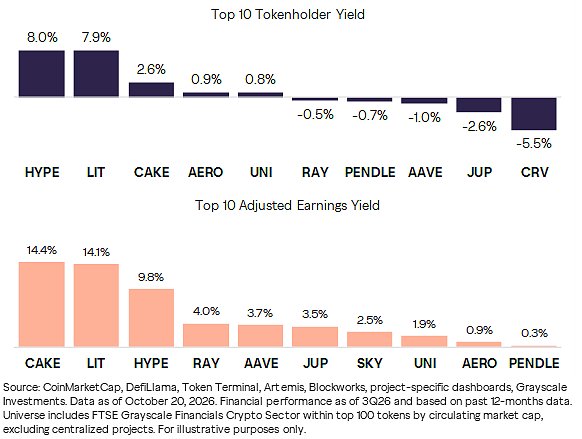
Grayscale Research assesses the economic returns for token holders using two metrics: Tokenholder Yield and Adjusted Earnings Yield.
Token holder yield reflects the distribution of returns to token holders after accounting for supply-side inflation. Token holder yield = (Staking rewards + Buybacks − Issuance) ÷ Circulating market capitalization.
The adjusted revenue yield measures the ratio of protocol revenue to market capitalization, adjusted for inflation. Adjusted revenue yield = (Total Revenue ÷ Circulating Market Capitalization) − Circulating Supply × Inflation Rate.
Combining these two metrics provides a more comprehensive picture of how on-chain protocols generate economic value and the ultimate scale of value that accrues to token holders.
Key conclusion: Cryptocurrency valuations need not rely solely on narratives. On-chain applications generate quantifiable economic value through profitability and capital returns, providing investors with a fundamental basis for valuation.
Figure 1: Token holders' returns across different protocols differ significantly from adjusted revenue yields.