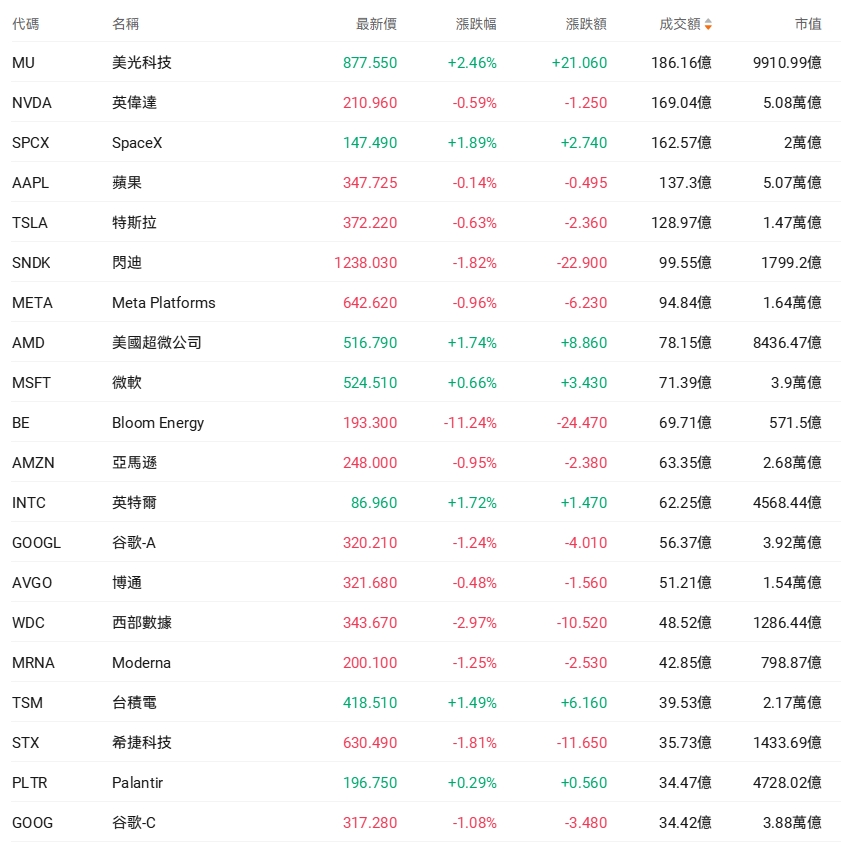
No. 1$Micron Technology (MU.US)$It closed up 2.14%, with trading volume reaching $18.616 billion.
Micron Technology will roll out a global, quarterly employee bonus tied to the company's performance starting in fiscal year 2027, Reuters reported Thursday, citing information disclosed at a press conference. The new compensation plan will be integrated into the company's existing annual incentive program, with payouts based on after-tax profits adjusted for projected capital expenditures in the next quarter and benchmarked against fiscal year 2026. According to the report, half of the payout will be made in cash upon earnings release, while the remaining portion will be paid in stock, vesting after one year.
2nd place$NVIDIA (NVDA.US)$It closed down 0.59%, with trading volume at $16.904 billion.
 On October 22, local time, during NVIDIA's GPU Technology Conference held in Berlin, Germany, when asked whether he was considering partnering with China's ChangXin Memory, NVIDIA CEO Jensen Huang responded that he was open to the idea. He stated, "We collaborate with Chinese companies; virtually the entire world is involved with Chinese firms at some point in the supply chain. China excels in foundational infrastructure technologies, and no country is stronger than China in manufacturing."
3rd place$SpaceX (SPCX.US)$It closed up 1.89%, with trading volume reaching $16.257 billion.
SpaceX enters the mobile communications sector: a hybrid approach combining satellites and terrestrial networks. At the heart of SpaceX's current talks is an effort to gain access to the U.S.'s existing cellular infrastructure, reportedly involving roughly 80,000 base stations.
This strategy means that SpaceX is not building a ground network from scratch, but rather seeks to integrate its already sizable satellite constellation with existing terrestrial base stations, leveraging a hybrid architecture to rapidly achieve nationwide coverage.
The feasibility of this approach lies in SpaceX's substantial accumulation of technology and user base in the low‑Earth‑orbit satellite communications sector. By combining this with a high‑density ground‑station network, it could, in theory, achieve competitive positioning in both urban and rural markets. For traditional operators that have long relied on heavy capital investment to maintain their network advantages, this "light‑asset entry" model poses a particularly significant threat that warrants close attention.
4th place$Apple (AAPL.US)$It closed down 0.14%, with trading volume at $13.73 billion.
Apple's first foldable-screen phone, the iPhone Duo, went on sale officially on Friday, and long lines outside stores reappeared after many years, signaling strong market demand for this device priced at over $2,000.
Supply shortages are the core issue behind this launch. Consumers who place orders on Apple's official website are currently told they won't receive their devices until as late as the end of January next year, with estimated shipping dates for some orders pushed back to November or December—setting a new record for the longest wait times for new Apple products in recent years. Meanwhile, in-store inventory is extremely limited, and many customers must register and make reservations well in advance to secure a purchase.
5th place$Tesla (TSLA.US)$It closed down 0.63%, with trading volume at $12.897 billion.
6th place$SanDisk (SNDK.US)$It closed down 1.82%, with trading volume at $9.955 billion.
7th place$Meta Platforms (META.US)$It closed down 0.96%, with trading volume at $9.484 billion.
Alexandr Wang, Meta's Chief AI Officer, told Nikkei that Meta's personal AI agent, Muse, will remain ad-free and available to ordinary users at no cost, though advanced features and enterprise services will be subject to fees. The company also plans to collect commissions on shopping transactions facilitated by the agent. Wang added that Muse can not only answer questions but also perform tasks on behalf of users, saving them time and money, making it more useful than previous AI products.
On the day Nikkei News published its report—Friday, October 23—Muse made its debut in the Japanese market. Following its launch in North America on September 8, Muse received an enthusiastic reception, with app downloads reaching 10 million within six weeks—a growth rate that outpaced some competitors, including ChatGPT.
8th place$Advanced Micro Devices (AMD.US)$It closed up 1.74%, with trading volume at $7.815 billion.
10th place$Bloom Energy (BE.US)$It closed down 11.24%, with trading volume reaching $6.971 billion.
Driven by the continued growth in power demand from artificial intelligence (AI) data centers, U.S. fuel cell manufacturer Bloom Energy (BE.US) posted strong third-quarter results, with both revenue and earnings beating Wall Street expectations. The company also raised its full-year guidance for the third time this year. Following the earnings release, Morgan Stanley and Bernstein both increased their price targets for the stock: Morgan Stanley raised its target from $310 to $335 while maintaining an "Overweight" rating, while Bernstein lifted its target from $282 to $306, keeping a "Hold" rating.
Morgan Stanley believes that Bloom Energy is continuously demonstrating its ability to scale up production and meet the power demands of AI data centers and other end markets. Bernstein, meanwhile, notes that the company has not only achieved rapid revenue growth but has also seen sustained improvements in profitability. However, as the business expands rapidly, operating cash flow and order backlog will become the key areas of focus for the market in the next phase.
11th place$Amazon (AMZN.US)$It closed down 0.95%, with trading volume at $6.335 billion.
Amazon CEO Andy Jassy said that the cost of AI inference is still about ten times higher than that of commercially available software, and he believes Amazon's in-house chips could help bring costs down. "In my view, its cost is still an order of magnitude higher, so it hasn't yet achieved the broadest possible adoption," Jassy stated in an interview with a16z published on Friday. This assessment comes as Amazon plans to invest $220 billion in capital expenditures this year, yet still struggles to build sufficient infrastructure to meet the demands of artificial intelligence.
15th place$Western Digital (WDC.US)$It closed down 2.97%, with trading volume reaching $4.852 billion.
According to Wallstreetcn, during the Q1 earnings call on October 22, Western Digital CFO Kris Sennesael stated that its hyperscale cloud‑service customers "show no signs of wavering," are continuing to ramp up capital expenditures, and are in discussions with the company regarding supply‑demand dynamics for 2030–2031.
Despite the company's quarterly results beating expectations and its upward revision of earnings guidance, a sharp increase in its capital‑expenditure plan overshadowed these positives, sparking market concerns about the sustainability of AI‑datacenter investments. On Friday, Western Digital closed down roughly 3%.
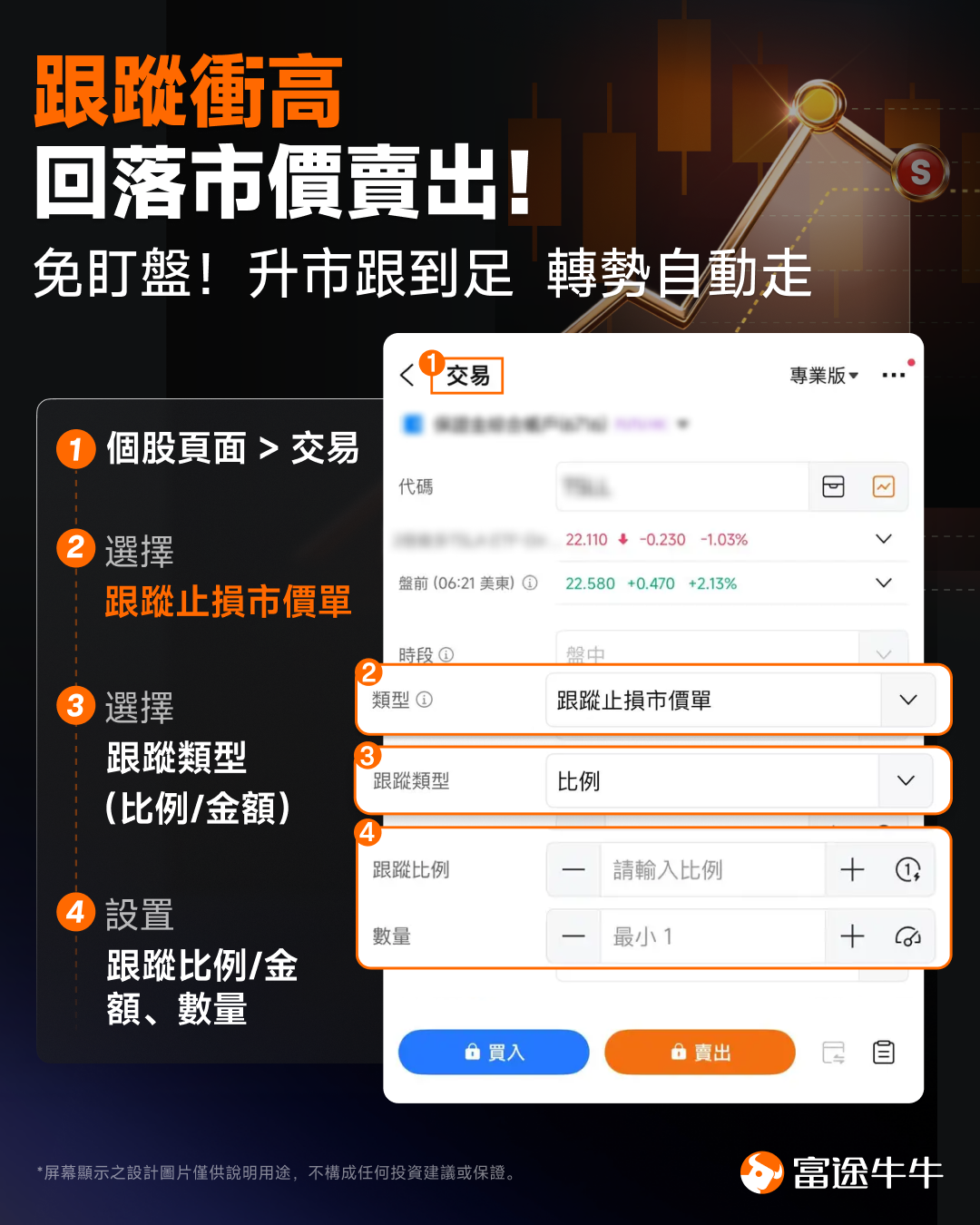
No need to watch the market—ride the rally all the way, and let the trend run on its own! Futu's trailing stop-loss market order lets you dynamically monitor stock prices based on a preset amount or percentage, helping you capture gains while managing potential pullbacks. When the price hits your stop-loss level, the system instantly places a market order to execute the trade.
Note that sharp price swings may lead to slippage; and if the trailing stop is set too tightly, you could be forced out of your position prematurely due to minor short-term volatility. Experience our trailing stop order feature now—automatically sell at the peak!
Editor/stephen