
Citadel Securities warns that the stock market sell-off signals waning investor patience with AI‑related returns, while high interest rates are making the issue of infrastructure‑investment returns even more pressing; AI‑related capital spending has become a double-edged sword. With fiscal, tariff, energy, and geopolitical pressures compounding one another, the Federal Reserve finds itself in a dilemma. The report notes that risks have long been obscured by the AI‑and‑growth narrative, leaving the market with very little room for error.
The sharp sell-off in the stock market has revealed that investors' patience with AI‑related investment returns is waning, while multiple risks—previously obscured by robust growth expectations—are now coming to the fore simultaneously.
In its latest report, Citadel Securities warns that as the logic underlying AI‑driven trading comes under strain, market tolerance for error has become extremely limited. Higher interest rates have made the question of return on investment in AI infrastructure even more pressing, while the continued expansion of investment scales renders the answers to these questions increasingly critical. The report notes that this scrutiny spans the entire value chain—ranging from improvements in client productivity and model developers' pricing power to whether infrastructure spending can adequately cover financing costs and depreciation.
 Meanwhile, mounting pressures from fiscal policy, tariffs, rising energy prices, and geopolitical tensions are compounding one another, leaving the Federal Reserve in a difficult predicament. Citadel Securities argues that these risks have long been obscured by the dominant narrative of artificial intelligence and robust economic growth; however, as market confidence in this narrative begins to waver, the cumulative strain will become increasingly hard to absorb.
AI Capital Expenditures: A Double-Edged Sword Emerges
The massive spending on AI infrastructure has evolved from a mere indicator of growth into a double-edged sword.
Take Meta as an example. In the third quarter, its revenue grew 26% year over year, yet capital expenditures—including principal payments on finance leases—totaled $34.9 billion, surpassing operating cash flow of $32.8 billion for the same period and resulting in negative free cash flow of $2.1 billion. The full-year guidance further implies that the company will invest another $49 billion to $59 billion in the fourth quarter.
Citadel Securities notes that the ultimate returns may justify these expenditures, but investors need greater confidence that the associated capacity can be financed, built, and brought to commercial operation on schedule. This gives rise to what is known as "two-sided capital‑expenditure risk": cutting spending raises doubts about the sustainability of the investment cycle, while continuing to ramp up investment subjects financing capabilities, execution, and eventual returns to scrutiny.
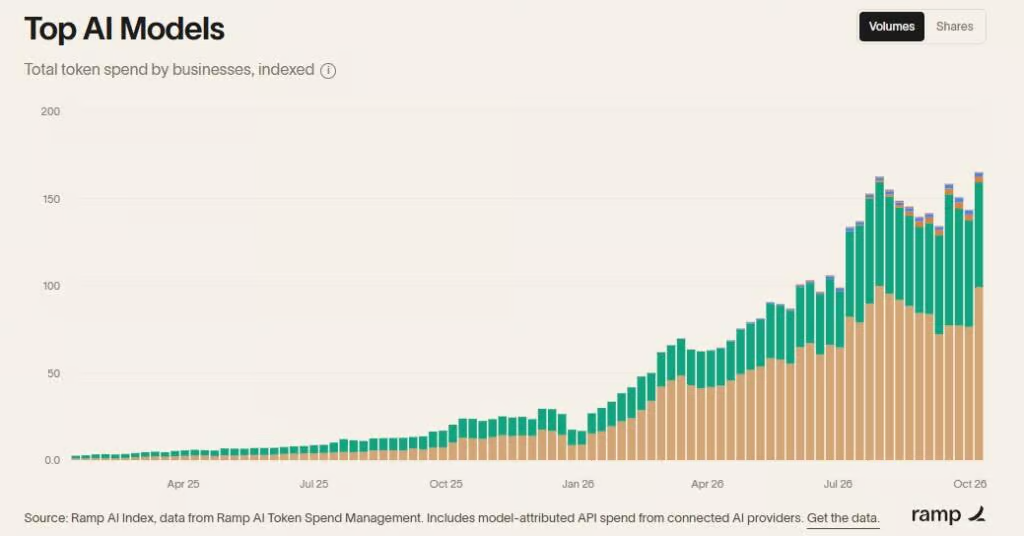
On the demand side, spending data paint a more nuanced picture. Ramp's data show that, despite continued growth in token usage, related expenditures remained virtually flat between August and September; declining prices and improved efficiency largely account for this divergence. Spending then reached a new high in early October, though the pace of growth has since slowed markedly.
DeepSeek's DeepInfer further demonstrates that software‑level optimizations can boost the effective throughput of existing hardware, thereby introducing uncertainty into the scale of incremental capacity required to meet future AI demand—even as lower inference costs encourage broader adoption.
Citadel Securities believes that more affordable smart services have enhanced client‑side economics and expanded the boundaries of viable applications; however, for vendors, profitability hinges on whether cost reductions outpace price declines and on the dynamic interplay between the resulting increase in usage and the accompanying capital investments. A successful technology can generate substantial economic value while leaving some producers with disappointing returns. This logic continues to favor diversified platforms with mature cash flows and multiple monetization pathways—though even shareholders of such platforms must distinguish between "funding the next phase of growth" and "capturing attractive returns."
Political headwinds and regulatory risks are intensifying.
The AI industry is addressing the aforementioned economic challenges with limited political goodwill.
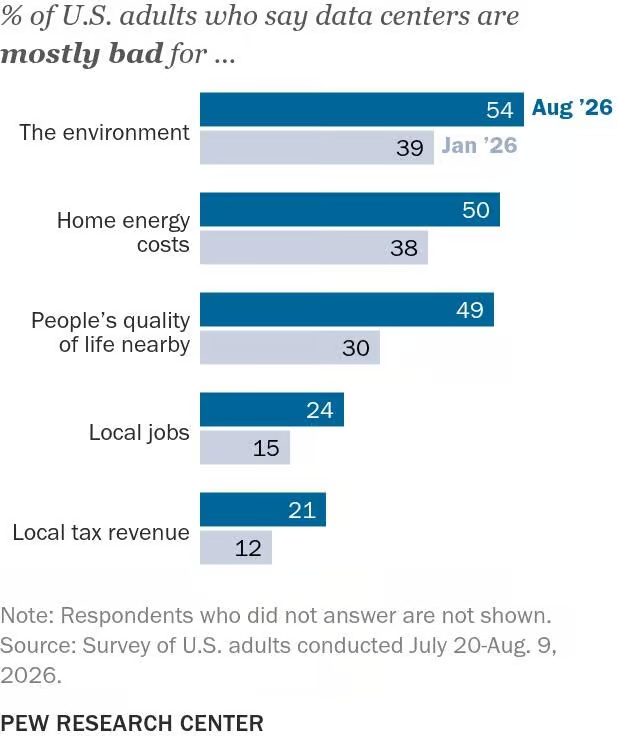
According to a Reuters/Ipsos poll this month, 69% of registered Democratic voters support restricting the construction of data centers, while among Republican voters, the figure stands at 43%, highlighting opposition that cuts across party lines. Citadel Securities notes that the November midterm elections could usher in stricter congressional scrutiny, while state and local elections directly influence project permitting and development conditions. Even without comprehensive federal restrictions, additional compliance requirements, local construction limits, and lengthy approval processes are enough to slow down and increase the cost of AI deployment. For projects financed with leverage, delays translate into higher interest expenses before revenue begins to flow, and they may face a markedly different competitive landscape by the time capacity is brought online.
This week's cybersecurity news has further heightened political risks. AI-assisted researchers have discovered a critical vulnerability in widely used PHP software that has persisted for over a decade, while, at the same time, Amazon reportedly detected attempts to exploit the flaw and warned that AI is shortening the time it takes to turn vulnerability information into usable attack tools.
Citadel Securities has voiced clear concerns: legitimate security concerns could serve as a pretext for imposing broad restrictive measures, and the economic costs of such policy responses may far outweigh the vulnerabilities they seek to address—particularly at a time when the pace of AI adoption is critical to growth prospects, thereby posing additional risks to return timelines.
With macroeconomic pressures mounting, there is little room for error left.
The aforementioned risks do not exist in isolation; rather, they arise within a policy environment that has already driven up both the cost of financing and the operational expenses of the economy.
Citadel Securities notes that pro‑cyclical fiscal easing has boosted demand and increased financing needs, while tariffs have raised costs and heightened uncertainty, jointly making it more challenging to bring inflation sustainably back to target. At the same time, although rising real interest rates partly reflect stronger growth and productive investment, the cumulative burden cannot be ignored: as debt is rolled over, higher rates will gradually pass through to a broader base of borrowers; higher input costs will squeeze profit margins or be passed on to consumers; and persistent inflation will further complicate the implementation of monetary easing.
Energy prices represent another key variable. Brent crude has risen above $117 per barrel this week, as attacks on Saudi Arabia and disruptions to shipping in the Gulf have reignited market concerns about supply interruptions—despite robust regional oil exports. Persistently high energy costs will erode purchasing power and drive up operating expenses.
Citadel Securities believes that if the AI‑driven investment slowdown coincides with an energy shock, the Federal Reserve will face a dilemma: deteriorating growth prospects coupled with persistently high inflation. Furthermore, reports suggest that post‑election military action against Iran could materialize, while a divided Congress would also constrain Washington's ability to address the fiscal trajectory.
The report concludes by noting that while the stock market's temporary pullback remains manageable, a sustained contraction in investment and financing activities would threaten the growth momentum, corporate earnings, and household wealth that have thus far underpinned the U.S. economy amid ongoing pressures. Even as Treasury yields decline, this is unlikely to provide meaningful relief to borrowers whose credit spreads have widened substantially—since risk-free rates may fall while the cost of risk‑bearing financing could rise simultaneously. These risks have been building for some time, obscured only by robust growth and the AI narrative; but as market confidence in that narrative begins to waver, and with both the economy and equity markets so heavily bet on AI‑driven trading, there is little room left for error.
Editor/Deng