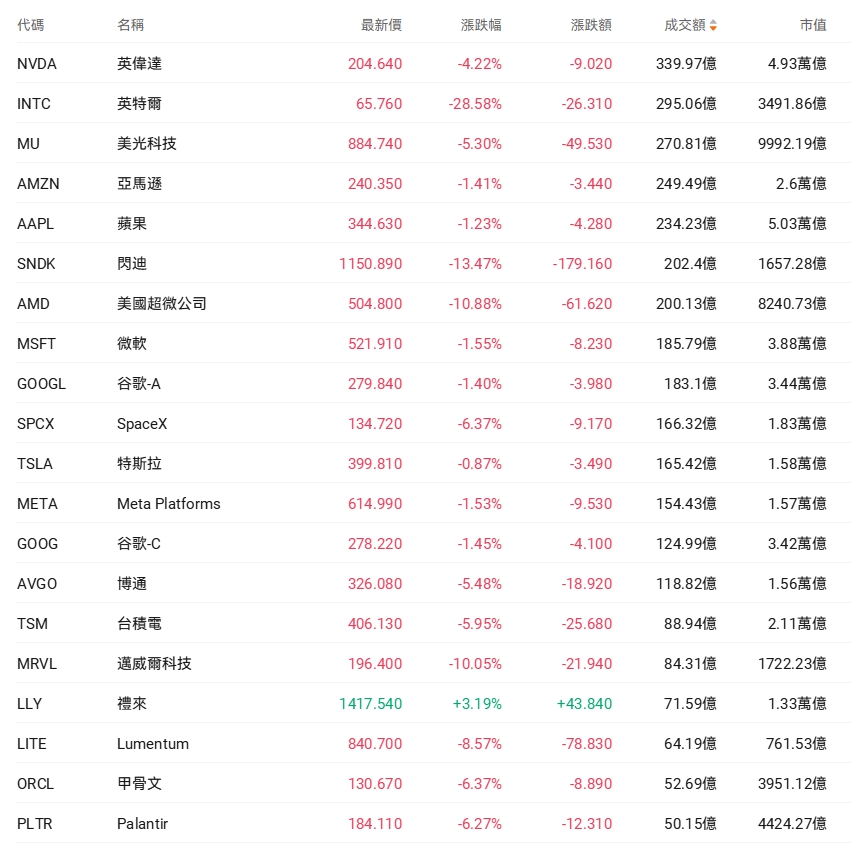
Top US stock by trading volume on Friday $NVIDIA (NVDA.US)$ Closed down 4.22%, with trading volume of $33.997 billion.
NVIDIA is in discussions with Nscale to provide over $5 billion in credit guarantees for the construction of a 460-megawatt data center facility, which will serve Anthropic. The guarantee is structured as a residual value guarantee; if Nscale defaults, NVIDIA will step in to take over the facility. This represents the latest move in NVIDIA’s series of initiatives to support the emerging cloud provider ecosystem, having provided approximately $170 billion in credit support and investments to date.
Ranking 2nd, $Intel (INTC.US)$ Closed down 28.58%, with trading volume of $29.506 billion.
 Intel reported third-quarter earnings that exceeded expectations, but its fourth-quarter guidance triggered a sharp decline in its stock price. On October 30, two investment banks downgraded their ratings for the chip giant on the same day: JPMorgan maintained a Neutral rating but lowered its target price from $85 to $80; Bank of America Securities downgraded its rating directly from Buy to Neutral and cut its target price from $145 to $100.
Intel's fourth-quarter revenue guidance is $15 billion to $16 billion (midpoint $15.5 billion), approximately 9% below the market consensus of about $17.05 billion. The guided adjusted earnings per share (EPS) is $0.25, significantly lower than the consensus range of $0.43 to $0.44.
During intraday trading in the U.S. market today, the company's shares fell by more than 30% at one point, ultimately closing down over 28%, marking the largest single-day percentage decline on record.
3rd Place $Micron Technology (MU.US)$ Closed down 5.30%, with trading volume of $17.081 billion.
4th Place $Amazon (AMZN.US)$ Closed down 1.41%, with trading volume of $24.949 billion.
As spending on AI infrastructure continues to expand and future expenditure commitments rise to $883 billion, Amazon has disclosed a supplier financing facility of up to $80 billion, providing new financial flexibility to support its continued heavy investment in AI.
According to quarterly filings submitted by Amazon to the U.S. Securities and Exchange Commission (SEC), the company retains discretion over whether to utilize this financing facility between early 2027 and the third quarter of 2028, with loans secured by certain related procurement assets. Previously, Amazon primarily relied on operating cash flows and bond issuances to fund data center construction and chip purchases. This further diversification of funding channels underscores the heightened demands that AI infrastructure expansion places on capital raising and cash flow management.
Ranked 5th $Apple (AAPL.US)$ Closed down 1.23%, with trading volume of $23.423 billion.
Apple reclaimed its title as the world's most valuable company by market capitalization on Friday, taking the top spot from NVIDIA. Amid growing concerns over artificial intelligence spending, investors sought the relative safety offered by Apple, the iPhone manufacturer. Apple's stock fell 1.2% on Friday, bringing its market capitalization down to $5.03 trillion; NVIDIA dropped 4.2%, closing with a market cap of $4.93 trillion. This marks the first time since late July, when Apple briefly surpassed NVIDIA, that it has regained the lead.
Ranked 6th $SanDisk (SNDK.US)$ Closed down 13.47%, with trading volume of $20.24 billion.
SanDisk's revenue and profit for the first fiscal quarter both exceeded market expectations, as demand for AI inference is positioning NAND flash memory at a more core infrastructure level.
After the U.S. stock market closed on October 29, SanDisk released its financial results for the first quarter of fiscal year 2027. Revenue for the first quarter ended October 2 reached $11.031 billion, up 23% quarter-on-quarter and 378% year-on-year. The non-GAAP gross margin stood at a high 85.1%, and non-GAAP diluted earnings per share (EPS) were $49.51, both exceeding the company's previous guidance. During the same period, the company generated $5.7 billion in adjusted free cash flow.
No. 8 $Microsoft (MSFT.US)$ Closed down 1.55%, with trading volume of $18.579 billion.
Backed by its rare AAA credit rating and strong financial results, Microsoft successfully completed a $25 billion bond issuance, marking one of the most sought-after transactions in the history of the U.S. corporate bond market. However, behind this盛况 (spectacle), the bond market's selective divergence regarding AI hyperscale cloud providers has become increasingly clear.
The issuance attracted peak orders exceeding $115 billion, with a subscription multiple of 4.6x. The underwriting syndicate, led by Wells Fargo & Co, JPMorgan, and UBS Group, narrowed the spread on the longest-maturity bonds by up to 30 basis points from the initial price guidance.
Ranked 12th $Meta Platforms (META.US)$ Closed down 1.53%, with trading volume of $15.443 billion.
S&P downgraded Meta's rating outlook from stable to negative, citing uncertainty over how long capital expenditures will remain elevated and how long free operating cash flow will stay negative.
S&P stated that the negative outlook reflects its expectation that if capital expenditures remain high and the monetization of AI investments is delayed or fails to materialize, the company's leverage ratio could exceed 1.0x, and free operating cash flow could remain negative for longer than anticipated.
Ranked 17th $Eli Lilly and Co (LLY.US)$ Closed up 3.19%, with trading volume of $7.159 billion.
Eli Lilly and Co released its third-quarter earnings at 10:00:00 a.m. Eastern Time on October 29, during regular trading hours. Revenue came in at $24.397 billion, exceeding the consensus estimate of $22.616 billion; adjusted earnings per share were $7.48, also surpassing the market expectation of $6.26.
Amid growing concerns over artificial intelligence spending, Eli Lilly and Co's stock continued to buck the trend and hit a new high at Friday's close.
No need to monitor the market constantly; fully capture upside trends and automatically exit when the trend reverses! Futu's trailing stop-loss market orders dynamically monitor stock prices based on preset amounts or percentages, helping you lock in gains while controlling potential pullbacks. When the price hits the stop-loss level, the system immediately executes a market order.
Please note that slippage may occur during periods of high stock price volatility. Additionally, if the trailing percentage is set too narrowly, short-term minor fluctuations may trigger premature exits. Experience the trailing stop-loss order feature now to automate selling at peak prices!

Edited by Stephen