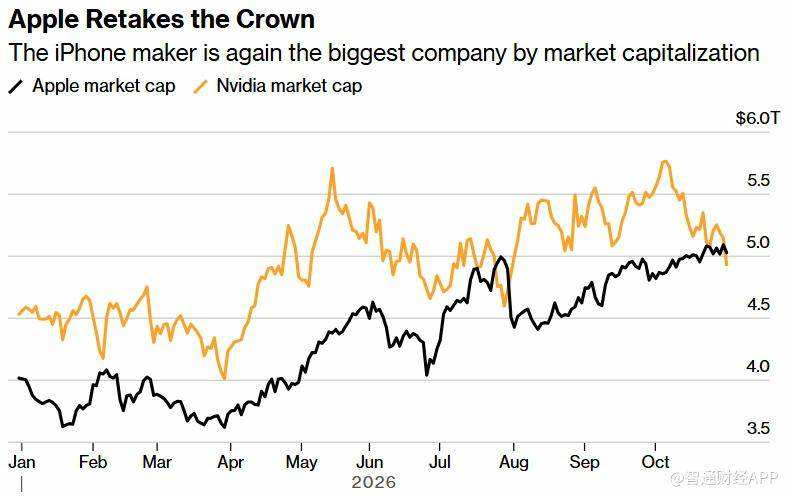
As concerns on Wall Street about the hefty returns on tech giants' massive investments in artificial intelligence (AI) continue to mount,$Apple (AAPL.US)$Surpass on Friday$NVIDIA (NVDA.US)$, once again becoming the world's most valuable publicly traded company. Amid widespread sell-offs in tech stocks, Apple has emerged as a more defensive choice for investors, thanks to its relatively restrained capital expenditures and robust cash flow.
On Friday, Apple's stock fell 1.2%, closing with a market capitalization of about $5.03 trillion; NVIDIA's shares dropped 4.2%, bringing its market cap down to $4.93 trillion. This marks the first time Apple has reclaimed the top spot on the global market-cap leaderboard since briefly surpassing NVIDIA at the end of July this year.
Behind Apple's regaining the top spot in market capitalization lies a shift in the market's attitude toward the AI investment prospects of tech giants. Recently,$Intel (INTC.US)$ 、$Amazon (AMZN.US)$、 $Alphabet-A (GOOGL.US)$and$Meta Platforms (META.US)$As major tech companies have successively released disappointing financial results or earnings guidance, investors have grown concerned about the growth prospects of the tech sector and the returns on AI investments.
 Notably, as major tech companies continue to pour substantial capital into building AI data centers and other computing infrastructure, the market is beginning to question whether these investments can generate sufficient revenue and profits within a reasonable timeframe.
Some tech giants' capital expenditures have already exceeded their operating cash flows, resulting in negative free cash flow. Both Alphabet and Amazon are experiencing this situation and are increasingly relying on the bond market to finance their investments. Meanwhile, rising interest rates are further driving up companies' financing costs.
In contrast, Apple has not made large-scale investments in AI infrastructure like other tech giants, instead maintaining a relatively restrained capital expenditure strategy. This has won it favor from investors as the market re-evaluates the risks of AI investments.
Data shows that Apple's stock has risen 27% year-to-date, making it not only the best-performing stock among the U.S. "Big Seven," but also outpacing NVIDIA, which ranks second, by more than double. Meanwhile, Apple's cash flow performance has also significantly surpassed that of some of its tech peers. The market expects Apple's free cash flow to grow 38% year over year in fiscal year 2026, which ends on September 30, reaching $142 billion.
Strong cash flow means that Apple can support its business growth and shareholder returns without resorting to large-scale borrowing, unlike some of its competitors. Against the backdrop of rising interest rates and increasing financing costs for tech companies, this advantage is attracting growing attention from investors.
As Apple regained the top spot in global market capitalization, the U.S. tech sector is undergoing a noticeable correction. Dragged down by weaker-than-expected earnings reports from major tech companies and concerns over the returns on AI investments,$NASDAQ 100 Index (.NDX.US)$In October, the cumulative decline reached 6.7%, marking the worst monthly performance since March 2025. Among them, stocks related to AI infrastructure faced particularly heavy selling pressure. Data center operators that provide AI computing services…$CoreWeave (CRWV.US)$and$NEBIUS (NBIS.US)$In October, stock prices all fell by more than 30%.
Intel's decline has been even more severe. Following a sharp plunge on Friday, the stock has posted a cumulative drop of over 45% in October, marking the largest monthly decline in more than four decades of data compiled by Bloomberg.
Overall, Apple has once again surpassed NVIDIA, reflecting a shift in how investors evaluate large tech companies. Previously, the market favored firms that aggressively invested in AI infrastructure and could capitalize on the AI boom; now, as capital expenditures continue to rise and financing costs increase, investors are placing greater emphasis on corporate cash flow, profitability, and financial stability. Against this backdrop, Apple's relatively conservative AI investment strategy has become a key differentiator from other tech giants.
Editor/Jeffy