
Author | Alan Root
Editor | Wang Mei
Weak earnings reports from tech stocks are prompting investors to pull back, so now may not be the time to be overly optimistic. However, it's also not the moment to overreact.
 $Alphabet-A (GOOGL.US)$The stock price has suffered a sharp setback. Yes, risks do exist—any company that makes substantial investments in AI development will face them. However, Barron's continues to stand by its original assessment.
The company remains an AI winner. Moreover, its stock is now astonishingly cheap, with a valuation multiple only half that of Apple, which takes a cautious stance on AI.
We first recommended Alphabet in November 2024, when the stock was trading around $168. At the time, we believed that market concerns about a potential breakup of the company and the notion that Google Search would be rendered obsolete by OpenAI's ChatGPT were overstated. For readers who followed our advice, the recommendation delivered solid returns. By November 2025, Alphabet's share price had risen to approximately $320, and we reaffirmed our stance.
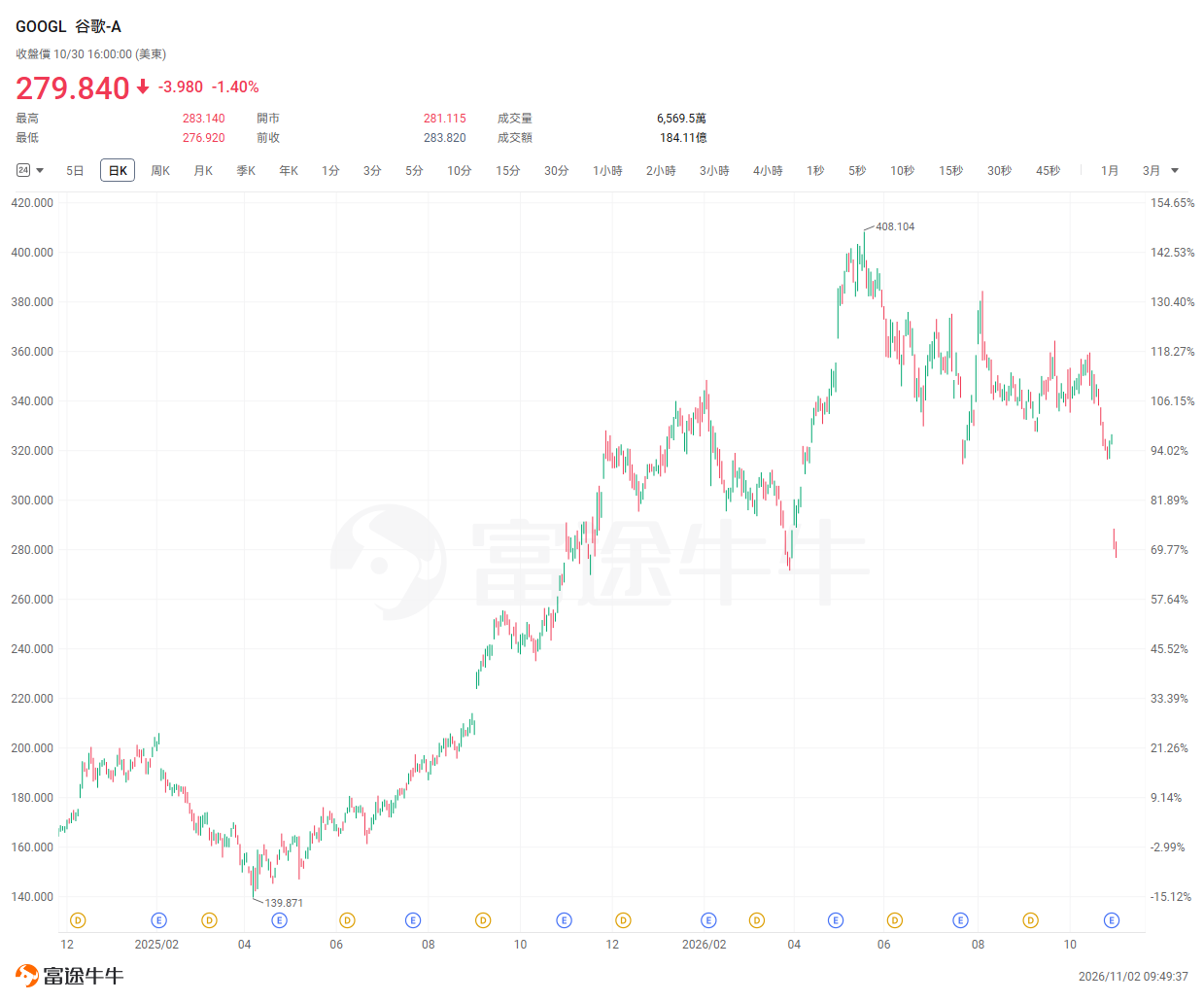
This assessment had initially seemed quite sound, until concerns about AI resurfaced in the market this summer. The iShares Semiconductor ETF peaked in June, following Broadcom's release of a disappointing earnings report that included semiconductor‑business guidance below expectations—guidance that had projected 200% year‑over‑year growth.
Around the same time, Alphabet announced a $80 billion share sale, and just days later, SpaceX raised $75 billion in its record-breaking IPO. This has sparked a host of questions: Are tech companies overextending themselves in AI? Can these investments translate into profits? And how are they financing this新一轮 of expansion?
Earlier this week, concerns reached a tipping point when Alphabet reported third-quarter results that fell short of expectations. Operating profit edged close to $41 billion, yet it rose by only 30% year over year. Where did things go wrong? Wall Street had been forecasting $43 billion.
Following the earnings release, the stock plunged nearly 13% to $282.32, bringing its year-to-date decline from the May peak of $404.47 to over 30%. A $2 billion profit shortfall wiped out $560 billion in market value in a single day.
Barron's has no intention of going against the market. However, when volatility picks up, it's crucial to maintain a clear-headed assessment. This time, the earnings miss was hardly related to AI.
Alphabet's cloud business more than doubled year over year this quarter, marking a further acceleration from the nearly 80% growth rate in the second quarter. Other vendors' cloud businesses are also posting strong growth. Amazon AWS grew 39% in the same quarter, outpacing its second-quarter growth; Microsoft Azure's cloud business expanded by 48%—also faster than in the second quarter.
These strong results came after several AI‑related policy measures were announced this week. SpaceX's AI‑related business outperformed expectations, and Anthropic's IPO filing also highlighted robust profitability.
The issue with Alphabet is that ad spending on Google Search grew by 12%, down from 17% in the previous quarter, while ad spending on YouTube increased by 9%, also lower than the 13% recorded in the prior quarter.
This gives rise to two risks.
First, this indicates that the economy is not as strong as it once was. The performance of other tech companies also confirms this. Amazon's retail business was relatively weak in the third quarter, while Intel's sharp decline was partly due to an unexpected slump in the PC market; soaring memory chip prices have also driven up the cost of PCs.
The economic outlook is a risk that all investors must keep under close watch. However, over the next few months, it will not be the primary driver of Alphabet's stock price.
The real crux lies in the second risk: self‑cannibalization. In other words, is Google's AI business undermining its search business?
Meanwhile, on Wall Street, there's no shortage of differing viewpoints. Melius analyst Ben Reitzes said Alphabet's earnings report signals a prolonged period of weakness for the company. However, most analysts remain optimistic. Citi analyst Ronald Josey stated, "The monetization of the AI (search) model has only just begun." KeyBanc Capital Markets analyst Justin Patterson described this quarter as a "short-term dip," arguing that the pressure on search monetization is merely "temporary." Deutsche Bank analyst Benjamin Black noted that AI is driving the strongest five-year growth in search query volume, and he expects Alphabet to eventually capitalize on this search‑driven growth, drawing a parallel to when Meta first launched Reels—initially, that new feature siphoned off user time from Facebook and Instagram's main feeds.
Analysts' commentary is worth considering, but valuation provides an even stronger rationale for buying.
Alphabet's forward 12-month P/E ratio is 18x, lower than$S&P 500 Index (.SPX.US)$Its price-to-earnings ratio is 19 times. Among the "Big Seven," Alphabet is the second most undervalued stock.$NVIDIA (NVDA.US)$The stock is trading at roughly a 15x price-to-earnings ratio.
In addition, Alphabet's P/E ratio has long been similar to Apple's; over the past few years, Alphabet typically traded at a 25% discount to Apple. Currently, however, Alphabet's P/E is less than half of Apple's 36x P/E, marking the largest valuation discount between the two companies in nearly five years. If it returns to its usual 25% discount level, Alphabet's stock price could rebound to $400, up nearly 50% from its recent low.
So how should we interpret the fact that free cash flow has been negative for two consecutive quarters? In reality, Alphabet is far from a struggling startup trying to turn a profit. It's ramping up its investments in AI to build a new business worth trillions of dollars. If it were to pull the plug on AI spending overnight, free cash flow would indeed rebound—but would investors really welcome that outcome? Probably not.
Copyright Notice:
This article is an original piece by Barron's. Reproduction without permission is prohibited. The English-language version appeared in the October 31, 2026 issue under the headline "Yes, Alphabet Stock Got Hammered. No, We're Not Selling." (The content of this article is for informational purposes only and does not constitute any form of investment or financial advice; markets carry risks, and investors should proceed with caution.)
Editor/Joe