
Text by Jiang Ya, Li Xin, Sheng Xia, and Xu Xiaofang.
Yang Qingpu, Zheng Yiming, Liu Jiwei, Jiang Yi
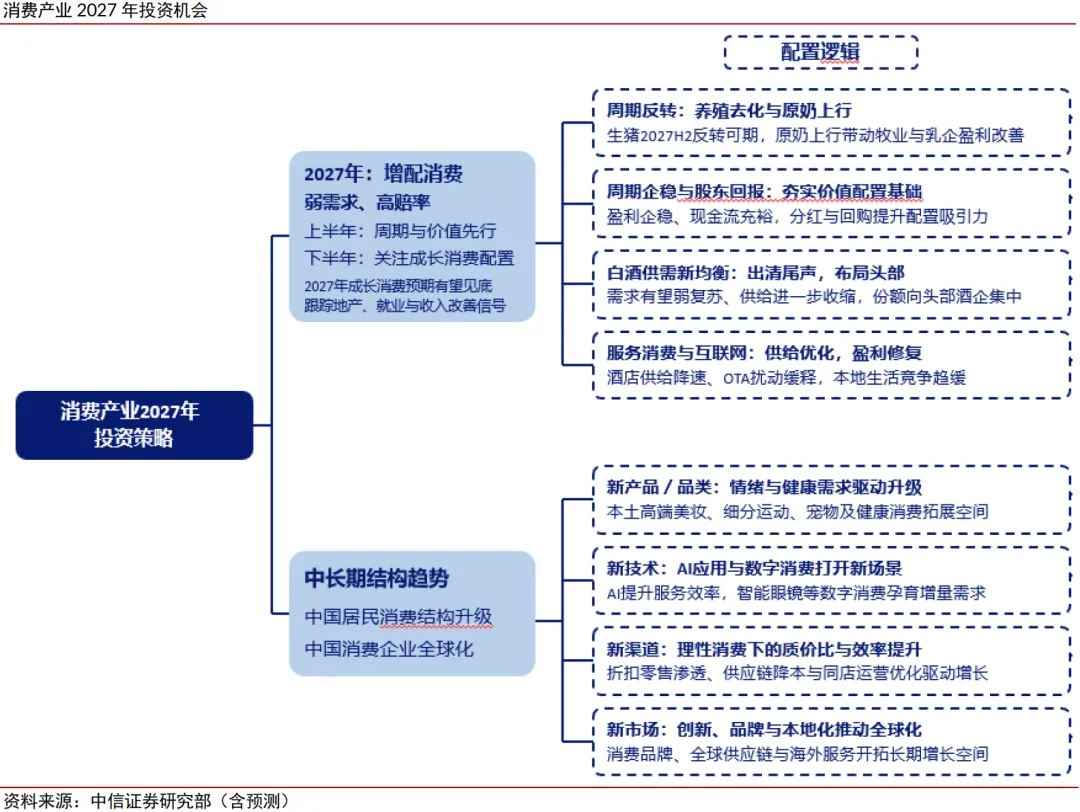
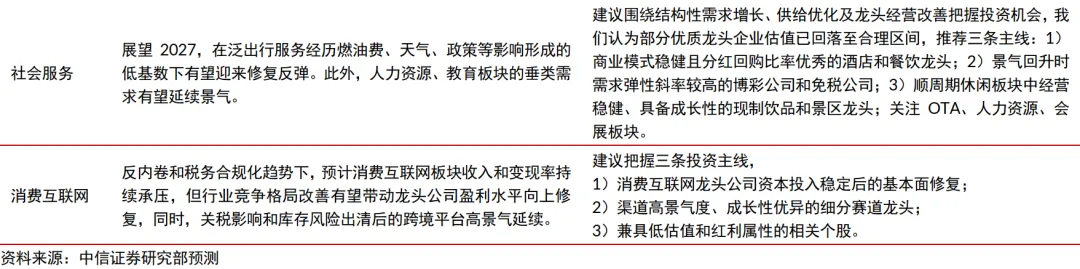
Following further adjustments since 2026, the consumer sector's pessimistic outlook has been largely priced into both valuations and portfolio allocations. Looking ahead to 2027, we maintain a neutral stance on household employment, income expectations, and the broader macroeconomic environment. However, the drag on consumer confidence from the real estate sector is expected to ease marginally, while easing industry competition and improving returns for leading‑company shareholders are providing more reliable structural support. For the consumer sector to outperform over the medium term, fundamental validation remains essential; in the near term, it offers attractive "low demand, high odds" positioning on the left side of the market. We recommend prioritizing short‑term allocation to cyclical sectors such as livestock farming, pastoral industries, and dairy products, with phased overweighting in top‑tier baijiu brands where supply‑demand dynamics may soon settle into a new equilibrium, and maintaining high‑dividend consumer leaders as core holdings. In the second half of the year, we will focus on opportunities arising once growth‑oriented consumption expectations bottom out. Over the longer term, we continue to deploy capital across new products and categories, emerging technologies, innovative distribution channels, and untapped markets.

 ▍Market Review: Weak demand and low valuations have pushed portfolio allocations to historic lows.
Since 2026, the consumer sector has significantly underperformed the market. As of Q2 2026, the proportion of consumer stocks held by domestic public mutual funds has fallen to 4.0%, with active funds holding only 2.6% in this sector. Meanwhile, northbound capital's allocation to consumer stocks has declined to 4.9%, both down nearly 90% from their historical peaks when holdings exceeded 20%. Amid ongoing adjustments, pessimistic expectations regarding the weak outlook for the consumer sector appear to have been fairly priced into both valuations and portfolio allocations.
▍Configuration Assessment: Weak demand and high odds suggest that consumer stocks offer left-side rebalancing opportunities.
Looking back at the performance of consumer stocks during previous bull markets, under conditions of ample liquidity and low valuations, strong fundamentals and earnings realization have been key drivers of the sector's upward momentum—and the primary determinants of its upside potential and resilience. Consequently, for consumer stocks to outperform over the medium term, they will need to be validated by improvements in household employment and incomes, a stabilization of asset prices, and a broader macroeconomic recovery. However, with current positioning at extremely low levels, even a modest inflow of incremental capital could trigger significant valuation repair; we recommend gradually increasing allocations on the left side of the market.
▍Demand Elasticity: For the real estate sector, "stopping the bleeding" carries more weight than "stimulus"; upward elasticity hinges on stabilizing incomes and the release of pent-up savings.
Over the past few years, the negative wealth effect stemming from falling property prices has been a key factor undermining consumer confidence among China's middle class. By 2026, some core cities have begun to show signs of localized improvement; if, in 2027, property market stabilization is accompanied by better employment prospects and rising income expectations, pent-up spending—delayed due to wealth losses and uncertainty—could be unleashed, thereby gradually easing the drag of the real estate sector on consumption. We believe this development can already serve as a positive indicator to watch.
▍Supply Optimization: Cyclical and Competitive Dynamics Are Becoming More Evident.
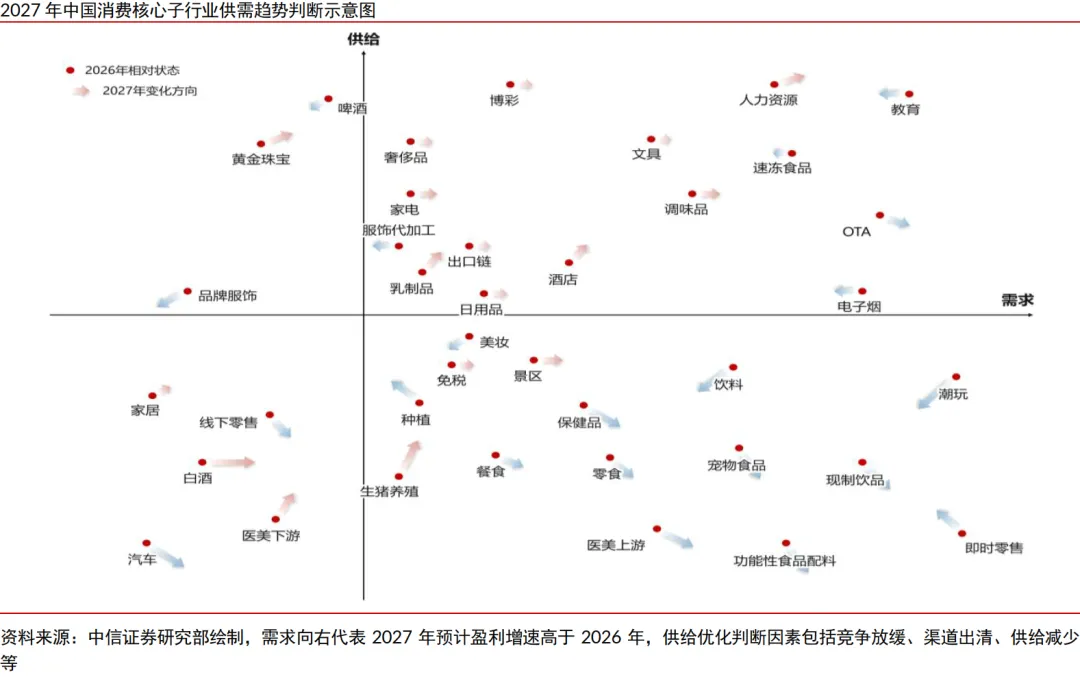
The view that supply-side optimization will take the lead in 2026 has already been validated to varying degrees across sectors such as frozen foods, seasonings, dairy products, and the upstream livestock industry. In 2027, we recommend continuing to seek certainty along the path of improving supply and demand: crop‑and‑livestock cycles are expected to align, with an upward turn in the raw milk cycle boosting both the livestock and dairy sectors; baijiu is nearing the end of its bottom‑building phase and the final stages of inventory clearance, suggesting a new supply‑demand equilibrium may emerge in 2027; meanwhile, hotels, restaurants, and the consumer‑internet sector stand to benefit from declining supply, improved operating conditions, and easing competition.
▍Corporate Alpha: Enhancing shareholder returns, with top-tier consolidation and globalization unlocking growth potential.
Under the assumption of a moderate recovery in overall market volume, leading companies can still achieve robust growth through increased market share, optimized product mix, improved channel efficiency, and enhanced business synergies. In recent years, consumer‑sector firms have significantly ramped up dividend payouts and share buybacks: by 2025, A‑share consumer companies (excluding automobiles) are expected to distribute RMB 314.2 billion in dividends and repurchase shares worth RMB 32.15 billion, while Hong Kong‑listed consumer firms are projected to deliver RMB 281.3 billion in dividends and RMB 149.86 billion in buybacks. Rising shareholder returns provide a solid valuation foundation for consumer sector leaders even before earnings fully recover, while the clear internationalization strategy of Chinese consumer companies remains a key driver of their long-term growth potential.
▍Our long-term structural outlook remains unchanged: new products and categories, new technologies, new distribution channels, and new markets constitute the enduring growth drivers.
China's overall consumption growth trajectory has shifted lower, but this does not alter the long-term trends of consumption‑structure upgrading and corporate internationalization. We recommend focusing on new products and categories, emerging technologies, innovative distribution channels, and expanding into new markets. Key themes to watch include emotional‑ and health‑related consumption, AI‑powered applications, discount‑channel strategies, and the global expansion of consumer brands. We expect growth‑oriented consumer sectors to likely bottom out in 2027, making them a compelling allocation theme for the second half of that year.
▍Risk Factors:
The recovery of the domestic consumer market has fallen short of expectations; real estate sales, project deliveries, and price improvements have not met forecasts; improvements in household employment and incomes have been weaker than anticipated; there are significant risks stemming from geopolitical tensions, global liquidity conditions, tariff fluctuations, and exchange-rate volatility; large-scale natural disasters and animal disease outbreaks could occur; pork and grain prices may fail to reach projected levels; raw-material prices could surge sharply; changes in industrial policies, sectoral regulation, and the competitive landscape could exceed expectations; cross-border e‑commerce faces risks related to overseas regulatory scrutiny, international logistics costs, and export demand; and food safety, corporate investments in new business lines, product R&D, cost‑and‑expense control, business expansion, capacity development, and the acquisition of new customers may all fall short of expectations.
▍Investment Strategy:
In summary, the core of consumption and investment in 2027 lies in capturing recovery resilience amid subdued expectations. For now, we recommend building positions on the left side, with cyclical sectors such as animal husbandry, livestock farming, and dairy products, along with high-dividend consumer leaders, forming the base allocation. Meanwhile, leading baijiu producers, hotel and restaurant stocks, and consumer‑focused internet companies should be positioned as beneficiaries of improving supply‑demand dynamics and easing competitive pressures. Should real estate transactions continue to rebound, employment and income prospects strengthen, or more concrete domestic demand‑stimulating policies take effect, we could further increase allocations to pro‑cyclical and growth‑oriented consumer segments. Over the longer term, we remain committed to deploying capital along the dual tracks of upgrading consumption patterns and advancing globalization.