
Market Snapshot
As of press time, futures tied to the three major U.S. stock indexes showed mixed movements in pre-market trading. Dow Jones Industrial Average futures rose 0.86%, S&P 500 futures declined 0.41%, and Nasdaq 100 futures fell 1.29%.

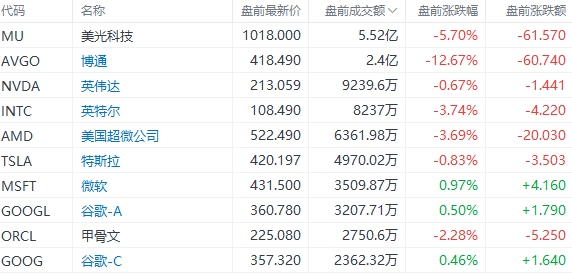
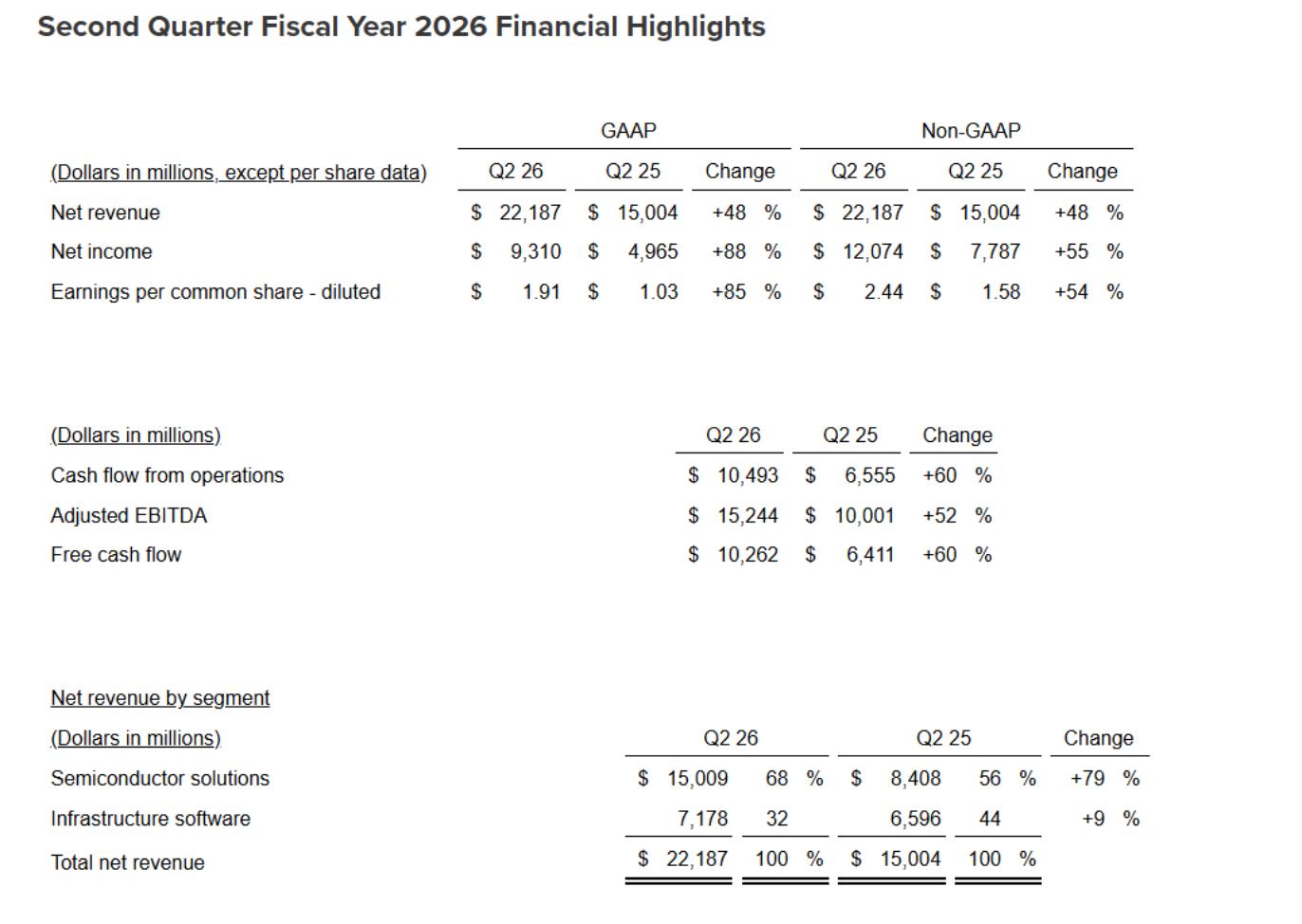
$Star Tech Companies (LIST2518.US)$ Overall performance was weak during pre-market trading, with Broadcom down more than 12% and Micron falling nearly 6%.
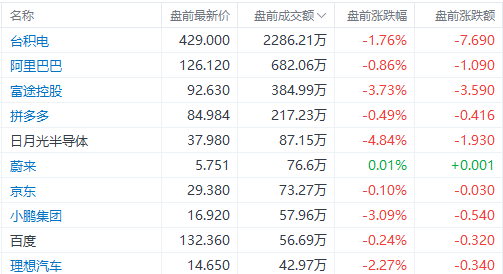
$China Concept Stocks (LIST2517.US)$ Pre-market trading saw broad declines, with ASE Semiconductor down nearly 5% and XPeng Group falling over 3%.
Individual Stock News
 Jensen Huang arrives in Korea tonight! Itinerary revealed: BBQ dinner with tech leaders to discuss AI, first-ever appearance on a variety show...
Jensen Huang is expected to arrive in South Korea this evening (Thursday). His four-day visit to South Korea is packed with meetings scheduled with executives from both large Korean technology firms and small startups. The AI luminary will also throw the ceremonial first pitch at a Korean professional baseball game and make his debut appearance on a variety television show.
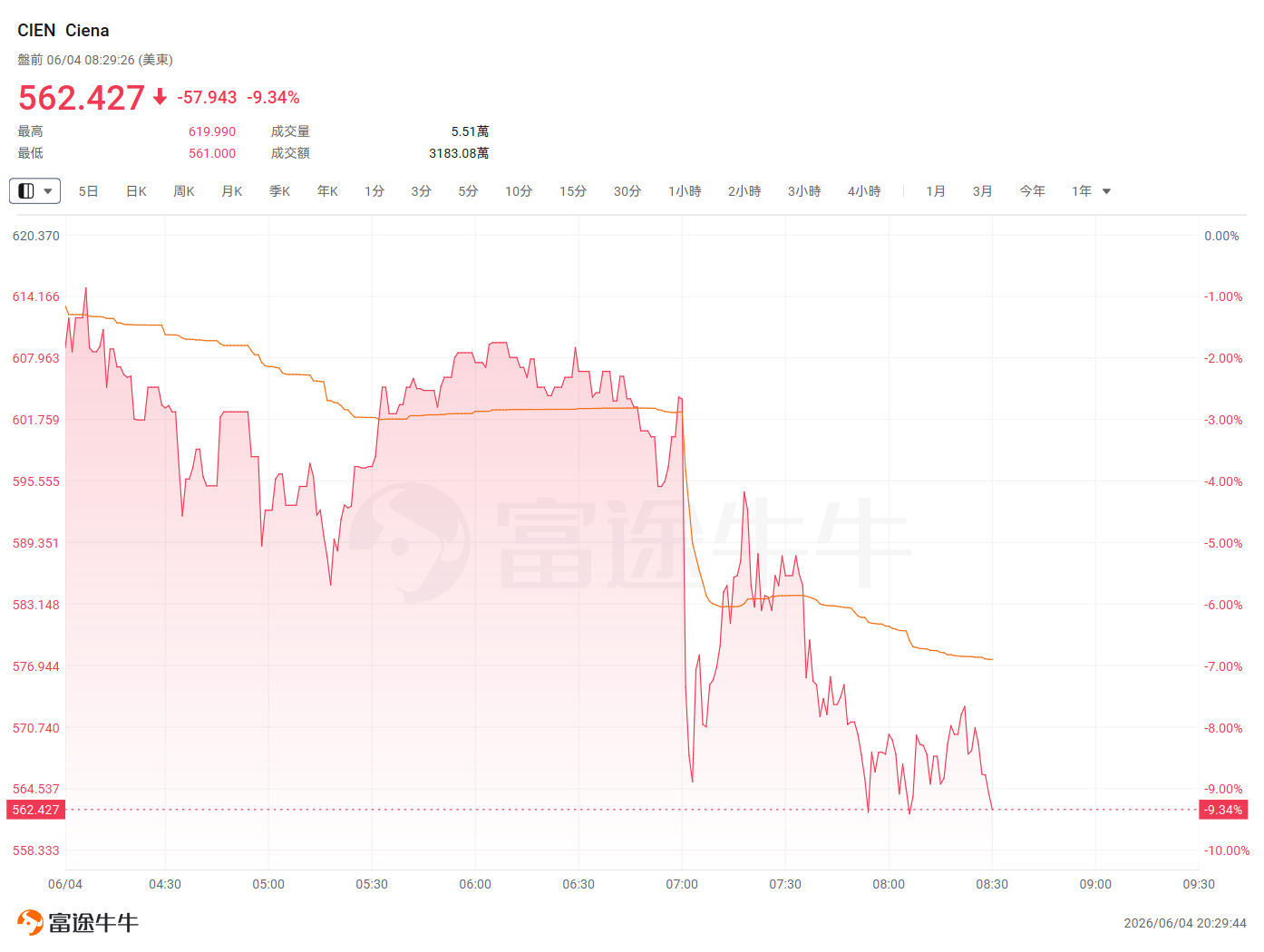
Ciena reported second-quarter revenue of $1.57 billion, an increase of 40% year-over-year; adjusted EPS was $1.64 per share.
Optical communications stocks $Ciena (CIEN.US)$ Second fiscal quarter revenue totaled $1.57 billion, up 40% year-over-year, versus analyst expectations of $1.5 billion; adjusted EPS was $1.64, up 290% year-over-year, compared to analyst expectations of $1.46. The company forecasts third fiscal quarter revenue of $1.63 billion, plus or minus $50 million, above the analyst consensus of $1.55 billion. Full-year fiscal 2026 revenue is projected at $6.3 billion, plus or minus $100 million, exceeding the prior guidance range of $5.9 billion to $6.3 billion and surpassing analyst expectations of $6.18 billion.
SpaceX has launched its IPO roadshow, with an expected share price of $135.
SpaceX has launched its initial public offering (IPO) roadshow, proposing to issue 555,555,555 shares of Class A common stock to the public. Retail investors will be able to participate at the same price as large institutional investors, with SpaceX shares expected to be priced at $135 each. The underwriters are expected to be granted a 30-day option to purchase up to an additional 83,333,333 shares of Class A common stock. An application has been filed to list its Class A common stock on the Nasdaq Global Select Market and Nasdaq Texas under the ticker symbol “SPCX.” Goldman Sachs, Morgan Stanley, BofA Securities, Citi, JPMorgan, Barclays, and other firms will serve as joint bookrunners for the offering.
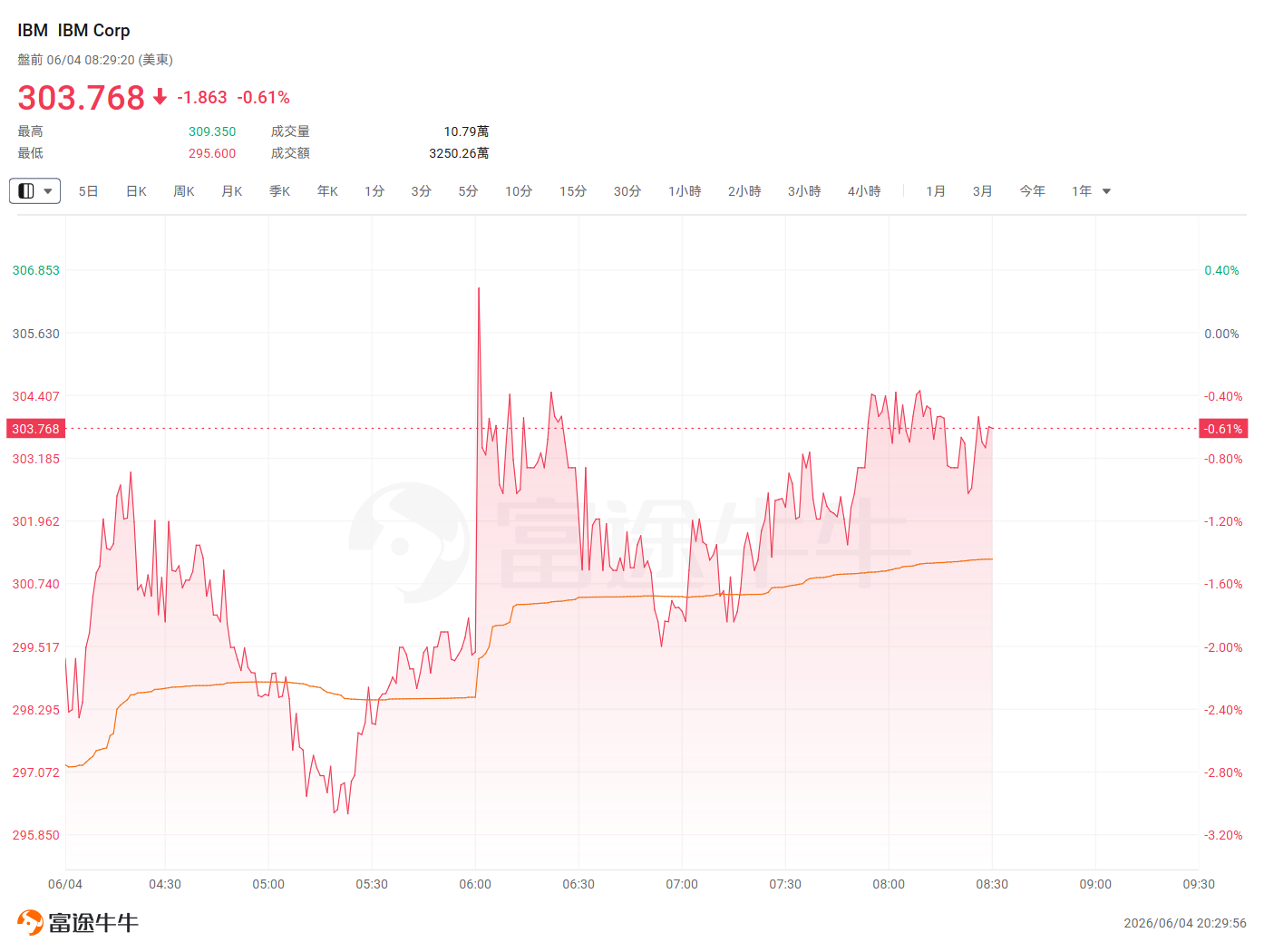
IBM and Google Cloud are collaborating to advance the large-scale application and deployment of artificial intelligence technologies.
IBM and Google Cloud announced a strategic partnership to accelerate the large-scale adoption of AI by combining human expertise with an AI-driven delivery model. This collaboration will expand the IBM Consulting Advantage AI-powered delivery platform by introducing industry-specific intelligent agents for Gemini Enterprise. This business initiative represents a multibillion-dollar market opportunity within Google Cloud services.
Taiwan Semiconductor CEO: No signs of cooling in AI boom; growth outlook remains optimistic for coming years
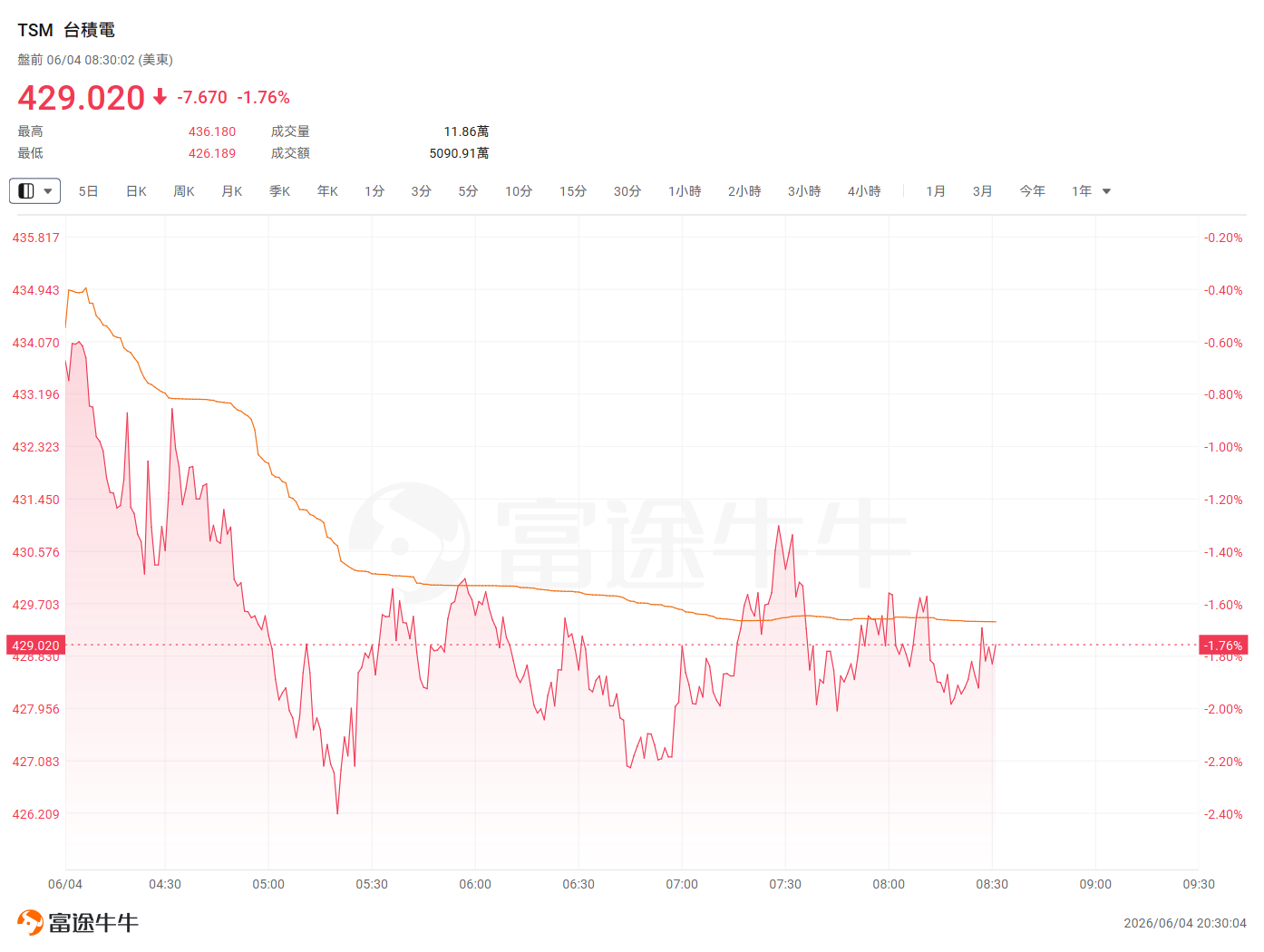
Global semiconductor foundry leader $Taiwan Semiconductor (TSM.US)$ C. C. Wei, Chairman and CEO of Taiwan Semiconductor, said on Thursday that robust demand for computing power and advanced semiconductors driven by the artificial intelligence (AI) boom has left the company confident in its growth prospects for the next few years.
Speaking at the company's annual general shareholders’ meeting in Hsinchu City, northern Taiwan, Wei noted that although the company continues to monitor the impact of rising component costs, its customers remain optimistic about the outlook for AI development.
Wei stated, “We continue to observe increasing adoption rates of AI models across consumer applications, enterprise applications, and sovereign AI domains.” He added, “This trend is driving market demand for more powerful computing capabilities, which in turn is further bolstering strong demand for advanced semiconductor chips.” He emphasized that Taiwan Semiconductor is doing everything possible to meet all customer demands, but cautioned that relying solely on U.S.-based capacity to fully satisfy U.S. customer needs would still take “a very long time.” However, he did not provide a specific timeline.
NVIDIA’s RTX Spark chip sparks debate over the definition of 'AI PC,' potentially reshaping the Windows ecosystem
NVIDIA’s launch this week of the RTX Spark superchip in collaboration with Microsoft has reignited discussions about the future form of personal computers. The AI hardware giant is making a renewed push into the laptop processor market, claiming it will bring the most disruptive transformation to the PC industry in decades.
At Computex Taipei, the launch of RTX Spark overshadowed nearly all other product announcements. As a result, shares of Intel (INTC.US) and AMD (AMD.US) came under pressure, while NVIDIA’s partner MediaTek rose against the trend. The first devices featuring this technology will go on sale this fall, marking the official start of an intense battle in the PC processor market.
Broadcom earnings call: Order backlog extends to 2028; 'demand for XPUs and networking is insatiable'; building a $35 billion AI compute financing platform
$Broadcom (AVGO.US)$ It held its second-quarter earnings call for fiscal year 2026. Broadcom disclosed to the market for the first time detailed information about its deep strategic partnerships with Silicon Valley giants such as OpenAI, Google, and Meta.
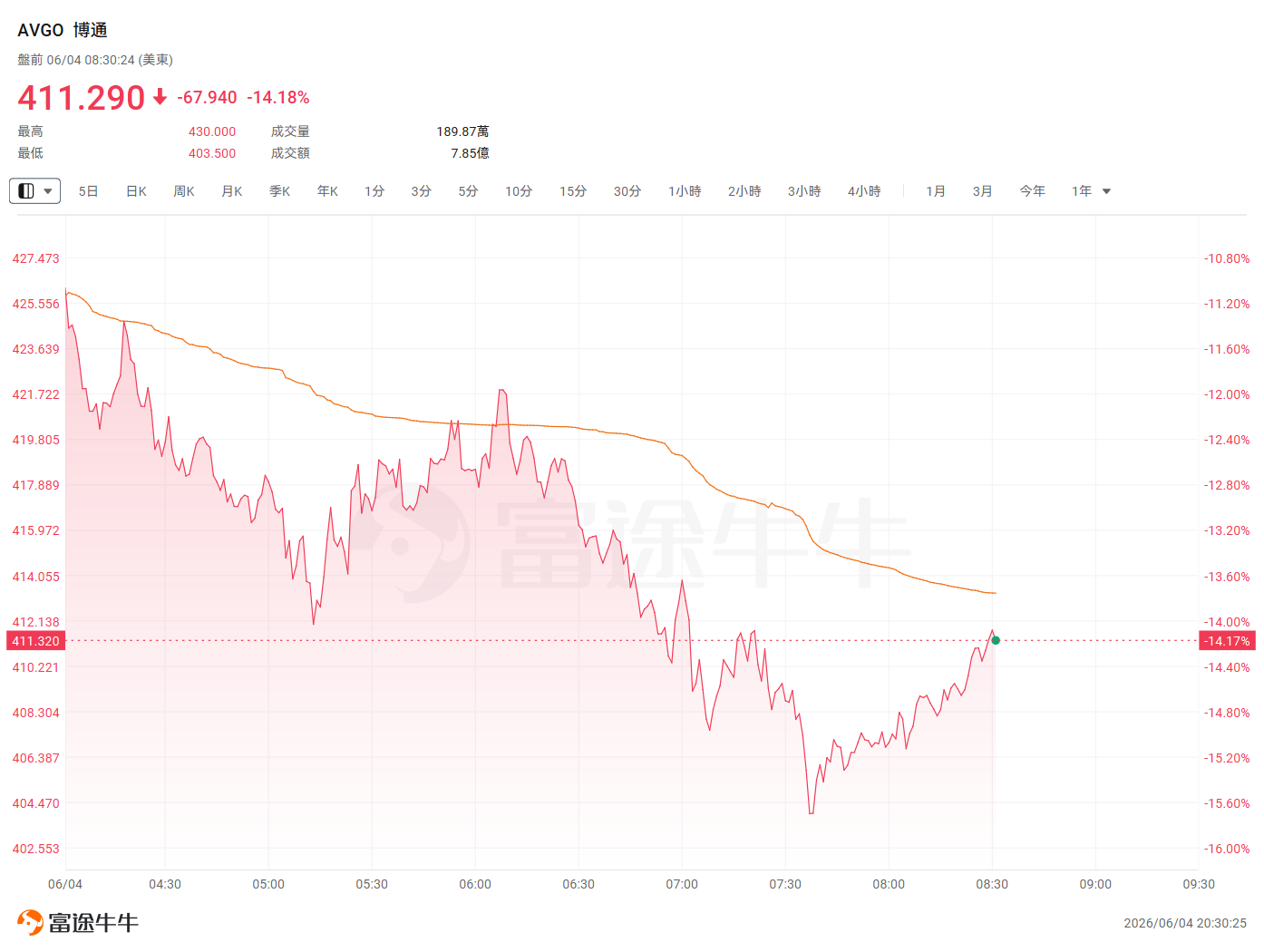
Despite an exceptionally high revenue base, Broadcom’s profitability remains robust. Its operating margin reached a record 67% in Q2, and adjusted EBITDA hit a record 69%, amounting to $15.2 billion—both exceeding guidance.
However, the much-anticipated revenue guidance for AI chips disappointed, suggesting the company’s progress in capturing market share in the rapidly growing AI chip segment may be slower than market expectations.
Global Macro
Initial jobless claims in the U.S. for the week ended May 30 stood at 225,000, above the forecast of 213,000 and the prior week’s figure, which was revised downward from 215,000 to 212,000.
The four-week moving average of initial jobless claims in the U.S. for the week ending May 30 stood at 214,750, with the previous figure revised down to 208,250 from 209,000.
Continuing claims for unemployment benefits in the U.S. for the week ending May 23 stood at 1.777 million, versus an expectation of 1.78 million and a previously reported figure of 1.786 million, revised down to 1.785 million.
Trump: Currently in the final negotiation phase to end the war with Iran
Trump posted on social media: "Yesterday, in a meaningless vote, the House restricted my war powers by the votes of four terrible Republicans and all Democrats—precisely as I was engaged in final negotiations to end the war with Iran. Who would do something so unpatriotic? They know exactly how the negotiations are progressing. The Democrats’ actions stem from ‘Trump Derangement Syndrome’—a colloquial term mocking those who, due to excessive animosity toward Trump, have lost objectivity, reason, logic, and common sense. They would rather see our nation fail than allow me to claim even one more victory among the many I’ve already achieved. As for those four Republicans—that’s an entirely different matter. They’re just grandstanding! They should be ashamed of themselves."
Is the 'AI bubble' alarm sounding again? Tokyo's AI investment frenzy meets profit-taking, with foreign investors recording their first net sale of Japanese equities in two months.
As of last week’s close of Japanese equity markets, overseas investors became net sellers of Japanese stocks for the first time in two months, ending the latest wave of aggressive buying that had driven Japan’s benchmark Nikkei 225 index to repeated record highs amid an AI-driven investment surge. According to data from Japan Exchange Group, foreign investors sold a net ¥395 billion (approximately USD 2.5 billion) of Japanese equities in the week ended May 29. This marks the end of eight consecutive weeks of net foreign buying in Japanese stocks.
This foreign sell-off coincided with the tech-heavy Nikkei 225 index surpassing the unprecedented 65,000 mark for the first time and briefly surging toward 68,700, primarily driven by strong gains in major companies closely tied to AI computing infrastructure, including SoftBank Group, Kioxia, Tokyo Electron, Advantest, and Murata Manufacturing.
Waller’s debut faces a 'hot potato': inflation flares up again, and the bond market has already 'hiked rates' ahead of the Fed
Just three weeks after Kevin Volcker assumed office as Chair of the Federal Reserve, the former Goldman Sachs banker and economic advisor to President Bush during the Bush administration is set for what may be the most pivotal public appearance of his career: on June 16–17, he will preside over his first FOMC interest rate decision meeting and hold his inaugural press conference since taking office. This event is widely regarded as the most significant monetary policy and geopolitical development for global capital markets in the first half of 2026.
In a research note published on June 2, Morgan Stanley bluntly stated that the June FOMC meeting poses a “key risk” to the current low-volatility environment and consensus market positioning, potentially creating new tradable trends in the U.S. dollar and broader foreign exchange markets. DBS noted that as June 2026 approaches, the FX market is grappling with a “dramatic and volatile shift in narrative,” with all eyes fixed on Volcker’s debut meeting.
The backdrop to this meeting is far from easy. With ongoing Middle East conflicts pushing energy prices higher, multiple inflation indicators are rising noticeably. Meanwhile, during his confirmation hearing, Volcker explicitly expressed reservations about anchoring policy solely to the traditional core PCE metric, instead favoring the Dallas Fed’s “trimmed-mean” PCE index, which excludes extreme price movements. This preference appears less a technical choice of indicator and more a theoretical foundation laid in advance for a potentially dovish policy path. Markets are now asking: Will a chair who pledged during his hearing to prioritize price stability face immediate pressure over perceived inconsistency between words and actions at his very first policy summit? The conventional framework of “fight inflation first, then cut rates” could be rewritten through a seemingly minor technical detail.
Middle East conflicts drain crude oil supplies: U.S. inventories fall to their lowest level since 2004, prompting analysts to warn of a potential sharp spike in oil prices.
According to the latest data released Wednesday by the U.S. Energy Information Administration (EIA), U.S. crude oil and petroleum product inventories declined by 10.6 million barrels last week, reaching their lowest level since 2004.
The EIA report showed that in the week ending May 29, crude oil inventories fell by 8 million barrels to 433.7 million barrels—3% below the five-year average, more than double the decline forecast by analysts.
U.S. crude oil production remained steady last week at 13.7 million barrels per day, while crude exports surged from 4.4 million barrels per day to 5.9 million barrels per day, continuing the sharp upward trend in exports since the outbreak of the Iran conflict.
Crude oil in the Strategic Petroleum Reserve (SPR) dropped sharply by 8 million barrels to 357.1 million barrels, reaching its lowest level since January 2024; this release is part of the approved drawdown of 172 million barrels from the SPR aimed at curbing soaring crude prices.
Crude oil inventories at the Cushing, Oklahoma delivery hub declined by 583,000 barrels to 224 million barrels.
Overall, crude oil inventories have fallen by a cumulative 63.9 million barrels since the U.S.-Israeli strikes on Iran on February 28. Analysts stated that inventories are now at critically low levels and warned that oil prices could surge significantly in the near future.
Breaches $63,000! Bitcoin Halves from Its Peak as 'Crypto Winter' Sets In
Notably, in recent months, Bitcoin had actually remained stable within a relatively narrow trading range following its sharp decline from peak levels. However, some of Bitcoin’s most steadfast supporters have recently changed their stance, delivering what appears to be a fatal blow to market confidence...
Michael Saylor, Executive Chairman of Strategy, was renowned in crypto circles for his mantra 'Never sell Bitcoin.' Yet the company announced on Monday that it had sold 32 Bitcoins last week, realizing a gain of approximately $2.5 million, with proceeds earmarked for preferred stock dividends.
By the next day (June 2), Bitcoin’s price had dropped below $70,000 for the first time since early April.
Strategy’s unexpected sale has raised concerns among investors and analysts that the market could face additional downward pressure. Further sales by the company could trigger a sharp decline in Bitcoin’s price.
“This strategic shift by Strategy may only be the beginning,” said Joshua Lim, Co-Head of Global Markets at cryptocurrency trading firm FalconX. “Most Bitcoin buyers will likely remain on the sidelines until some key pending catalysts fade this summer.”
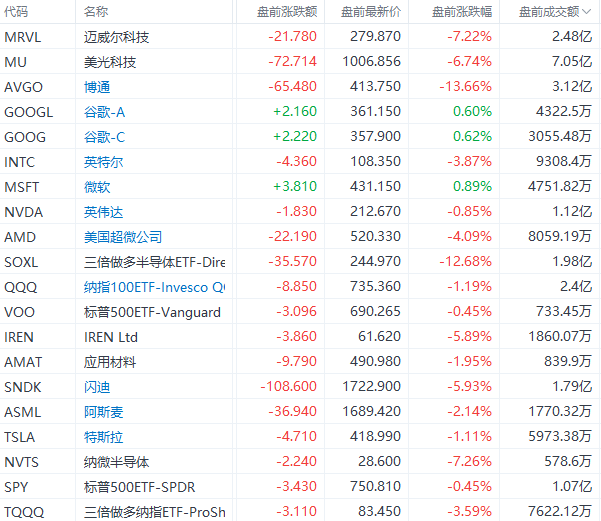
Top 20 pre-market trading volume stocks in the U.S.
Reminder of the US stock market macroeconomic calendar
(The following times are in Beijing Time)
1:00 AM – Jeffrey Schmid, President of the Kansas City Fed and 2028 FOMC voting member, participates in a fireside chat.
1:10 AM – Mary Daly, President of the San Francisco Fed and 2027 FOMC voting member, delivers remarks.
 Looking to pick stocks or analyze them? Want to know the opportunities and risks in your portfolio? For all your investment-related questions,just ask Futubull AI!

Editor/Lee