Market Snapshot
According to Iran's Fars News Agency: The Iranian Armed Forces announced the conclusion of their military operations against Israel and warned that if Israel resumes attacks on Lebanon, Iran would respond with even harsher retaliatory measures.
As of the time of writing, futures tied to the three major U.S. stock indices were trading higher in pre-market hours. Dow Jones Industrial Average futures rose 0.21%, S&P 500 futures gained 0.62%, and Nasdaq 100 futures climbed 1.23%.

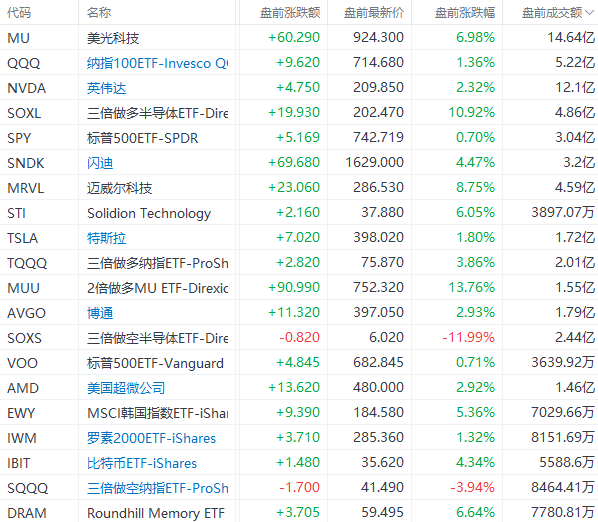
$Star Tech Companies (LIST2518.US)$ Most stocks rose in pre-market trading, with Micron Technology up over 6%, and NVIDIA, AMD, and Broadcom each gaining more than 2%.
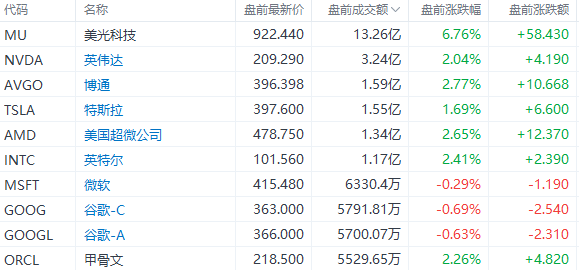
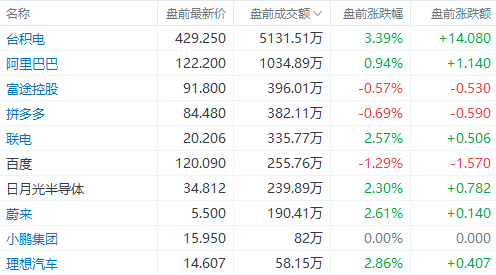
 $China Concept Stocks (LIST2517.US)$ Most stocks advanced in pre-market trading, with Taiwan Semiconductor rising over 3%, and Li Auto, XPeng, and Nio each gaining more than 2%.
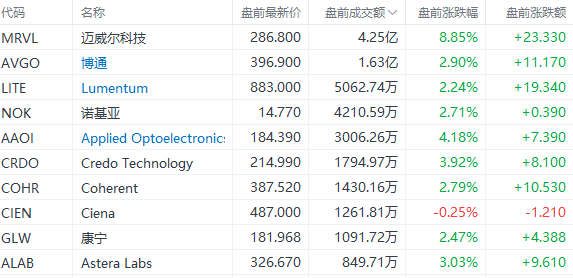
$Optical Communication (LIST23979.US)$ Shares continued to rise, with Marvell Technology up nearly 9%, POET surging over 5%, AAOI and Credo climbing nearly 4%, and Corning gaining nearly 3%.
Individual Stock News
The U.S. Department of Energy has reinstated a $115 million critical minerals grant to American Battery Technology.
Following a successful appeal by American Battery Technology, Phase I of the Tonopah Flats Lithium Project will proceed.
Nurix soars in pre-market trading! Roche agrees to pay up to $2.3 billion for rights to bexobrutinib, an experimental blood cancer drug.
Pharmaceutical giant $ROCHE HOLDING AG (RHHBY.US)$ has agreed to acquire from U.S. biopharmaceutical company $Nurix Therapeutics (NRIX.US)$ up to $2.3 billion for rights to its experimental blood cancer drug bexobrutinib. Boosted by this news, as of the time of writing, Nurix surged over 49% in Monday’s U.S. pre-market session.
Under the agreement announced Monday, Nurix will receive a $700 million upfront payment. Roche and Nurix will share development costs and split profits equally in the U.S. market; outside the United States, Roche will be responsible for commercializing the therapy. The companies expect the transaction to close in the third quarter of 2026.
This collaboration further reflects Roche’s strategy to strengthen its oncology portfolio. As several of its blockbuster drugs approach maturity, Roche is seeking new growth drivers. Roche is betting that bexobrutinib can help patients who have become resistant to existing therapies.
Jensen Huang secures multiple landmark collaborations during Korea visit, as NVIDIA advances comprehensive布局 in embodied intelligence and AI infrastructure
$NVIDIA (NVDA.US)$ It is currently collaborating with South Korea's LG Group in the fields of humanoid robotics and next-generation data centers. This underscores NVIDIA's aggressive push into 'physical AI' (embodied intelligence) applications beyond its traditional AI chips.
Following his meeting in Seoul with LG Group Chairman Kwang-mo Koo, Jensen Huang stated, 'We are working with them on motor technologies and mechanical systems to integrate humanoid robotics with the future of robots.' He added, 'We are also collaborating with LG to build the data centers of the future.'
NVIDIA stated, 'This collaboration perfectly combines NVIDIA’s full-stack, end-to-end AI factory platform with LG Group’s global leadership in consumer electronics, robotics, mobility components, smart spaces, and data center technologies.'
Up 90% and Still Unanimously Bullish on Wall Street! Micron Technology’s Target Price Doubled by Two Major Institutions
Despite $Micron Technology (MU.US)$ Having surged an impressive 90% by May 2026, Wall Street continues to raise its target price, reflecting sustained bullish sentiment toward the stock. Micron Technology also featured on our list of top-performing stocks for May.
Recently, on June 3, Morgan Stanley raised its price target for Micron Technology from USD 520 to USD 1,050, while maintaining a “buy” rating. Previously, on May 29, Susquehanna also increased its price target for the stock from USD 600 to USD 1,750 and kept its “buy” rating.
Morgan Stanley noted that its investment thesis for memory stocks is very clear: the current persistent memory shortage cannot be resolved quickly. The firm expects supply tightness to last two to three years or even longer, creating a continuously favorable market environment for memory manufacturers such as Micron. Although memory stocks have already delivered strong performance in 2025 and 2026, Morgan Stanley believes there remains further upside potential in this rally.
Apple WWDC 2026 Preview: Will Siri’s ‘Brain Transplant’ Redeem Apple’s AI Ambitions Before Cook Steps Down?
At 1:00 a.m. Beijing time on June 9, $Apple (AAPL.US)$ Apple’s Worldwide Developers Conference (WWDC) 2026 will kick off at its Cupertino headquarters. This event is not only Apple’s most important annual showcase for software but also CEO Tim Cook’s final public appearance as host before stepping down. After two years of missed promises in artificial intelligence (AI), Apple urgently needs a full-throttle product launch to convince both Wall Street and consumers that it can still lead the generative AI wave. The highly anticipated updates across its entire operating system lineup—including iOS 27, iPadOS 27, and macOS 27—as well as a completely overhauled Siri, will serve as Apple’s redemption moment.
Opening a New Blue Ocean in Weight-Loss Drugs! Eli Lilly and Co Releases Latest Clinical Data; Foundayo Poised to Fill Treatment Gap for Menopausal Obesity
$Eli Lilly and Co (LLY.US)$ The company stated that a new analysis of late-stage clinical trial data shows its investigational weight-loss therapy, Foundayo, enables significant weight reduction in overweight or obese women, regardless of menopausal transition status (premenopausal, perimenopausal, or postmenopausal).
The findings were presented Sunday at the American Diabetes Association’s (ADA) annual scientific meeting, based on an analysis of data from over 1,500 women who participated in the company’s ATTAIN-1 and ATTAIN-2 trials.
A Combined $70 Billion! SpaceX Secures Major Deals with Anthropic and Google—'Compute Leasing' ARR Reaches $26 Billion
SpaceX is transforming its vast computing infrastructure into a high-velocity cash-generating machine. On the eve of its anticipated listing on the U.S. stock market, Elon Musk’s SpaceX has signed massive computing capacity leasing agreements with Anthropic and Google, with the two contracts collectively valued at over USD 70 billion and generating annualized revenue of USD 26 billion—providing strong momentum for its IPO narrative.
On June 6, according to Reuters, SpaceX announced on June 5 that it had signed a multi-year cloud services agreement with Alphabet’s Google (GOOGL.US). Regulatory filings show that Google will pay SpaceX $920 million per month from October of this year through June 2029 for access to approximately 110,000 NVIDIA GPUs and associated computing resources; during an initial ramp-up phase prior to that period, Google will pay a lower rate.
Previously, in May, Anthropic announced it would lease the majority of the computing capacity at SpaceX’s Colossus 1 data center in Memphis, Tennessee, at a rate of USD 1.25 billion per month, with an initial commitment period of six months. Combined, the two agreements generate approximately USD 2.17 billion in monthly revenue for SpaceX from its computing leasing business, translating to an annualized figure of about USD 26 billion. If both contracts are fulfilled through their respective expiration dates, their total combined value will exceed USD 70 billion.
Following Google, Meta (META.US) is considering a multi-billion-dollar equity financing to meet AI-related capital expenditure needs.
Meta is exploring large-scale equity financing to support its substantial capital expenditure plans in artificial intelligence, marking the latest move in a wave of tech giants racing to secure funding for AI infrastructure.
According to the Financial Times, Meta executives are discussing the possibility of issuing tens of billions of dollars in new shares to fund AI-related capital expenditures that could reach as high as $145 billion this year and even higher by 2027.
Discussions within Meta have notably accelerated following Alphabet, Google's parent company, completing a record-breaking $85 billion equity offering this week—a deal whose size was increased by $5 billion due to strong investor demand.
Meta has denied the reports, with a spokesperson calling the speculation about equity financing "purely speculative," while adding, "We have consistently stated that there is a significant opportunity in AI, and we will continue to raise capital in the most flexible manner to support this initiative." This statement leaves considerable room for interpretation.
Global Macro
Soaring inflation expectations have severely undermined bets on rate cuts! The U.S. Treasury market is bracing for the possibility that the Federal Reserve may resume hiking rates.
The U.S. Treasury market has come under significant pressure recently, with traders widely expecting the upcoming inflation data to show the most substantial increase in consumer prices in several years. This expectation is reinforcing market views that the Federal Reserve will further tighten monetary policy. Swaps linked to the U.S. May CPI data—scheduled for release on Wednesday—indicate an annual rate of approximately 4.3%. Against the backdrop of persistently elevated energy prices due to the unresolved U.S.-Iran conflict, this reading could mark the highest level since 2023. With no clear prospect of a lasting ceasefire in sight, energy prices may remain elevated, further fueling inflationary pressures. Additionally, the resilience of the U.S. economy has weakened bond market expectations for monetary easing. As of this writing, the 10-year U.S. Treasury yield stands at 4.54%, while the two-year yield—which is sensitive to monetary policy—trades at 4.149%.
Wassh’s debut draws considerable attention, with markets closely watching three key signals that could foreshadow a rate hike.
The U.S. labor market remains robust, and there are no signs of inflation easing. Wall Street and Washington experts widely anticipate that the Federal Reserve’s upcoming policy meeting—set to take place in fewer than ten days—will send a clear signal that the next move in interest rates is likely to be a hike. This meeting marks Kevin Warsh’s first FOMC meeting as Chair of the Federal Reserve. Economists generally expect rates to remain unchanged at the June meeting, but markets will focus on three key indicators to assess whether the Fed is laying the groundwork for a rate increase later this year: the removal of dovish language included in the December 2023 policy statement—a move that would underscore Warsh’s policy independence; a hawkish shift in the dot plot; and a rebalancing of the risk assessment toward inflation concerns. Beyond interest rate policy, markets are also watching whether Warsh will immediately adjust the Fed’s external communication approach following his appointment.
Is the AI bull market intact? After a sharp sell-off in tech stocks, Wall Street assesses it as a healthy correction!
At a moment when market confidence teetered on the brink of collapse, Mike Wilson’s voice stood out distinctly. As one of Wall Street’s most accurate strategists in recent years, he issued a clear and resolute assessment in his Monday research note: Friday’s position-driven selloff was a 'healthy correction,' and for the bull market to persist through year-end, 'a pullback is both inevitable and ultimately benign.'
Wilson is not blindly optimistic. He precisely dissected the nature of the pullback: 'This correction was led primarily by semiconductors and memory chips—stocks that had surged sharply year-to-date and where hedge funds and leveraged ETFs held excessively concentrated positions.' In other words, the core driver of the decline was not deteriorating fundamentals but rather a natural unwinding of previously overcrowded trades. Data show that as of last week, hedge funds’ net exposure to the semiconductor sector stood at the 98th percentile historically. Once marginal shifts in sentiment occur, such extreme positioning can amplify downward momentum significantly. The Philadelphia Semiconductor Index fell a cumulative 12% over Thursday and Friday.
Wilson’s optimism rests on a more fundamental foundation: sustained corporate earnings strength and an expanding breadth of growth. He believes the AI infrastructure investment cycle is now permeating downstream segments. The outsized performance of chip stocks will gradually diffuse into software, cybersecurity, data center operations, and even traditional industrial sectors adopting AI applications—thereby creating a more diversified earnings support base. Wilson maintains his year-end target of 8,000 for the S&P 500, implying approximately 8% upside from current levels, and has preliminarily set a mid-2027 target of 8,300.
Recalling Wilson’s stance during the early days of the Iran conflict—when markets plunged in panic, he remained steadfast in his positive earnings outlook, a call later vindicated by the rebound—he is once again taking an 'anti-panic' position.
‘Next-generation storage’ emerges! AI consumes MLCC capacity: lead times exceed 20 weeks, triggering supply concerns for the ‘rice of the electronics industry’
While market attention remains focused on the competition for GPU, HBM, and advanced packaging capacity, the wave of artificial intelligence (AI) infrastructure development is propelling another critical electronic component into the eye of the supply chain storm—multilayer ceramic capacitors (MLCCs). Industry insiders note that following GPUs, HBM memory, and advanced packaging, MLCCs are emerging as another potential bottleneck in the expansion of AI infrastructure.
Multilayer ceramic capacitors—often dubbed the 'rice of the electronics industry'—are now experiencing an unprecedented shortage crisis. According to recent data from multiple industry sources, spot prices for high-end MLCCs have risen by approximately 20%, and lead times have stretched from the typical 8–12 weeks to over 20 weeks, with some scarce specifications requiring up to 24 weeks for delivery. Bill Tang, Chairman of Holy Stone Holding Corp., stated bluntly that demand for high-end MLCCs has reached its highest level in more than two decades, with lead times already exceeding 20 weeks, and supply conditions are expected to tighten further over the next 18 months.
This crisis is not merely a cyclical fluctuation in traditional supply and demand dynamics, but rather a structural shift driven by the breakneck expansion of AI computing infrastructure—one that has thrust a once-supporting component into the spotlight. MLCCs now rank third in terms of bill-of-materials (BOM) cost in AI servers, trailing only GPUs and memory modules. A single top-tier AI server rack may require as many as approximately 600,000 MLCCs operating in concert.
Top 20 pre-market trading volume stocks in the U.S.
Reminder of the US stock market macroeconomic calendar
(The following times are in Beijing Time)
23:00 U.S. May New York Fed 1-year inflation expectations
 Want to select stocks or get a stock diagnosis? Curious about the opportunities and risks in your portfolio? For all your investment questions,Just ask Futubull AI!

Editor/Lee