Market Snapshot
On June 11 local time, U.S. President Trump posted on the social media platform Truth Social that the United States would launch a 'fierce strike' against Iran that evening. In the near future, the U.S. will seize Kharg Island and other oil infrastructure and gain full control over Iran's oil and gas markets.
Additionally, the U.S. released inflation data showing that the Producer Price Index (PPI) rose 6.5% year-over-year in May, above the forecast of 6.4% and the prior reading of 6%; it increased 1.1% month-over-month, compared with an estimated 0.7% and a previous figure of 1.4%.
U.S. stock index futures pared gains, international oil prices rose, and spot gold declined slightly in the short term.

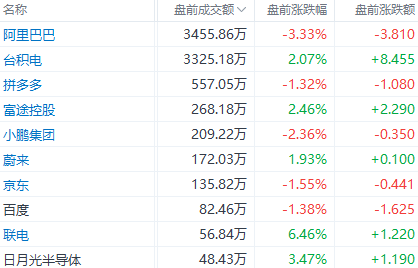
 $Star Tech Companies (LIST2518.US)$Broad gains in pre-market trading: Intel rose nearly 5%, and ASML Holding gained over 3%.
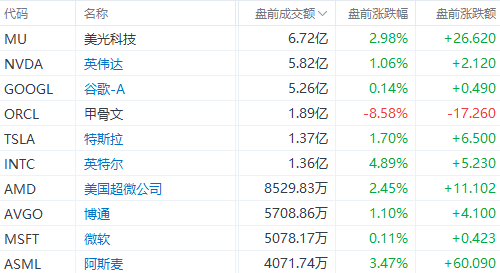
$China Concept Stocks (LIST2517.US)$Mixed performance in pre-market trading: United Microelectronics Corporation (UMC) surged over 6%, while Alibaba declined more than 3%.
Individual Stock News
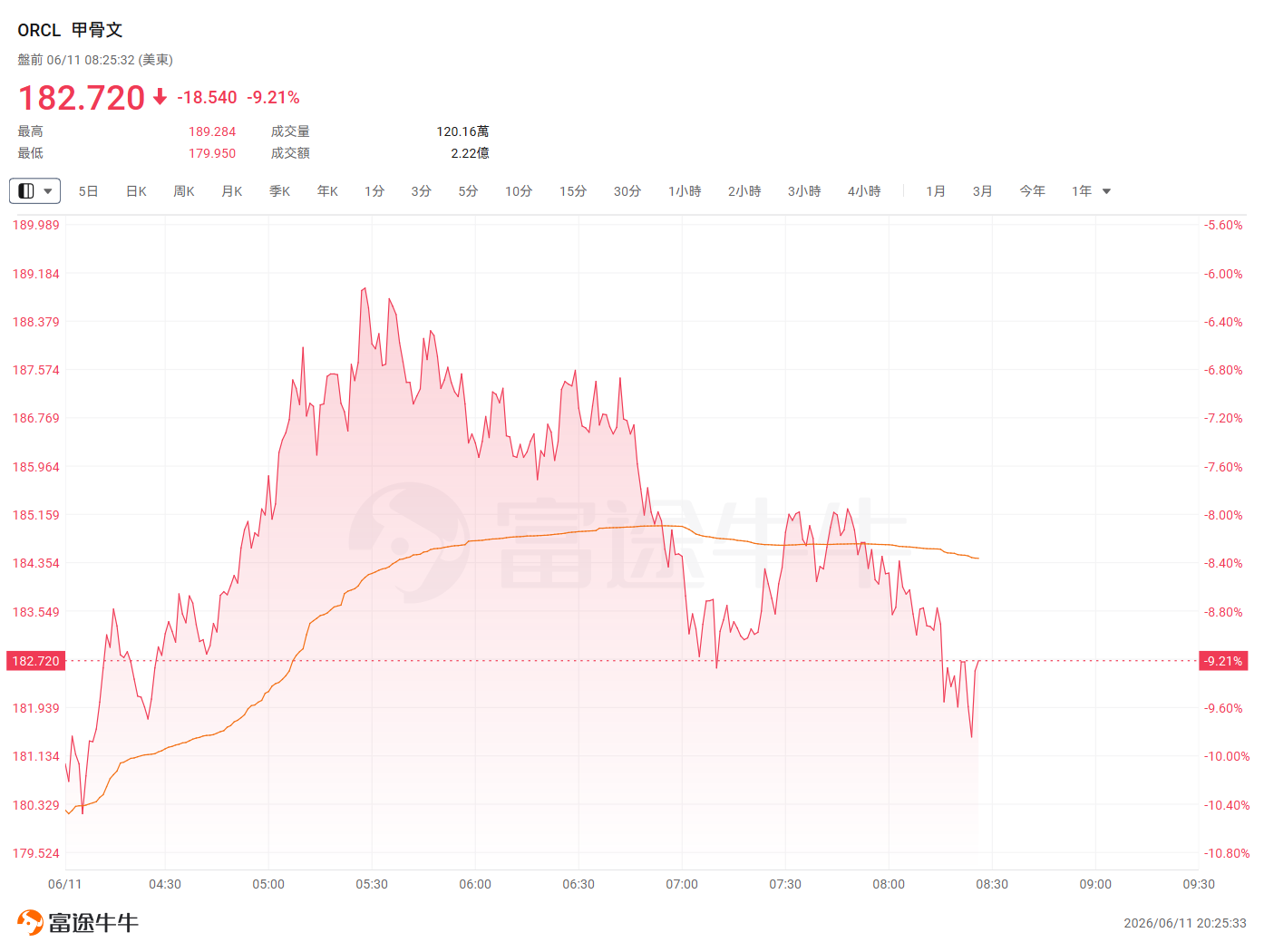
Even massive AI orders can’t sustain market confidence! Oracle’s runaway capital spending triggers a sharp post-earnings stock drop.
The financial report shows that,$Oracle (ORCL.US)$Total revenue for the fourth quarter reached $19.18 billion, up 21% year-over-year and exceeding analysts’ expectations of $19.1 billion. Net income was $4.22 billion, or $1.45 per share, compared to $3.43 billion ($1.19 per share) in the same period last year. Adjusted earnings per share came in at $2.11, beating the market consensus of $1.96. Oracle’s Cloud Infrastructure (OCI) business—the key growth driver closely watched by the market—generated $5.8 billion in revenue this quarter, surging 93% year-over-year, slightly ahead of analysts’ projected growth rate of 91%. Despite broadly surpassing market expectations across core financial metrics for the fourth quarter, the company’s reported capital expenditures exceeded forecasts, raising investor concerns about the profitability of its AI infrastructure business. For fiscal year 2026, Oracle’s total capital expenditures amounted to $55.66 billion, a 162% increase year-over-year, significantly higher than its previous guidance of $50 billion. Capital expenditures alone for the fourth quarter were approximately $16.5 billion. More alarming to investors is the company’s free cash flow situation—annual free cash flow stood at negative $23.7 billion.
Rumors swirl that Elon Musk will make a surprise appearance at ASML Holding’s closed-door summit to unveil his ‘chip empire,’ Terafab.
$Tesla (TSLA.US)$Elon Musk, CEO of SpaceX, will secretly attend ASML Holding’s internal annual technology conference via video link on Thursday. During this private, invitation-only meeting, Musk will engage in a fireside chat with ASML’s new CEO, Christophe Fouquet, and for the first time provide thousands of ASML’s core employees with a detailed update on the progress and vision of his ambitious semiconductor manufacturing venture, ‘Terafab.’
General Motors shifts battery strategy: LMR overtakes LFP as primary chemistry, diverging from Tesla’s approach.
Foreign media cited$General Motors (GM.US)$Citing comments from Kurt Kelty, General Motors’ head of battery technology, foreign media reported that the automaker is reassessing its future electric vehicle battery chemistry roadmap and may prioritize lithium-rich manganese-based (LMR) technology over lithium iron phosphate (LFP). This strategic shift indicates that General Motors is pursuing a different path from competitors like Tesla and Ford in its efforts to reduce EV costs.
BNP Paribas mines the liquid cooling sector: AI cooling demand will continue to surge, with Eaton and Vertiv poised to benefit
The race to build artificial intelligence infrastructure is creating a powerful new growth engine for companies that can address one of the industry’s biggest challenges: preventing increasingly power-hungry AI servers from overheating. This was the key message conveyed during a recent investor conference call hosted by Andrew Buscaglia, equity research analyst at BNP Paribas, which featured a former Microsoft data center expert and consultant discussing the future of liquid cooling technology. The discussion has left BNP Paribas more optimistic about the sector’s outlook, particularly for companies like $Vertiv Holdings (VRT.US)$and$Eaton (ETN.US)$ that offer comprehensive infrastructure solutions combining power management and advanced cooling systems.
SpaceX IPO frenzy sparks nationwide excitement; prominent short-seller quickly tempers enthusiasm: 'Don't pay for distant hopes and dreams!'
Noted short-seller investor James Chanos stated that SpaceX’s much-anticipated public listing is being driven more by investor enthusiasm for Elon Musk and artificial intelligence than by financial fundamentals. He believes the company’s valuation is difficult to justify under any reasonable business assumptions.
Ahead of the company’s highly anticipated IPO, Chanos, founder of Chanos & Co., gave an interview in which he described the deal as a critical test of market sentiment, as investors pour substantial capital into speculative growth narratives.
Speaking at the iConnections Global Alternatives Conference in New York—an event attended by over 2,500 institutional asset allocators and fund managers—Chanos said, “We’re about to witness an IPO raising $75 billion with a valuation approaching $2 trillion, yet the company generates only $19 billion in revenue and has negative free cash flow. This is essentially an IPO selling hope and dreams.”
OpenAI secretly filed for an IPO; Altman says 'going public within a year,' proposes tender offer to employees at $687.69 per share
OpenAI CEO Sam Altman informed employees via a Slack message that he expects the company to go public “within the next year.”
He added, “Many factors could cause this timeline to accelerate or delay, but filing now gives us the option to move forward sooner if we choose to.”
Also on Monday, OpenAI revealed it had confidentially submitted a draft IPO prospectus to the U.S. Securities and Exchange Commission (SEC).
Reports indicate that Altman also informed employees the company is preparing to launch a tender offer at the current price of $687.69 per share. He further suggested that delaying the IPO might be more advantageous if artificial intelligence achieves 'Recursive Self-Improvement' (RSI).
He stated, “The sooner a potential RSI breakthrough appears likely, the more advantageous it may be to delay the IPO,” as “technology and the world could change in astonishing ways, and there may be compelling reasons to remain a private company during that period.”
Responding to SemiAnalysis? NVIDIA posts video of first CPO switch deployments
Just days after the bearish report was released, $NVIDIA (NVDA.US)$ it responded with a hardware demonstration.
NVIDIA recently posted a video on X showcasing its Quantum-X InfiniBand Photonics Q3450-LD switch, which incorporates its silicon photonics CPO technology. The device has already been deployed in Lambda’s production-grade GPU clusters, delivering a 3.5x improvement in power efficiency and a 10x increase in network resilience. CoreWeave, Meta, Microsoft, and Oracle Cloud Infrastructure have also joined the initial deployment cohort.
However, just prior to this development, markets were rattled by a bearish report questioning NVIDIA’s CPO prospects. On June 9, SemiAnalysis downgraded its shipment forecasts for NVIDIA’s CPO switches and stated that mass adoption of its native 800V DC power solution would be delayed until after 2028, triggering a sharp sell-off in the U.S. optical communications sector. Currently, divergent market expectations regarding NVIDIA-led CPO and 800V DC power technologies remain the key variables influencing the trajectory of the AI infrastructure segment.
Global Macro
The European Central Bank raised its three key interest rates for the first time since 2023, in line with market expectations.
The European Central Bank raised the deposit facility rate to 2.250%, the main refinancing operations rate to 2.400%, and the marginal lending facility rate to 2.650%—its first rate hike since 2023, consistent with market expectations.
Initial jobless claims in the U.S. for the week ending June 6 came in at 229,000, the highest level since the week ending February 7, 2026.
Initial jobless claims in the U.S. for the week ending June 6 came in at 229,000, compared with an expectation of 219,000 and a previous reading of 225,000.
JPMorgan: Fed expected to unanimously hold rates steady next week
May may mark the peak of this inflation cycle. Although the latest U.S. inflation data rose to its highest level in over three years, JPMorgan Asset Management believes this is insufficient to prompt the Federal Reserve to act at next week’s meeting, and policymakers are most likely to keep rates unchanged. David Kelly, Chief Global Strategist at JPMorgan Asset Management, stated that while inflation remains above the Fed’s target, the May reading is likely close to the peak of this inflation cycle, and price pressures are expected to gradually ease in the coming months. 'Essentially, I think the Fed will vote 12–0 next week to do nothing.'
Core CPI in the U.S., excluding food and energy prices, rose just 0.2% month-over-month in May, below market expectations, indicating that underlying inflationary pressures have not deteriorated significantly further. Kelly noted this is also a key reason why the Fed can afford to remain patient and stay on the sidelines. He said, 'Seeing inflation return to the ‘4% range’ isn’t pleasant, but there’s currently no justification for an immediate easing of monetary policy.'
U.S. consumer market remains as attractive as ever! Deutsche Bank forecasts a shift in cross-border M&A trends, with U.S. consumer goods companies becoming highly sought-after targets.
Siddharth Malik, Global Co-Head of Consumer & Retail Investment Banking at Deutsche Bank, stated that despite market concerns about the economic outlook, global corporations may still place U.S. consumer goods companies on their acquisition target lists to further expand into the U.S. market—the world’s largest consumer market. Malik remarked, “Cross-border M&A deals flowing into the U.S. will accelerate. For all consumer goods companies, the U.S. remains the absolute top-priority market.”
Large deals targeting U.S. consumer goods companies suggest a potential shift in M&A trends. In recent years, deal flows have largely moved in the opposite direction. Earlier this year, U.S. spice and flavoring manufacturer $McCormick & Co (MKC.US)$ has agreed to acquire $Unilever (UL.US)$ the majority of its food business. Not long ago, Keurig Dr Pepper (KDP.US) acquired JDE Peet's NV, a Dutch coffee and tea company.
Concerns have emerged over a pullback from elevated storage levels, but Morgan Stanley argues this is merely a healthy reset, with AI having delayed the cycle peak by several quarters.
In a research note dated June 10, Shawn Kim of Morgan Stanley’s Asia Technology team wrote: 'A reset in price performance does not signal the end of the cycle; our core view is that the cycle is still accelerating, earnings expectations remain robustly revised upward, and are more sustainable than most believe.' The memory sector may experience short-term volatility, but AI demand, constrained supply, and long-term agreements (LTAs) continue to support the current cycle.
The real shift is that the memory industry is no longer solely tied to the cycles of consumer electronics such as PCs and smartphones. AI inference, AI agents, and data center infrastructure have turned DRAM, HBM, and NAND into components of 'token capacity.' Historical patterns suggest the DRAM upcycle may be nearing its end, but with AI agent demand starting to ramp up from January 2026 onward, the cycle peak could be pushed out by at least several more quarters.
This does not imply prices will rise indefinitely. New capacity from current investment plans will begin entering the market by late 2027, and memory prices will eventually decline. However, AI-driven demand may exhibit different price elasticity compared to consumer electronics: cheaper DRAM lowers inference costs, making AI deployment more affordable and potentially spurring new demand, rather than simply reducing spending on a fixed number of PCs and smartphones.
Has OpenAI’s 'WeWork moment' arrived? Gary Marcus warns: price wars are eroding AI moats
OpenAI is evaluating a significant reduction in its token pricing structure. OpenAI CEO Sam Altman recently acknowledged at an event that AI usage costs have become 'a huge problem' and stated, 'We’ll have many ways to help users get more value for less spending.' Related discussions remain fluid.
Marcus characterized the aforementioned developments on social media as "indicators of weakening strength," directly citing the WeWork IPO collapse as a precedent and stating he "would not be surprised if OpenAI’s IPO plans ultimately fell through." He also noted that although critics habitually label him as "always making wrong predictions," many of his judgments are gradually being validated by the market.
Bank of Japan's June Meeting: The Balancing Act Between Dovish Hikes and Ending Quantitative Tightening
According to Nomura Securities’ latest report, a Bloomberg survey of analysts conducted from June 3 to June 8 showed that 96% of respondents expect the Bank of Japan to raise interest rates at its upcoming policy meeting, and the yen overnight index swap (OIS) market is pricing in approximately a 95% probability of a rate hike. Nomura forecasts the policy rate will be increased from 0.75% to 1.00%.
JPMorgan also expects a 25-basis-point rate hike but notes that the bar for delivering a hawkish message is extremely high—if the Bank of Japan simultaneously announces the cessation of QT, the meeting as a whole may still be perceived by markets as dovish, even if a rate hike is implemented.
Beware the 'AI bubble'! A U.S. senator has formally introduced legislation requiring Wall Street to fully disclose its AI risk exposure.
U.S. Senator Elizabeth Warren has formally introduced legislation requiring financial institutions to mandatorily disclose their risk exposures to artificial intelligence–related enterprises, directly targeting the unprecedented surge in AI financing.
The bill, titled the AI Bubble Transparency Act, would mandate financial institutions to report their debt and equity exposures to chipmakers, data centers, cloud service providers, and hyperscale computing firms to the Office of Financial Research (OFR).
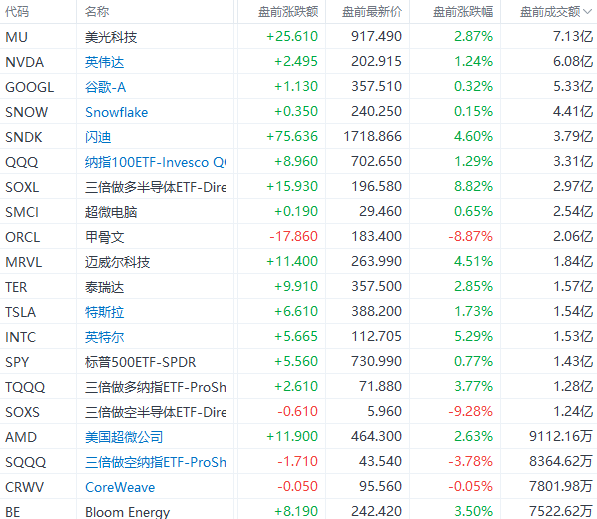
Top 20 pre-market trading volume stocks in the U.S.
Reminder of the US stock market macroeconomic calendar
(The following times are in Beijing Time)
22:30 U.S. EIA Natural Gas Inventory for the Week Ended June 5 (Billion Cubic Feet)
 Want to select stocks or get a stock diagnosis? Curious about the opportunities and risks in your portfolio? For all your investment questions,Just ask Futubull AI!

Editor/Lee