Market Snapshot
According to Bloomberg, senior officials said that the United States and Iran are moving closer to signing an agreement to reopen the Strait of Hormuz as leaders of the Group of Seven (G7) prepare to meet next week. Iran's Mehr News Agency reported that the memorandum of understanding with the U.S. includes American commitments to lift sanctions, withdraw troops from around Iran, and lift the maritime blockade.
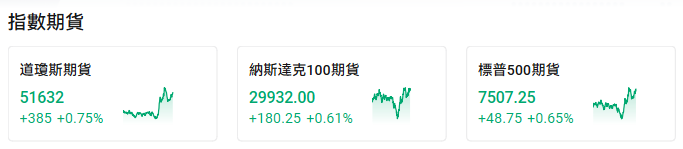
U.S. stock index futures rose in pre-market trading, with the Dow Jones Industrial Average up 0.75%, Nasdaq-100 futures up 0.61%, and S&P 500 futures up 0.65%.
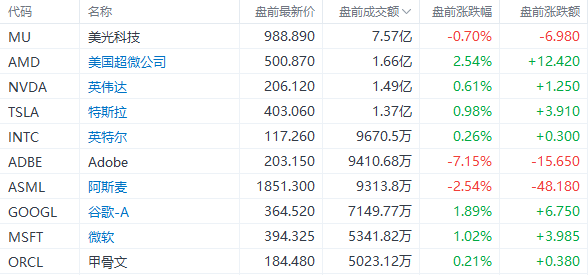
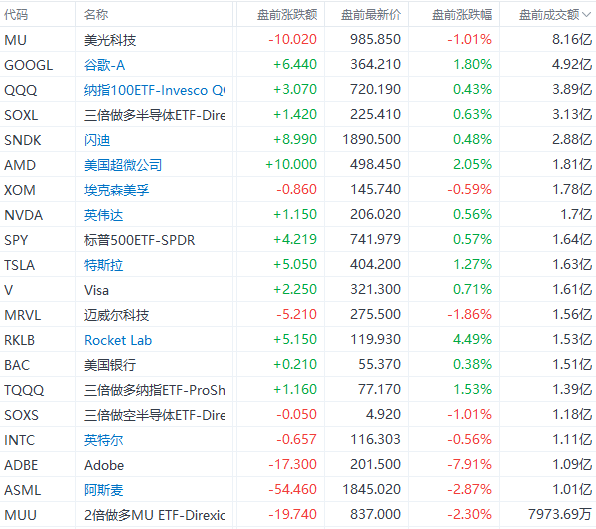
$Star Tech Companies (LIST2518.US)$ Most stocks rose in pre-market trading, with AMD gaining over 2% and Adobe falling more than 7%.
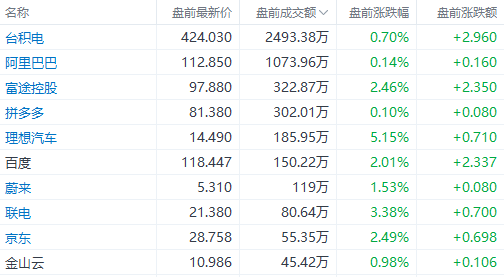
 $China Concept Stocks (LIST2517.US)$ Most stocks rose in pre-market trading, with Li Auto up over 5% and United Microelectronics Corporation (UMC) up over 3%.
Individual Stock News
The largest IPO in global history debuts today! How will SpaceX ignite a 'super valuation storm' across space, telecommunications, and AI?
On June 12, 2026, the largest IPO in history will officially list on Nasdaq. SpaceX will trade under the ticker symbol $SpaceX (SPCX.US)$ with an offering price fixed at $135 per share, implying a valuation of nearly $1.8 trillion and raising $75 billion. At this valuation, the Musk-led tech giant would surpass $Tesla (TSLA.US)$ to enter the top ten most valuable companies listed on U.S. exchanges.
However, the significance of this 'IPO of the century' extends far beyond the listing of a single company. SpaceX operates not only as a space launch service provider and a satellite communications operator but is also rapidly transforming into a leader in artificial intelligence (AI). Its public debut is reshaping—unprecedentedly—the valuation frameworks for space, telecommunications, and AI stocks alike.
SpaceX IPO will begin quoting at 9:50 a.m. ET (21:50 Beijing time) and will be available for trading starting at 10:00 a.m. ET (22:00 Beijing time).
Nasdaq-100 Index undergoes quarterly rebalancing: Astera Labs, CoreWeave, NEBIUS, Rocket Lab, and Teradyne added
Nasdaq today announced the results of the Nasdaq-100 Index quarterly rebalance for June 2026, which will take effect prior to market open on Monday, June 22, 2026. The following five companies will be added to the index: $Astera Labs (ALAB.US)$ 、 $CoreWeave (CRWV.US)$ 、 $NEBIUS (NBIS.US)$ 、 $Rocket Lab (RKLB.US)$and$Teradyne (TER.US)$ . The following five companies will be removed from the index: Charter Communications, Cognizant, Insmed, Verisk Analytics, and Zscaler.
Has the optical communications market leader fallen into a 'golden pit'? JPMorgan interviews Ciena management: AI inference is driving optical network upgrades, with order visibility extending through 2027.
As large AI models accelerate their evolution from 'centralized computing training' to 'distributed computing clusters' and 'edge-side inference applications,' global optical networking hardware infrastructure is entering an epochal upgrade cycle. JPMorgan recently held an in-depth post-earnings discussion with the investor relations team of Ciena (CIEN.US), the global leader in optical networking—including head Gregg Lampf and Patti Trautwein. In a subsequent research report, JPMorgan noted that Ciena, leveraging its industry-exclusive 1.6T wide-area network solution WaveLogic 6, has successfully penetrated the core supply chain of hyperscale data centers, with a backlog of $7.7 billion underscoring its strong earnings dominance.
Sharon AI signs six-year computing power agreement with NVIDIA
Sharon AI announces a six-year computing power agreement with NVIDIA; Sharon AI expects to deploy more than 55,000 NVIDIA GPUs by mid-2027.
Commercial competition in autonomous driving intensifies! Waymo launches first-ever monthly subscription plan to support Alphabet’s loss-making 'Other Bets'
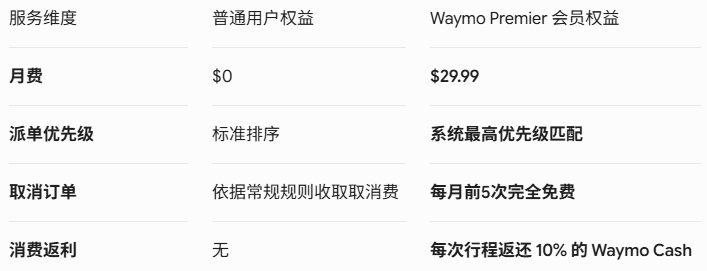
On June 11, Waymo, Alphabet’s (GOOGL.US) self-driving subsidiary, officially announced the launch of a membership subscription service named "Waymo Premier," priced at $29.99 per month. Initially available only to select high-frequency users in three core markets—San Francisco, Los Angeles, and Phoenix—the service operates on an invitation-only basis with limited access, aiming to lock in loyal users, smooth demand volatility, and explore diversified revenue streams. This signals that the global leader in autonomous driving is attempting to deeply retain its most core user base through a software subscription model.
This initiative marks the robotaxi industry’s official transition from a 'trial-and-exploration phase' to a 'phase of refined operations targeting existing users.' Subscribers to Waymo Premier will receive four core benefits: priority vehicle matching (faster ride hailing during peak hours), up to five free cancellations per month, a 10% rebate in Waymo Cash loyalty points per trip (redeemable toward future rides), and early access to new-city robotaxi services upon launch.
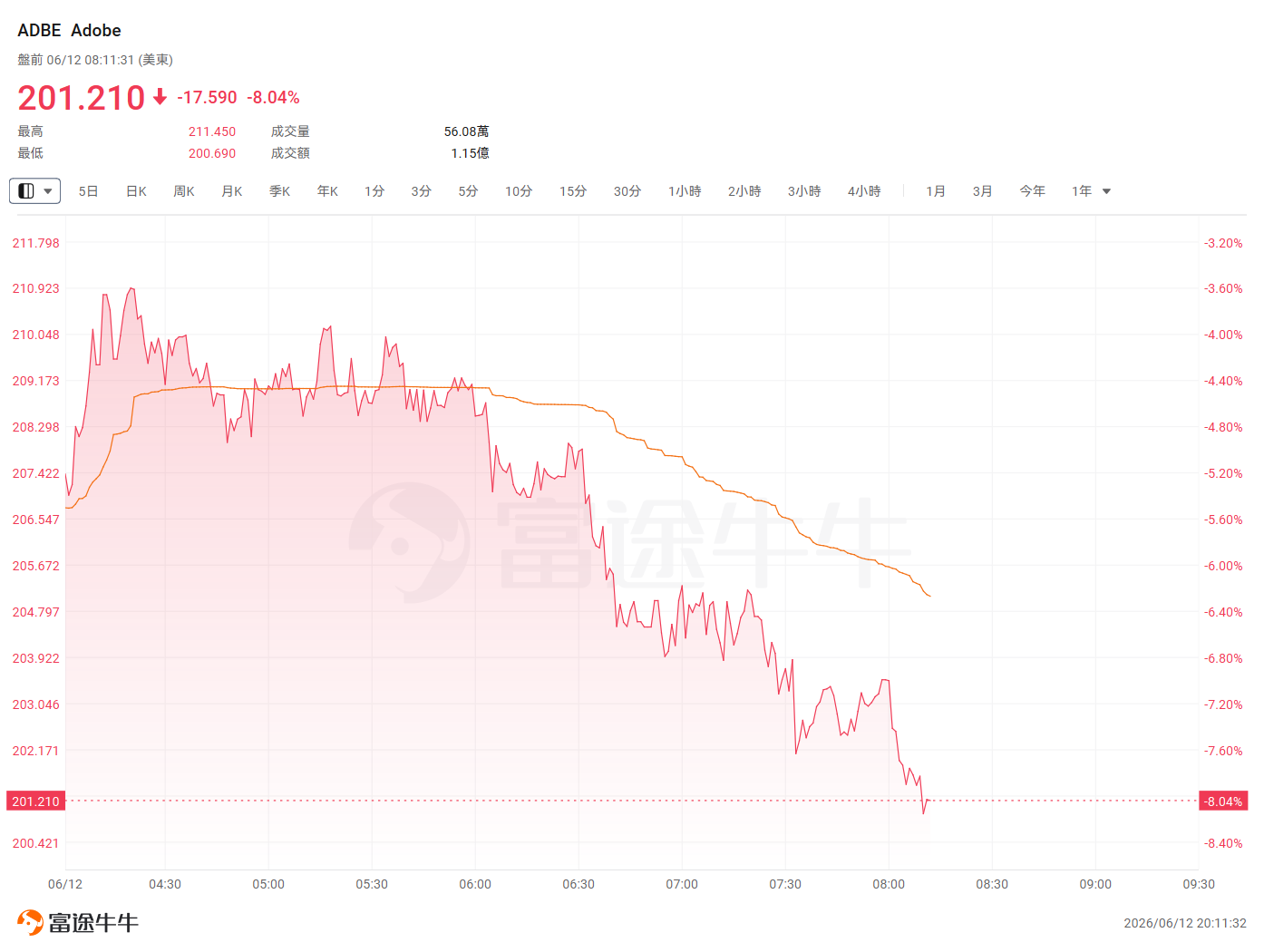
Despite strong Q2 earnings, Adobe shares plunged approximately 8% following a series of executive departures.
Despite $Adobe (ADBE.US)$ Despite reporting better-than-expected quarterly results on Thursday and raising its full-year guidance, the company simultaneously announced the departure of Chief Financial Officer Dan Durn. Coupled with the earlier announcement that CEO Shantanu Narayen would step down, investors are now uneasy about the strategic direction of the parent company of Photoshop.
In its statement, Adobe said CFO Dan Durn will officially leave on June 15. This announcement comes just three months after long-serving CEO Shantanu Narayen declared his intention to step down. Durn’s departure means Adobe must now search for both a new chief executive officer and a new chief financial officer, creating a leadership vacuum at the top of the company.
Global Macro
Strait of Hormuz may soon reopen! Reports suggest the U.S. and Iran are close to reaching an agreement, with a signing as early as this weekend.
According to multiple senior officials from the Group of Seven (G7) and diplomatic channels, the United States and Iran are on the verge of signing a breakthrough agreement aimed at reopening the Strait of Hormuz. As news emerged of the potential reopening of this globally critical 'oil chokepoint,' the specter of stagflation that had loomed over international capital markets for months instantly dissipated.
Crude oil short positions have tripled in two months as traders bet that the Strait of Hormuz crisis is nearing an end.
While an increasing number of traders bet that the Middle East crisis is nearing its end and oil prices will turn downward, global crude oil inventories are being drawn down at an alarming pace.
According to reports, exchange data as of June 2 shows that portfolio managers have consistently increased their short positions in crude oil since early April. Data compiled by energy analyst John Kemp indicates that Brent crude short positions have tripled between late March and early June.
The market widely believes that ceasefire agreements and diplomatic negotiations will ultimately restore normal shipping through the Strait of Hormuz, thereby normalizing global crude oil supply. However, in stark contrast to financial markets’ optimistic expectations, the physical crude oil market is experiencing a rapid tightening of supply-demand balance.
Soaring valuations spark bubble concerns; global banks collectively tighten leverage exposure to South Korea’s two semiconductor giants
According to informed sources, following a sharp rally in global semiconductor stocks this year that has raised market concerns about a potential pullback, several international banks are tightening hedge funds’ leveraged positions on Asia’s top chipmakers—including SK Hynix and $Samsung Electronics Co., Ltd. (SSNLF.US)$ ——'s leveraged bets.
According to sources, brokers including Citigroup, JPMorgan, and Goldman Sachs have raised the financing costs for hedge funds using swaps to take bullish positions on SK Hynix and Samsung Electronics. These banks have also tightened size limits on new trades and are screening eligible client counterparties. Similar measures have been applied to Taiwan Semiconductor.
Informed sources also indicated that Morgan Stanley has declined new swap transaction requests from clients for these two Korean equities, and some second-tier banks have ceased accepting new orders over the past two weeks. A few large global banks still willing to take on such trades are now reviewing them on a case-by-case basis.
SpaceX’s biggest surprise isn’t just rockets? Silicon Valley executive: The truly undervalued asset is its AI programming business.
SpaceX has officially entered the capital markets, but beyond rockets and satellite internet, a top Silicon Valley investor believes the company's most undervalued potential lies in an AI-powered coding tool.
SpaceX will complete its initial public offering tonight at an issue price of $135 per share, valuing the company at over $1.75 trillion. Brad Gerstner, founder and CEO of technology investment firm Altimeter Capital, noted on a podcast that the option to acquire the AI coding tool Cursor could represent SpaceX’s biggest upside surprise.
He argued that this move would enable SpaceX to internalize massive computing power and train and run cutting-edge AI models, with code scripts generated by Cursor users potentially providing valuable training data for the next iteration of the Grok model.
For investors, this implies that SpaceX’s valuation logic should not be anchored solely on rocket launch frequency and Starlink subscriber growth; the potential monetization pathway of its AI business could offer a previously underpriced growth trajectory.
After severe volatility in South Korean equities, Barclays warned that a pause in portfolio rebalancing by the 'national team' could amplify market fluctuations.
The National Pension Service (NPS) of Korea's decision to suspend portfolio rebalancing is becoming a significant driver of heightened volatility in both the Korean equity and foreign exchange markets.
In a recent research report, Barclays economist Bum Ki Son noted that while the NPS’s suspension of its rebalancing rule generated excess returns for the fund, it came at the cost of significantly amplifying market volatility. "Pension funds are typically viewed as stabilizers in financial markets, yet the NPS’s adjustment to its operational rules has instead turned it into an amplifier of volatility," he wrote.
This warning comes as the gauge of KOSPI 200 volatility hit a record high earlier this week, with Korean equities swinging violently between extreme market moves.
In response to a Bloomberg inquiry, the Ministry of Health and Welfare—the supervisory authority of the NPS—stated that the fund management committee’s prior decision was aimed at enhancing the fund’s profitability and stability, taking into account ongoing efforts to strengthen the fundamentals of Korea’s capital markets. The ministry also remarked, "The Barclays report relies heavily on excessive assumptions, and its analysis of causality has not been sufficiently validated."
IRNA Releases Framework of Iran-U.S. Memorandum of Understanding
On the 12th local time, Iran’s official media outlet, the Islamic Republic News Agency (IRNA), reported that the main framework of the agreement text of the memorandum of understanding between Iran and the United States concerning the cessation of hostilities includes the following:
1. The nuclear issue remains unchanged. The current memorandum does not address any nuclear-related agreements, nor will Iran make any new commitments. Negotiations on the nuclear issue will commence within 60 days after the agreement is signed.
2. Strait of Hormuz: No transfer of management authority or role granted to the United States. Iran will not make any commitment regarding the transfer of management authority over the Strait of Hormuz. Future arrangements for the strait’s management will be resolved as a regional matter through dialogue and joint decision-making between Iran and Oman.
3. Full cessation of hostilities across all fronts, including Lebanon. The primary objective of this memorandum is to end hostilities on all regional fronts. The United States commits to compelling Israel to end its war in Lebanon, and the phrase ‘extension of ceasefire’ does not appear anywhere in the agreement text.
4. A clear mechanism will be established to unfreeze Iran’s frozen assets. A portion of these assets will be unfrozen immediately upon signing the agreement, with the remainder released gradually during subsequent negotiations. Tehran has received explicit assurances regarding the mechanism it requested.
5. War reparations are on the agenda. Compensation for damages caused by aggression against Iran by the United States and Israel is among the issues addressed in the memorandum. The implementation mechanism for such reparations will be agreed upon during the 60-day negotiation period following the signing of the agreement.
6. Details regarding the lifting of primary and secondary sanctions will be reserved for discussion in the final agreement. The issue of removing all U.S. sanctions and related international resolutions will be reviewed during the 60-day nuclear negotiations.
VII. The Final Agreement’s Three Issues and the 60-Day Negotiation Period. During the 60-day negotiation period, discussions will be limited to three issues: the continuation of Iran's peaceful nuclear program; the lifting of U.S. unilateral sanctions; and a mechanism for compensation for damages. No other issues, including Iran’s missile capabilities, will be included on the negotiation agenda.
Top 20 pre-market trading volume stocks in the U.S.
Reminder of the US stock market macroeconomic calendar
(The following times are in Beijing Time)
22:00 Preliminary annual inflation expectation for June in the United States
22:00 Preliminary reading of the University of Michigan Consumer Sentiment Index for June in the United States
 Want to select stocks or get a stock diagnosis? Curious about the opportunities and risks in your portfolio? For all your investment questions,Just ask Futubull AI!

Editor/Lee